
Velukkutty, My Neighbour, My Classmate
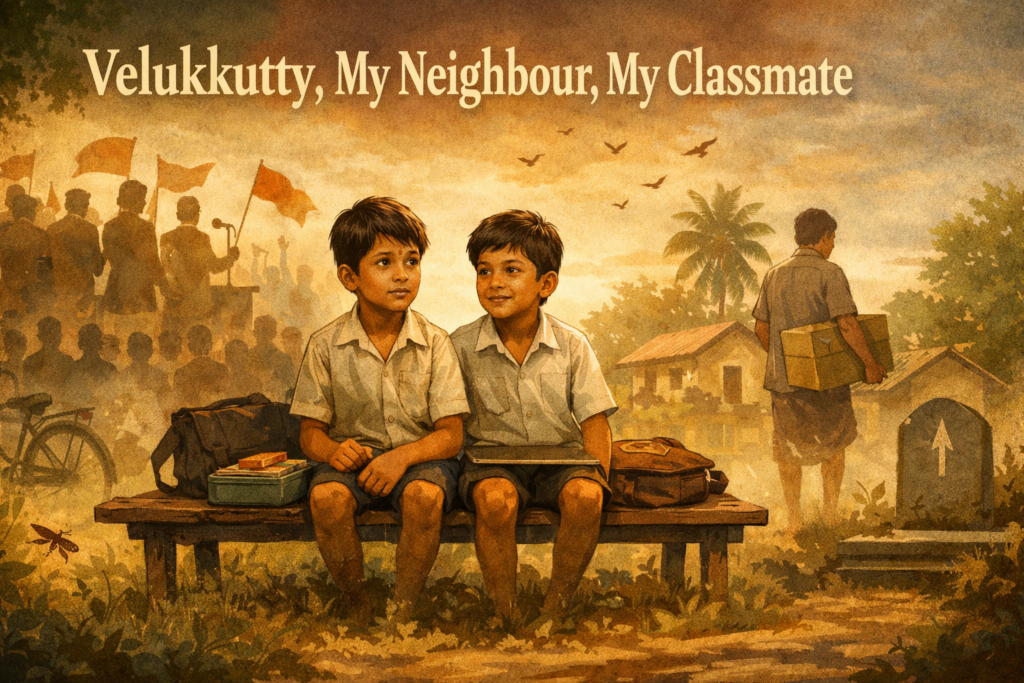
Velukkutty, My Neighbour, My Classmate
Our libraries are full of stories about great men.
Men who shook history like a mango tree in peak summer, everything fell, ripe or not.
Men who walked across a century and left footprints so deep that later generations stumbled into them by accident.
They started movements.
They led crowds.
They changed flags and slogans.
And somehow, even before the speeches were over, their names were already printed in bold letters.
Whenever something important happened, these men were always there,
standing in the front,
clearing their throats,
collecting applause,
accepting credit, sometimes on behalf of others.
And long after they were gone, their nephews and cousins continued to occupy important chairs, as if greatness travelled through blood vessels rather than effort.
All this is fascinating.
Very fascinating.
But as I grew older, a small, stubborn thought began to trouble me.
If great men deserve biographies, what about the boys who sat next to us on the school bench, shared their lunch, and borrowed our pencils without returning them?
That is why I am writing about Velukkutty.
Velukkutty was my neighbour.
My classmate.
My companion in school, play, hunger, fear, and unfinished homework.
He was not great.
He was not famous.
He did not change history.
He was just Velukkutty.
And I knew him well.
The Boy Who Sat Next to Me
Velukkutty and I studied in the same village school.
We walked there together every morning, our slates tied with the same kind of string and our confidence tied with the same kind of doubt.
We shared lunch, secrets, and the firm belief that teachers somehow knew our names even before roll call.
We planned many adventures together.
None of them succeeded.
Once, we decided to run away after school and become coconut climbers in another village. We reached only as far as the canal behind the temple and returned home before sunset, worried more about missing dinner than about punishment.
Another time, inspired by a movie, we tried smoking a dried leaf behind the school. Velukkutty coughed so loudly that the peon appeared at once.
I hid the leaf inside my geometry box, and we were rewarded with a lecture covering health, morals, and the uncertain future of the nation.
No teacher ever stopped the class and said,
“Look at Velukkutty. One day, he will be somebody.”
No neighbour ever leaned across the compound wall and whispered,
“There is something special about that boy.”
Velukkutty’s father looked at him often, but never long enough to feel proud.
Mostly long enough to feel worried.
Sometimes he wondered aloud whether Velukkutty was slow by nature or simply avoiding effort with great discipline.
Ordinary boys do not inspire dreams; they inspire calculations.
Velukkutty was afraid of many things.
So was I, but he admitted it more freely.
He feared his father’s silence.
Our class teacher’s ruler, which had tasted many palms.
Dogs sleeping under bicycles, because they woke suddenly and took offence without warning.
Thunder.
Darkness.
God, especially after evening prayers, when sins were counted carefully.
And girls, completely, permanently, and without hope of recovery.
Once, during moral science class, Velukkutty fainted when the teacher described hell in detail. We assumed devotion.
It turned out to be fear.
That was Velukkutty, my closest friend and my partner in failed adventures.
Sports, or the Lack of Them
Velukkutty was not good at games.
He could not swim properly in the pond behind the temple. When he tried, he swallowed more water than the pond lost.
He fell twice while learning to ride a bicycle on the same day, at the same spot.
He never hit a coconut with a stone, though he tried sincerely.
He never climbed trees, claiming he respected gravity too much.
In most things, he was average.
Sometimes below average.
Occasionally, impressively so.
Life, it seemed, was careful not to exaggerate him.
His mind offered no dramatic rescue either.
He did not dream of becoming a leader.
He did not dream of changing the world.
His greatest ambition was that the day should end without embarrassment.
When Fear Came Home
One afternoon, Velukkutty and I were late returning from school.
A rumour spread that a mad dog was roaming the road.
We stood frozen near the banyan tree, debating whether courage was necessary for survival. Velukkutty suggested waiting until sunset, convinced that mad dogs respected darkness.
We reached home shaking.
That night, Velukkutty developed a fever.
Fear, when it enters early, rarely leaves empty-handed.
A Career Decided for Him
When school ended, Velukkutty had no clear idea about life.
He did not want to be a doctor; you had to study too much.
He did not want to be a lawyer; you had to argue too much.
He did not want to be a teacher; he had seen enough of them.
If he were honest, he wanted to be someone else, or perhaps no one at all.
His father solved the problem efficiently and sent him to work in a textile shop in town.
Velukkutty folded shirts.
Sold dhotis.
Counted buttons.
That was adulthood.
Saturday Nights That Worried Us
After he started working, something changed.
One Saturday night, after toddy with old school friends and songs that improved sharply after the third glass, Velukkutty walked home.
The road moved.
Streetlights danced.
Houses shifted politely, forcing him to examine each one carefully.
He developed a strong dislike for water.
A lasting one.
These attacks returned on Saturdays, festivals, election days, and paydays. Whenever I saw him walking unsteadily, I wondered whether he would reach home or end up somewhere else.
Some fears arrive disguised as habits.
The Girl We Never Expected
Velukkutty surprised us all when he fell in love.
To him, she was beautiful and different.
Patient.
Willing to listen.
She laughed at his jokes. This alone convinced him she was special.
Holding her hand made him feel brave.
Sitting beside her made him feel complete.
He proposed marriage practically.
She would live with him, manage his clothes, and cook his meals.
In return, she would receive food, shelter, a little money, and his lifelong loyalty.
She agreed.
Love sometimes arrives as a mutual misunderstanding.
A House That Filled Too Quickly
Children arrived.
Then more.
Then many more.
The house filled with small hands, loud cries, and expenses.
Then arrived his mother-in-law.
Every visit brought back Velukkutty’s hydrophobia in full force.
The children grew up looking like him, tall, awkward, with large mouths and big ears. None showed any particular talent.
Talent, it seems, does not follow family plans.
A Career That Moved in Circles
Velukkutty stayed in the same shop for years.
He moved up slowly, from ribbons to shirts, from shirts to trousers.
Then age arrived quietly.
He moved down again, from trousers to shirts, from shirts to ribbons.
One day, a younger boy arrived, faster and cheaper.
Velukkutty came home with a cardboard box.
That was retirement, without ceremony.
The Ending We All Expected
His sons looked after him.
They did not enjoy it, but they did it.
In old age, Velukkutty told the same stories again and again.
He knew a few jokes.
He repeated them proudly.
Few people came to listen.
At sixty-five, Velukkutty fell ill.
He received treatment.
He died.
A tombstone was placed over him, with an arrow pointing toward heaven.
Whether he reached there, I do not know.
He was too much like us.
Author’s Note
This is not a story about failure or success.
It is about friendship, ordinariness, and lives that pass quietly without headlines.
Lives that leave no monuments, but leave memories, on school benches, village roads, and in shared lunches.
Velukkutty did not change the world.
But he walked through it beside me.
And that, I think, is reason enough to remember him.