
The Day Pain Opened a Window
The Day Pain Opened a Window
The day pain came, it didn’t knock or warn.
It just arrived and sat down in my chest.
I thought it came to darken everything,
To close the door on all the life I knew.
But loss did something I did not expect.
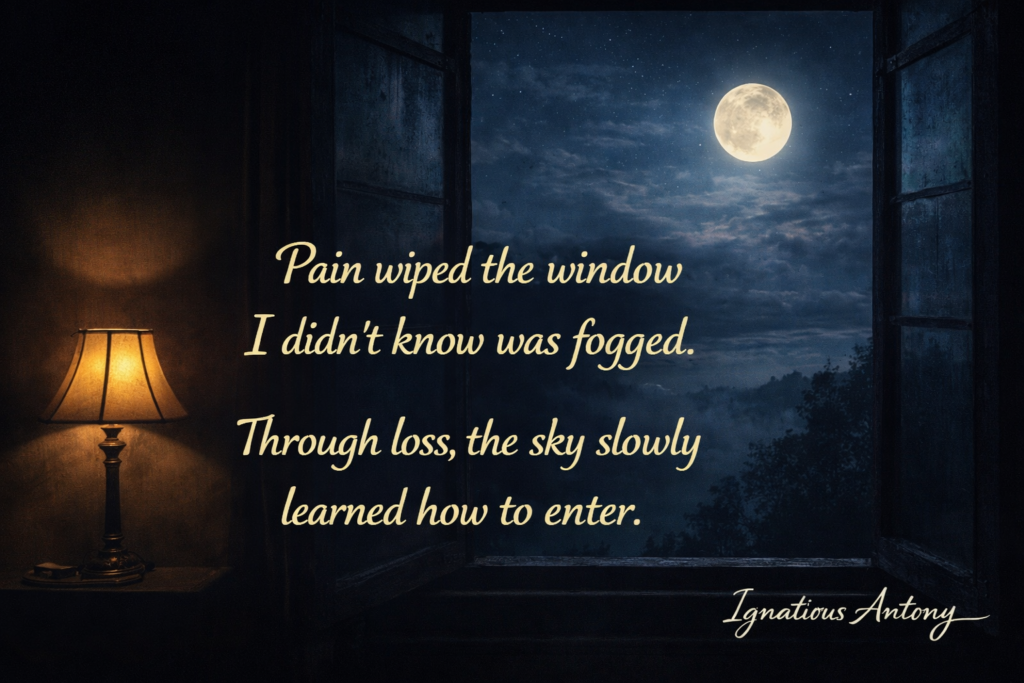
Like wiping steam from glass on a cold day,
It cleared a window I had lived beside
Without once knowing how much I’d missed.
What hurt became an opening, not a wall,
A place where breath could finally move free.
I saw the sky more clearly than before,
Less dressed in comfort, more honestly wide.
So pain was not the end I feared it was;
It opened space and taught me how to see.
Reflection on the Poem "The Day Pain Opened a Window"
This poem begins where most of us begin with pain, with fear. Pain arrives uninvited, heavy, and intimate.
It does not announce itself or ask permission. It settles in the chest, close to breath, close to life. The natural response is to believe that pain has come too close to something, to shut doors, darken rooms, and take away what once felt familiar and safe.
But the poem slowly turns, just as life sometimes does.
Loss, which we expect to blind us, instead clears a window. Like steam wiped from glass, it removes a layer we didn’t even know was there. Comfort, habit, and certainty often blur our vision.
Pain, harsh as it is, strips those away. What remains is not always easier, but it is truer.
The window in the poem is not a gift. It is opened by force. Yet through it, the speaker sees the world more honestly. The sky appears wider, less filtered, less decorated by illusions.
This clarity is not joy in the usual sense. It is a deeper kind of seeing, a recognition of what matters, what lasts, and what was previously overlooked.
The poem does not claim that pain is good or that loss should be welcomed. Instead, it acknowledges something more difficult: pain can change the shape of our inner life.
What once felt like a wall becomes an opening. Breath finds room. Perspective shifts. Freedom appears, not because pain disappears, but because something inside loosens its grip.
In the end, the poem suggests that pain did not end in the speaker’s life as they knew it. It came to widen it.
Not gently. Not kindly. But truthfully.