
My First Salary
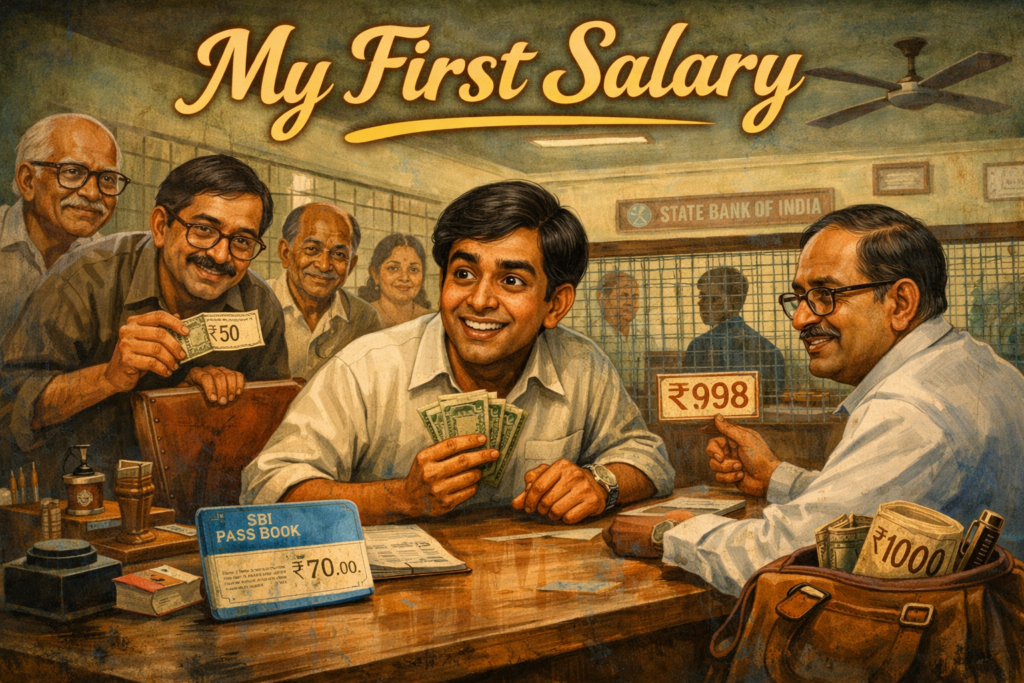
My First Salary
I remember my first salary more clearly than many important events that followed.
It was ₹998.
The year was 1976, and that number hurt.
Two rupees short of a thousand, close enough to taste respect, far enough to be denied it. In those days, a four-figure salary wasn’t just money; it was arrival. Numbers decided dignity.
We believed numbers knew our worth better than people did.
Money was treated with care. You didn’t fold it casually. You didn’t sit on it. And you certainly didn’t leave it lying around near curious relatives or ambitious cupboards. Wealth, I was learning, didn’t vanish; it migrated.
Especially when you weren’t looking.
I had just started my first job in Thiruvananthapuram, a modest position, a respectable office, and a sudden feeling that I was now an adult, though my confidence was still on probation.
Youth are often promoted based on confidence rather than experience during the interview.
Until then, money had come in fragments, bus fare, tea money, a five-rupee note folded tightly enough to pass as a bookmark. But this, ₹998, was arriving all at once. I had dreamed of it. This was not scholarship money. This was salary.
Salary meant the world to me; now I trusted myself with responsibility, and I trusted others even more.
My office asked me to open a bank account at the State Bank of India and submit the details. So I went.
The building looked capable of protecting kingdoms. Thick walls. High counters. Clerks who wrote as if every entry might later be produced in court. Ceiling fans turned slowly, confident they had outlived many ambitions.
I believed, without evidence, that opening a bank account required meeting the manager. Clerks handled routine. Managers handled destiny.
“I want to see the manager,” I said.
The clerk nodded kindly, the way one indulges beginners.
He had seen many like me, important only to ourselves.
The manager arrived, serious, neatly combed, trained to remain neutral in the presence of money and emotion. I kept my hand firmly in my pocket, guarding my salary like a classified file.
“You wanted to see me?” he asked.
“Yes,” I said, with unnecessary certainty. After all, I am an officer myself, I told myself.
Titles are most powerful when no one else has heard of them.
We sat in a small room.
And stared.
I had prepared myself to behave responsibly. I had not prepared sentences.
Finally, he asked, “You work in government service?”
“Yes,” I said proudly.
Pride, at that age, required very little evidence.
“So you want to open an account?”
“Yes. My salary should be credited here.”
“How much is your salary?”
My expression grew serious, very serious. I later realised this seriousness had nothing to do with the amount I would deposit each month and everything to do with the confidence with which I was treating it. People rarely fear money; they fear belief.
Belief, especially untested belief, demands performance.
I leaned forward and whispered, as if revealing a state secret.
“Nine hundred and ninety-eight rupees.”
The manager stood up immediately, opened the door, and announced to the clerk,
“This gentleman wants to open an account. He will deposit ₹998.”
The sound of my wealth travelling through the bank startled me. I followed him, briefly heading toward the strong room before being gently redirected.
Confidence, when unchecked, always chooses the wrong corridor.
Forms appeared, long, pale, and threatening. I was asked my name, my father’s name, my address, and details suggesting the bank wished to know me better than my own family did. I signed wherever fingers pointed. Rubber stamps fell like final judgments. Bureaucracy, I learned, is faith with paperwork.
Finally, the clerk asked me to sign where an X marked the spot.
“Please go to that counter,” he said, pointing to one sealed with wire mesh and glass, bearing a sign that read “Cashier.”
I handed the form to the cashier.
He looked at it.
Then at me.
“Where is the cash?”
“What cash?”
“The ₹998.”
Only then did I notice it, written clearly on the deposit slip I had signed.
“I don’t have cash now,” I said. “I only want to open the account. My office will deposit my salary.”
Pens stopped. Heads lifted. The bank, indifferent moments earlier, was suddenly alert. Nothing wakes a system faster than an ink-related mistake.
Bureaucracy forgives ignorance, but not documentation.
“How will you open an account without depositing money?” someone asked.
Thinking had abandoned me by then, so I spoke without it.
This is often when honesty makes its grand entrance.
I searched my pockets, my pants, my shirt, and my hope.
I found ₹20.
I handed it over.
The cashier examined the note as if it were an insult pretending to be currency, turning it over once to be sure it hadn’t transformed.
“And the balance?” he asked calmly.
“This is the only amount I have.”
Behind me, people settled in. A man cleared his throat. A woman adjusted her sari. Even the ceiling fan seemed to pause.
Public embarrassment enjoys an audience.
“So,” the cashier said, “you want to deposit ₹998… without ₹998.”
“Yes,” I said, relieved someone understood.
“No,” he said. “That is not how money works.”
The manager reappeared, summoned by instinct.
“He has declared ₹998,” the cashier reported. “He has brought ₹20.”
The manager looked at me.
I smiled. Weakly.
“Why did you write ₹998 if you don’t have it?”
“Because that is my salary,” I said. “That is what will come.”
“But today?”
“Today I have hope.”
It did not help.
Hope, I learned, is not legal tender.
A brief conference followed, low voices, serious nods. I stood there holding my ₹20, feeling like a man who had brought a spoon to buy a cow.
Finally, the manager said, “You must deposit some money.”
“I am depositing,” I said, raising the note like evidence.
“The minimum balance is fifty rupees,” someone said.
“Can I deposit twenty today and thirty tomorrow?”
“Money does not work in instalments.”
A kind elderly man whispered, “Son, go home.”
That sounded wise, except my office was waiting for my account number.
Wisdom is always correct, just rarely convenient.
Then a miracle occurred.
A clerk from the side counter, thin, spectacled, with a moustache that had known kindness, said, “Sir, I can lend him thirty rupees.”
The entire bank turned.
“You will lend?” the manager asked.
“Yes,” he said. “He will return it.”
Everyone looked at me.
I nodded enthusiastically, the way one agrees to lifelong friendship under pressure.
The ₹20 and the borrowed ₹50 were counted slowly, as if the bank wanted to be sure they would not escape.
“Seventy rupees,” the cashier announced.
“That is enough to begin a relationship,” the manager said.
Forms were adjusted. Entries corrected. Stamps struck again, louder this time.
Finally, a small blue passbook was handed to me.
“Your account is opened.”
I held it like a newborn.
Some achievements weigh nothing and still feel heavy.
As the heavy door closed behind me, laughter rose, soft at first, then spreading.
Outside, I stood blinking in the sunlight, holding a passbook with ₹70 credited and my name inside.
I walked to a nearby tea shop.
“Tea,” I said confidently.
“Two rupees.”
I hesitated. My money was now in the bank.
“Not now,” I said.
Something important had happened. I had opened a bank account and instantly become a man without cash. I was also, to my surprise, a four-figure-salary earner who borrowed money.
Prosperity, it seems, arrives before liquidity.
That evening, I placed the passbook under my pillow, not for safety, but out of respect. My heart was full, not with money, but with gratitude.
It was not money that was deposited that day, but a lesson, delivered without interest.
Money demands seriousness.
Life insists on humour.
Wisdom arrives disguised as embarrassment.
When ₹998 finally reached the account the next month, the bank quietly accepted it. No applause. No ceremony.
But I knew.
Because once upon a time, I had entered a bank with ₹20 in my pocket and dreams worth ₹998.
Even now, when I pass that old SBI building in Thiruvananthapuram, I smile. Somewhere inside, a younger version of me is still whispering numbers, clutching his pocket, and believing, quite sincerely, that ₹998 was the beginning of great wealth.
Perhaps, in its own small way, it was.