
Where the bangles fell silent
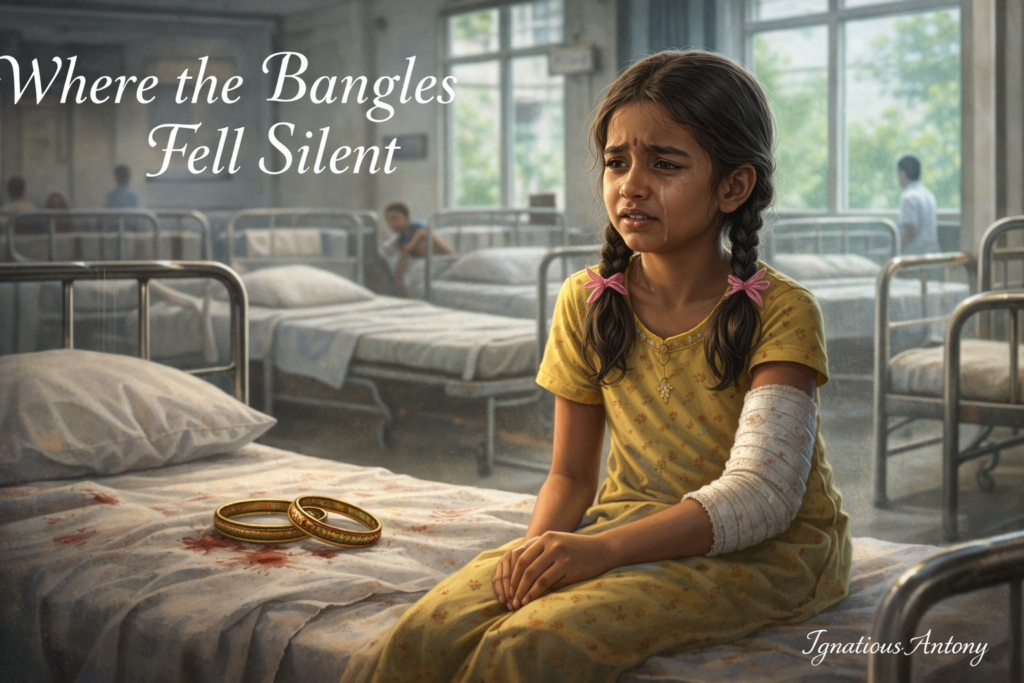
Where the Bangles Fell Silent
In a quiet Kerala dawn beneath swaying palms,
a child of nine ran laughing through the light,
her bangles singing like temple bells,
her world untouched by shadow or night.
A small fall, nothing the earth feared,
Yet pain awoke beneath her skin;
her mother held her trembling close,
whispering hope against the storm within.
In a crowded government ward, she lay,
under slow fans and weary air;
hands meant to heal moved hurriedly,
and careful eyes were no longer there.
A plaster wrapped her fragile arm,
too swift a task, too soon forgotten;
the child believed she would soon play again,
while worry in her mother had deepened and swollen.
Nights grew long. Sleep turned away.
“Amma, it hurts,” she softly cried.
each whisper struck like silent lightning
her mother endured but never denied.
The swelling rose like monsoon clouds.
Prayer filled the hours before the dawn.
Then came the words that shattered breath,
to save her life, her hand was gone.
She looked at Amma, frightened and small:
“How will I write when school begins?
Will my bangles sing again?
Can I still draw the sun I love?”
Questions fell like evening rain,
and her mother smiled through hidden pain,
holding the child with borrowed strength
while her own heart broke unseen.
After the blade, silence remained.
One sleeve rested, music undone.
Childhood shifted without warning,
a different life had just begun.
Yet beyond their sorrow, kindness stirred;
strangers carried her grief as their own.
From human care a miracle came,
an arm shaped gently, hope reborn.
She learned again to write and hold,
to greet the day without retreat;
life gave loss, the world gave grace,
and courage rose on unsteady feet.
O healers, guardians of fragile trust,
remember the weight your hands contain:
each patient holds a universe
of love, of hope, of unseen pain.
Now through Kerala’s morning light she walks,
changed, yet stronger than before;
between one hand lost to fate
and one shaped by human care,
She carries quietly into the world
the brave art of letting go.
Reflection on the poem “Where the Bangles Fell Silent”
Where the Bangles Fell Silent is not merely a poem about loss; it is a meditation on how ordinary moments can suddenly divide life into a before and an after. The poem begins in innocence, a Kerala morning filled with light, movement, and the music of a child’s bangles, symbols of childhood, joy, and continuity. This peaceful opening is important because tragedy rarely announces itself with warning; it arrives quietly, disguised as something small.
The fall itself is insignificant in appearance, yet it becomes the turning point that exposes human vulnerability. Through the mother’s eyes, the poem explores a deeper suffering, the silent anguish of witnessing pain that cannot be borne or exchanged. The child’s repeated whisper, “Amma, it hurts,” becomes more than physical discomfort; it echoes the helplessness shared by countless parents who stand between hope and fear, unable to protect their children from fate.
The hospital ward represents another layer of meaning. It is not portrayed as cruel, but as human, hurried, imperfect, and overwhelmed. The poem gently reminds us that healing requires not only skill but attention. Neglect here is not villainy but absence, and that absence alters a life forever. In this way, the poem becomes a quiet appeal to compassion within systems that often forget the emotional weight behind every patient.
Perhaps the most heartbreaking moment lies in the child’s questions. She does not mourn the loss in abstract terms; instead, she worries about writing, drawing, and the sound of her bangles, small details that reveal how children understand the world through everyday joys. These questions transform tragedy into intimacy, allowing readers to feel the loss not as an event but as a lived reality.
Yet the poem refuses to remain in despair. Compassion emerges collectively, suggesting that while suffering may begin in isolation, healing often arrives through community. The artificial arm becomes more than a prosthetic; it symbolises humanity’s ability to restore dignity even when restoration of the past is impossible.
In its closing movement, the poem shifts from grief to acceptance. The child walks forward “between one hand lost to fate and one shaped by human care,” embodying resilience rather than perfection. The title itself gains meaning here: the bangles may have fallen silent, but silence does not signify an ending. Instead, it marks transformation, the moment when innocence gives way to courage.
Ultimately, the poem asks readers to look more carefully at fragility, in hospitals, in families, and in everyday encounters. It reminds us that every life carries unseen stories, and that compassion, even when late, can still reshape destiny.
The poem leaves us with a quiet truth: letting go is not surrender, but a form of bravery learned slowly, one step at a time.