
When the House Finally Became a Home
When the House Finally Became a Home
The Illusion of Perfect Lives
In every city, there are houses that glow beautifully in the evening light, large gates polished to quiet perfection, balconies filled with flowering plants, windows reflecting a life that appears complete to those passing by. From the outside, such homes seem to contain certainty: laughter at dinner tables, shared dreams, and the steady warmth of companionship.
What we admire from a distance is often only the surface of a story still struggling to become whole.
Yet walls are faithful keepers of secrets. They know how often silence sits where love once spoke freely. They know how two people can share a roof and still live in separate worlds.
Silence does not always mean absence of love; sometimes it is love waiting to be heard again.
This is the story of one such house in Kowdiar, Thiruvananthapuram, a house admired by many, envied by some, and understood by none.
It is also the story of how loss, when it arrives without warning, sometimes removes everything except what truly matters, and in doing so, quietly saves a life.
Life rarely takes away without also revealing what we were meant to hold closer.
The Distance Between Two People
Meera Nair and Arun Nair had been married for nearly seven years, long enough for familiarity to replace excitement and for routine to settle gently over their days like dust no one noticed gathering.
Time does not destroy love; it merely asks whether love is willing to grow beyond comfort.
To outsiders, they were fortunate. Arun belonged to a respected business family whose name opened doors effortlessly. Meera carried herself with quiet grace, her sarees chosen with care, her smile calm and composed at weddings and gatherings.
Their wedding photographs still hung in relatives’ homes, framed evidence that happiness could be arranged through tradition, gold ornaments, and blessings spoken beneath temple lamps.
But marriages are not lived in photographs.
A picture preserves a moment; a marriage must survive every ordinary day that follows.
Inside their home, conversations had slowly grown smaller. Nothing dramatic had happened, no storms, no loud quarrels, only an almost invisible fading. Important thoughts remained unspoken. Small disappointments were quietly folded away. Over time, silence settled between them, not hostile, but heavy.
And sometimes silence wounds more deeply than anger.
Unspoken words often weigh more than spoken ones.
One evening, after a dinner party filled with polite laughter, their car moved slowly through rain-washed streets. Shops were closing. Steam rose from roadside tea stalls. Somewhere, an old Yesudas song drifted through the humid air, carrying a softness that felt almost painful.
Meera glanced at Arun. He stared through the window; lost in thoughts he no longer shared with her.
Seven years, she thought, and we have become strangers who know each other’s habits but not each other’s hearts.
She said nothing. They had both grown skilled at silence.
Relationships rarely shatter in a single moment. More often, they fade quietly, like evening light withdrawing from a room while no one notices the darkness arriving.
Distance rarely begins with conflict; it begins with neglect too small to notice.
The Night Everything Changed
Later that night, Arun followed her into her room, something he had not done in a long time.
“Can we talk?” he asked softly.
There was a hesitation in his voice she had never heard before.
He stood near the window, restless, as though searching for courage in the darkness outside.
“The business is over,” he finally said. “We’ve lost everything.”
The words sounded unreal, as if spoken in another language.
Debts. Creditors. Legal notices. Years of effort dissolving into numbers that no longer obeyed hope.
Failure often arrives not as a storm, but as a quiet accounting of reality.
Meera felt the ground shift beneath the certainty on which her life had quietly rested for years. The security, the reputation, the effortless respect that followed Arun’s name suddenly seemed fragile, like glass cracked long ago but only now beginning to shatter.
“What will happen now?” she asked, her voice trembling despite her effort at composure.
Arun did not answer immediately. He stood staring at the floor, searching for words that would not come.
The silence irritated her.
“Why didn’t you tell me before?” she demanded. “All this time you knew things were going wrong, and you said nothing? I stood beside you at functions, smiling as if everything were fine. Do you know how foolish that makes me look now?”
Her anger carried the weight of fear.
Anger is often grief searching for someone to blame.
“I am your wife, Arun,” she continued, softer but sharper. “Was I meant to enjoy only the good days? Not even worthy of knowing the truth when things were falling apart?”
He swallowed but did not defend himself.
“You let me live in an illusion,” she said quietly. “Everyone else probably knew before I did.”
When he finally spoke, his confidence had vanished.
“I thought I could fix it,” he said. “Every time things got worse, I believed one more decision would save us. I didn’t want you to worry. I didn’t want you to see me fail.”
His voice faltered.
“I kept waiting for things to turn around. They never did. Somewhere along the way… I ran out of time.”
Pride often prevents us from sharing the burdens that love was meant to carry together.
The anger in her eyes wavered. For the first time, she saw not the admired businessman, but a tired human being who had carried fear alone for far too long.
The distance between them suddenly felt visible, built not from cruelty, but from years of unshared burdens.
That night, neither of them slept. Outside, the city moved as always, vehicles passing, dogs barking in the distance, indifferent to the quiet collapse happening inside their home.
The future stood before them, unfamiliar and frightening.
And yet, beneath fear and accusation, something long absent began to stir: awareness.
Truth often enters relationships only after certainty leaves them.
For the first time in years, they looked at each other without roles, without pride, without the protective mask’s success had allowed them to wear.
Two ordinary people stood there at last, uncertain, wounded, and suddenly honest.
Fragility
The months that followed were harsh. Legal meetings replaced social visits. Phone calls carried tension instead of greetings. The house that once felt grand began to feel hollow.
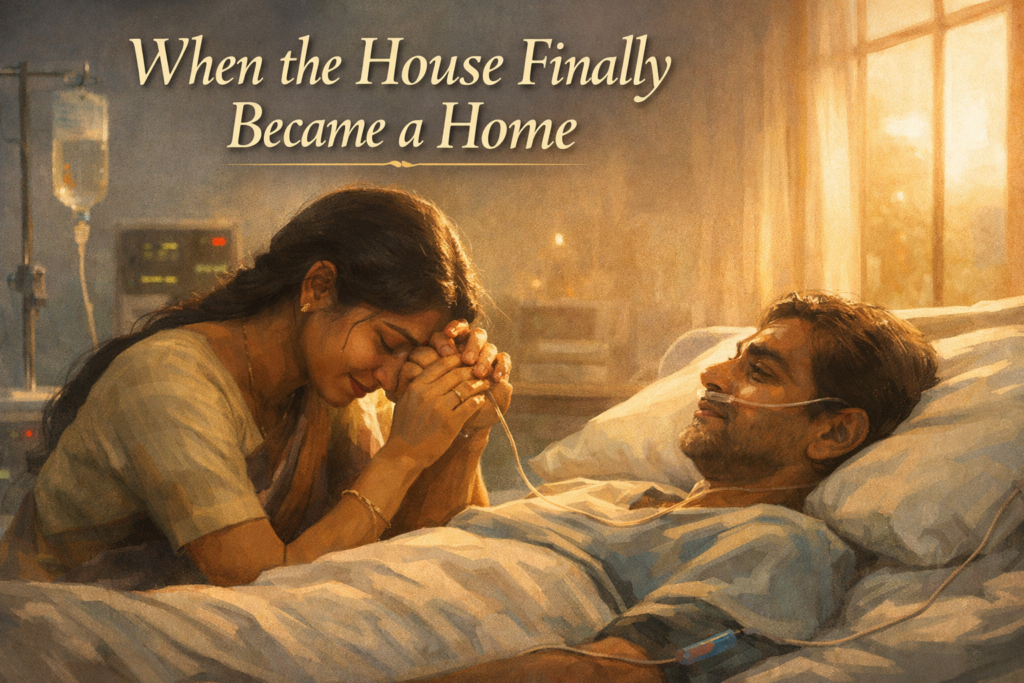
Under the strain, Arun’s health collapsed. Exhaustion and anxiety weakened him until one evening he fell seriously ill and was rushed to the Medical College Hospital.
For days, he drifted in and out of consciousness while machines hummed steadily beside him.
Meera sat there, first out of obligation, then fear, and finally something deeper: a rediscovery of care she had forgotten existed within her.
Watching him struggle to breathe, she understood how fragile human pride truly was. Wealth, reputation, status, none could sit beside a hospital bed and hold a trembling hand.
In the presence of vulnerability, all hierarchies disappear.
As the long hours passed, memories returned quietly. She remembered the young man who once waited outside her college gate, pretending to be coincidental.
She remembered their early days in Kodaikanal, mist, laughter, arguments over directions along Coaker’s Walk, shared cups of hot tea that tasted sweeter because they were together.
She remembered burnt milk from his failed attempt at making tea, late-night drives without a destination, conversations that stretched until dawn, and hands that once found each other without effort.
Love is remembered not through grand moments, but through small shared imperfections.
Somewhere along the years, those moments had been buried beneath expectations and the silent pressure to appear successful.
Now, watching the slow rise and fall of his chest, something softened within her. Anger loosened its grip. Beneath exhaustion, a forgotten warmth stirred, faint as the first breeze before rain.
She realised she was no longer there merely as a duty-bound wife.
She was waiting as someone who still cared.
And in that sterile hospital room, the distance between them began, almost imperceptibly, to close.
Healing often begins long before forgiveness is spoken aloud.
When he finally opened his eyes weeks later and whispered her name, tears came, not polite tears, but years of unspoken emotion finally finding release.
When life comes close to slipping away, the heart remembers what it refused to see while everything felt secure.
Near loss clarifies what comfort once concealed.
What Love Looks Like Without Wealth
Recovery was slow and humbling. Arun relearned ordinary strength, walking carefully, speaking without fatigue, trusting his body again.
After his discharge, he learned Meera was working nearby. He went to the place where she worked. A modest boarding house near Statue Junction, alive with ordinary sounds, utensils clattering, laughter from the kitchen, the comforting smell of sambar simmering.
Piece by piece, the truth unfolded. Meera had sold her jewellery to repay debts and begun working there simply to survive. Slowly, she had become its partner.
When she entered carrying vegetables, simple and tired yet peaceful, he saw a beauty deeper than elegance, purpose.
“What have you done?” he whispered.
She smiled gently.
“What we needed.”
Sometimes love returns quietly, disguised as responsibility.
Love rarely announces its return; it simply begins to stay again.
Learning Again
Their lives reshaped themselves.
Arun accepted a modest factory manager’s job at Kinfra Park, Menamkulam, Thiruvananthapuram. The salary was small, the work demanding, yet dignity returned, not through admiration, but usefulness.
Meera continued managing the boarding house. For the first time in years, they spoke openly.
Happiness, they learned, rarely grows where we seek applause; it grows where we become necessary to one another.
Meaning is born not from admiration, but from belonging.
The House
One October morning, Arun brought her to a small house in a village surrounded by coconut trees and a mango orchard.
The walls were old. Paint peeled gently. Sunlight entered freely, unafraid of imperfection.
“This is ours,” he said shyly.
She walked slowly through the rooms, imagining laughter, shared meals, and evenings unfolding without hurry.
Tears rose.
“It isn’t just a house,” she said softly. “It feels alive.”
And for the first time, it truly did.
Years Later
Time moved quietly.
They disappeared from old social circles. Some pitied them.
“They lost everything,” people said.
But one afternoon, travellers saw a family walking along a field path, a man carrying a laughing girl child, two boys racing ahead, a woman gathering flowers, her laughter free and unguarded.
They recognised Meera.
She did not recognise them.
She had stopped looking backwards.
Sunlight rested gently on her face. There was no trace of loss there, only peace.
Peace is not the absence of struggle, but the end of comparison.
The world often mistakes simplicity for failure because it does not know how to measure contentment.
In the end, they did not regain what the world had once admired. The wealth was gone. The status faded. The certainty that had once defined their lives dissolved without ceremony.
Yet something gentler took its place.
They learned the patience of listening, the humility of beginning again, and the quiet courage required to remain beside another human being when admiration is no longer the reason to stay.
What they discovered was not the happiness they had once pursued, but a steadier grace, the kind that grows slowly, unnoticed, through shared struggles and ordinary days.
For a house does not become a home when it is filled with success, but when it becomes a refuge for truth, when two people, stripped of pride and expectation, choose each other again without witnesses.
Home is the place where acceptance outlives achievement.
And perhaps this is life’s hidden mercy: that sometimes everything we lose is only what stood between us and what was always meant to remain.