
The Little Girl Who Ran Through the Storm
Now that I am old, and the evenings are quieter, some memories return to me with a strange force. They come like the smell of wet earth after the first rain—
soft, gentle, but strong enough to pull me back sixty years.
I grew up in a small village, not far from the forests that stretch towards the eastern forest parts of Thrissur.
In those days, the village was small and peaceful. Everyone knew everyone. Every child had the same dreams, the same games, and the same struggles.
Life was very simple then.
We woke up to the sound of the rooster.
The smell of woodsmoke filled every house.
Mothers cooked kanji, tapioca and chammanthi.
Children raced to school barefoot, laughing and chasing each other.
The paddy fields shone like mirrors after the early morning rain.
Dragonflies hovered above the water like tiny blue lamps.
And the whole world felt safe.
Among my closest friends in school was Velukutty.
Quiet boy.
Kind boy.
The kind of friend who walks with you without talking too much.
But the person I remember most clearly is his younger sister, Meenakshi.
She was a beautiful child—beautiful in a way the world often forgets to notice.
Dark skin glowing like rain-washed earth.
Large, bright eyes full of curiosity.
Always barefoot.
Always running.
Always smiling.
She came from a very poor family, a small hut made of mud and palm leaves, standing alone near the rubber estate path. The family struggled every single day. I used to see their mother walking long distances to gather firewood. Sometimes I saw Meenakshi carrying a small pot to fetch water from the stream. She would walk slowly, trying hard not to spill even a drop. There was never enough food, yet they lived with such dignity.
One afternoon, an incident happened—an incident I can never forget.
It was the beginning of the monsoon.
The sky had turned almost black near the hills.
Thunder rolled slowly, like the mountains themselves were speaking.
The air smelled of wet leaves and approaching rain.
School had just closed early because of the weather. My friends and I were walking home, stopping now and then to pick wild guavas falling from the trees along the road. Some boys tried to catch fish from the small stream running near the temple. Others were collecting wild red flowers to make a garland.
We were children.
We had time for everything.
Then, near the temple pond, I saw something that made me stop.
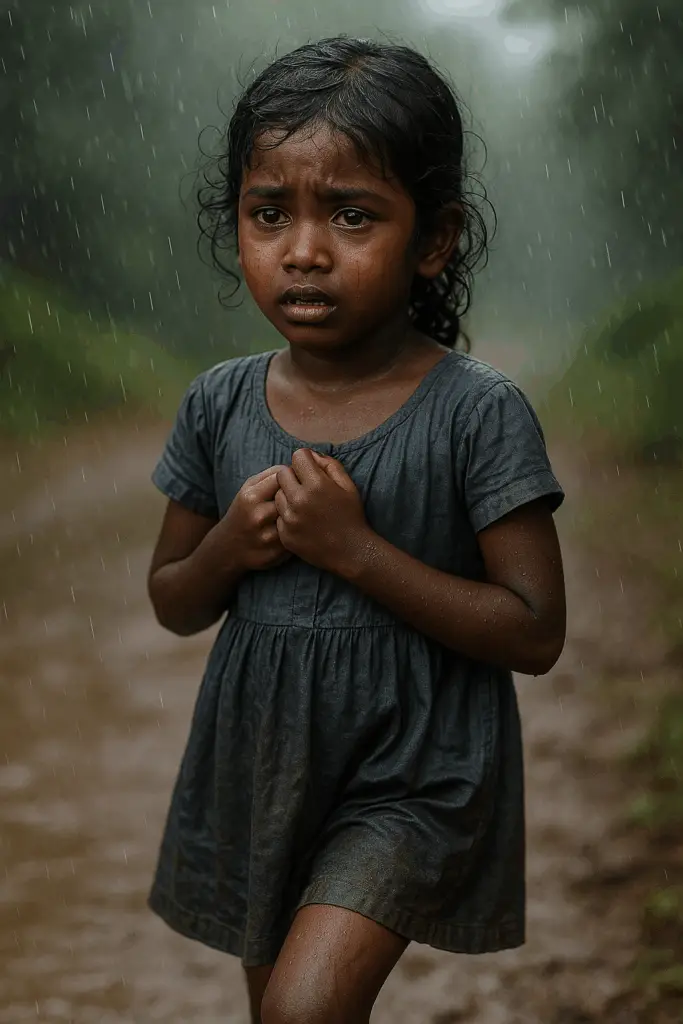
Little Meenakshi was running—running with all her strength.
Her hair was wet.
Her frock was stuck to her skin.
Her tiny feet were slipping in the mud.
Her face was full of fear.
She kept asking everyone she saw:
“Where is Unniyettan? Please tell me! Where is he?”
Unniyettan? was the village lineman—
the man who climbed electric poles with a belt and rope,
the man who fixed broken lines after storms,
the man every house depended on when the power went out.
He was tall, dark, thin, with a rough beard, but a heart as soft as a wet leaf.
Children trusted him.
He never scolded them.
He always helped, even when he had nothing.
Meenakshi found him at the small junction where he was repairing a loose cable.
She ran to him and held his shirt tightly.
Her voice broke as she cried:
“Chetta… please come fast…
Kunjunni slipped and fell into the stream…
he is stuck between the rocks…
he can’t climb out…
please help!”
The fear in her voice cut through the rain.
Kunjunni was Velukutty’s Younger Brother.
Unniyettan didn’t think.
He didn’t ask questions.
He didn’t even close his tool bag properly.
He simply ran.
Not walked—ran.
With the strength of a man who knew a child’s life might depend on him.
We followed behind, our hearts pounding.
The rain poured heavily.
Thunder cracked the sky.
The muddy ground sucked at our feet.
The sound of rushing water grew louder as we reached the small stream near the rubber estate.
There, between two slippery rocks, we saw Kunjunni,
shivering, crying silently, his small hands struggling to hold onto a branch.
The water was strong—strong enough to scare us—but too weak to sweep him away.
He wasn’t drowning, but he couldn’t climb out.
Before any of us could react,
Unniyettan jumped into the stream.
No hesitation.
No fear.
He didn’t even remove his shirt.
He held the rocks, moved through the strong current, raised the little boy, lifted him with both hands, and carried him out as if he were his own child.
When he reached the bank, he didn’t stop there.
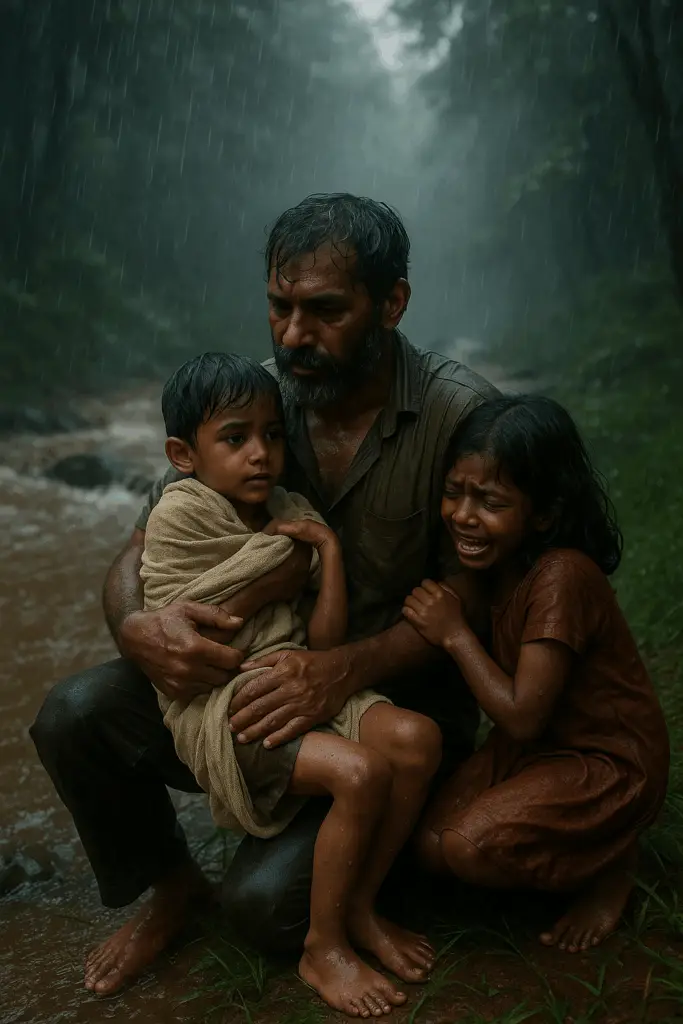
He sat on the wet soil and pulled the boy close.
He removed his own towel and wrapped it around Kunjunni’s shivering body.
Then he rubbed the boy’s arms and legs to warm him,
blowing air gently onto his cold fingers,
murmuring,
“It’s okay, mon… you’re safe… nothing will happen… Unniyettan is here.”
Meenakshi broke down crying and hugged her brother tightly.
Her small body shook with relief.
Unniyettan placed his hand gently on her head.
In that moment,
under the dark monsoon sky,
with the rain falling softly on all of us,
I saw something I have never forgotten:
the power of a human heart that chooses kindness instantly,
without thinking of danger,
without thinking of the cost.
After making sure Kunjunni was alright,
Unniyettan carried him all the way home—
in his own arms,
barefoot,
soaked,
shivering but determined.
Nobody told him to.
Nobody thanked him in words.
But sometimes the greatest rewards are silent.
Even today, when I close my eyes, I see that scene—
the rushing stream,
the frightened children,
and one good man who didn’t wait even one second
to save a child.
When I sit in my courtyard and hear the rain, the memory comes back to me.
Some memories soften you.
Some memories make you grateful.
Some memories stay with you forever.
I still see little Meenakshi running through the rain,
calling for help with all her innocent courage,
believing that someone good would come.
I see Meenakshi’s tiny hands holding her brother. I see her dark face full of fear and love. I see Unniyettan walking in the rain, protecting two children as if they were his own.
And sometimes,
When I think of her innocent face,
I still feel the same old ache in my heart.
Some memories are not just memories.
They are pieces of our heart that refuse to fade.
They remind us of a time when life was simple, people were kind,
and even the poorest among us carried immense love inside them.