
The Hen That Learned to Wait
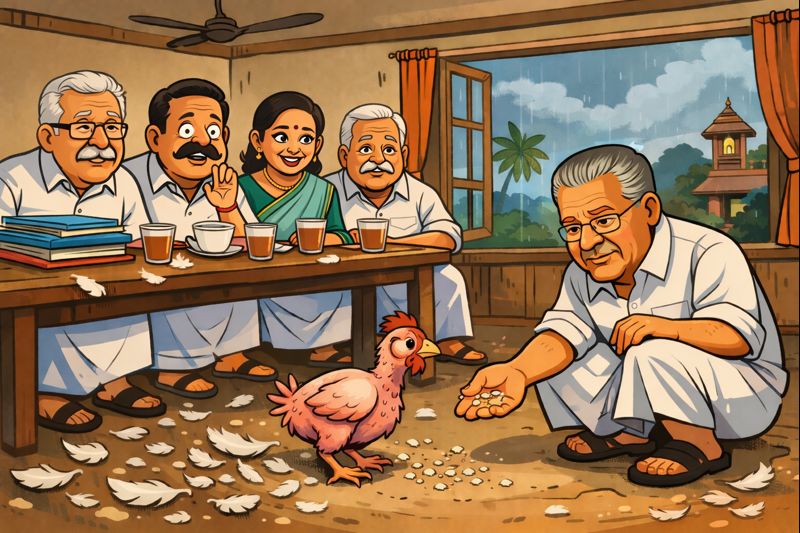
The Hen That Learned to Wait
The room smelled of old files.
The ceiling fan moved lazily, pushing warm air from one tired face to another. Outside, rain tapped on the windows, patient and obedient.
Power often announces itself quietly, disguised as routine.
The loyalists were already seated when the senior leader entered.
Under his arm was a hen.
Alive.
Its heart beat wildly against the pressure of the arm around its neck. Its wings flapped, scraping helplessly against starch and sweat. The room stiffened.
Fear always arrives before understanding.
The loyalists were surprised at first. They wondered what the leader was up to today.
The leader plucked one feather from the hen. As it came out, the hen cried out sharply.
The sound cut through the room like a pin through cloth.
Pain does not need language; it introduces itself.
One loyalist flinched.
That sound, he thought, I’ve heard it before, when workers were dismissed, when pensions were not paid on time.
He swallowed his words and stared at the table.
Silence is often not agreement, but survival.
Then another feather.
The hen twisted in pain. A loyalist tightened his jaw. His fingers curled slowly under the table.
This is wrong, he thought. This is unnecessary.
But he said nothing. He remembered past meetings. He remembered who spoke, and who disappeared.
Memory teaches caution faster than courage.
Another feather.
The hen screamed again. A loyalist’s teacup rattled slightly as his hand shook.
If I speak now, he calculated silently, tomorrow my file will stop moving.
The fear settled neatly into place.
Fear has a way of arranging itself logically.
“Oh, leader…” one of them finally murmured, testing the air.
“That poor creature…”
The leader did not even look up.
Feather by feather, the plucking continued.
Each pull made the hen shudder, and with each pull, something inside the room also tightened. Faces hardened. Eyes lowered. The pain was shared, but silently, carefully, like contraband.
Shared pain does not always create shared resistance.
One loyalist stared at the floating feathers.
We are all losing something, he thought.
Only the hen bleeds openly.
Those who bleed publicly make it easier for others to hide their wounds.
Soon the hen stopped screaming. Its body trembled quietly now, resigned. The room felt heavier.
No one spoke.
When nothing remained but bare skin and shallow breath, the leader loosened his arm and threw the hen onto the floor.
Some loyalists felt relief, at least the plucking is over, and hated themselves for that thought.
Relief can be as morally dangerous as cruelty.
The ground was cold. The hen lay still, not because it trusted, but because it had learned that movement brought pain. Around it, white feathers lay scattered like memories nobody wanted to pick up.
The hen lay there, stunned.
Its warmth was gone.
Its strength was gone.
The hen did not hate.
It was too tired for hate.
Exhaustion is the final victory of oppression.
But it remembered.
And something else began to grow quietly inside it, a bitter knowing.
Then it smelled rice.
Hunger rewrites memory faster than time.
The leader crouched down and scattered a few grains.
Just a few. Not enough to heal, not enough to forget, but enough to pull at hunger.
The hen lifted its head slowly.
Inside it, something resisted.
This hand hurt me.
This hand took everything.
But hunger spoke louder than memory.
Need is more persuasive than truth.
The hen stepped forward.
Each step was heavy with resentment, not loud, not angry, just thick and slow. It pecked at the grains. One. Two. Its stomach burned with need.
The leader held out his palm again.
The hen came closer.
The loyalists stared.
One of them whispered, almost ashamed,
“What are we seeing?”
The leader stood up calmly.
“ We plucked feathers one after another,” he said, “we took everything, comfort, voice, peace, security.”
No one interrupted.
A few loyalists exhaled, tension loosening. Understanding crept in, and with it, comfort.
Understanding injustice does not automatically create the will to stop it.
A loyalist smiled faintly now, the way people do when truth confirms their worst instincts.
“And dignity too, by throwing to the floor,” he added.
Soft laughter spread.
Cruelty feels lighter when shared.
“Then,” said the leader, “at the right moment, we give a little. Just enough to survive.”
Another loyalist chuckled.
“The hen forgot everything for a handful.”
“Yes,” said another, warming to the moment.
“The bird even thank us for this small gift of rice.”
The leader nodded.
“They forget the feathers.”
Memory is expensive; hunger is immediate.
The room relaxed completely now.
Outside, thunder rolled.
On the floor, the hen finished the last grain and looked up again,
not trusting,
not grateful,
just waiting.
Because waiting had become its habit.
Habit is how suffering settles into normalcy.
A loyalist glanced at it and said lightly,
“See? Still hopeful.”
Another replied, stirring his tea,
“Hope costs nothing.”
That is why it is so easily sold.
The leader sat back in his chair with a cunning smile.
Feathers lay scattered across the floor,
light enough to be swept away,
heavy enough that no one wanted to pick them up.
What is easy to erase is hardest to answer for.
And the hen stayed close,
while everyone else leaned back,
finally comfortable with what they had chosen not to say.
The leader opened the next file, but his hand returned once more to his pocket.
More rice.
He scattered it again, this time a little wider, a little more generously.
The hen hesitated.
Its body remembered pain.
Its skin still burned where feathers once were.
But its stomach spoke louder now, with a steadier voice.
Hope often enters through the same door as fear.
It stepped forward again.
One grain. Then another. The rice was fresh. Clean. Easy.
The leader smiled faintly and moved his hand closer, slower this time. No sudden grip. No pressure.
The hen paused.
Maybe this time is different, something inside it whispered.
Maybe the pain is over.
Another few grains fell.
The hen came closer. It watched the leader’s face carefully now, tilting its head, learning his movements. Hunger softened into hope, fragile, cautious, but real.
Trust rarely returns whole; it comes back in fragments.
Around the table, the loyalists watched with interest.
“See?” one of them murmured, amused.
“Rice works better than force.”
“Yes,” another said softly.
“Give it regularly, and it forgets why it was afraid.”
The leader extended his palm fully now, open and still.
The hen stepped onto it.
Its feet trembled, but it did not pull back. The warmth of the hand felt familiar again. Comforting. Almost safe. The memory of pain drifted farther away, blurred by the present.
Yet somewhere deep inside, a tightness remained.
Doubt is the last thing power can never fully kill.
The hen did not close its eyes.
It did not turn its back.
It ate, and watched.
The leader nodded, satisfied.
“Hope,” he said quietly, “is the strongest grain of all.”
The loyalists smiled, relaxed now, pleased with the lesson.
Outside, the rain softened into a steady rhythm.
On the floor, feathers lay forgotten.
And the hen stayed close,
fed, hopeful, learning to trust again,
while a small, silent doubt
rested inside it,
waiting.