
Advice I Will Not Give My Children
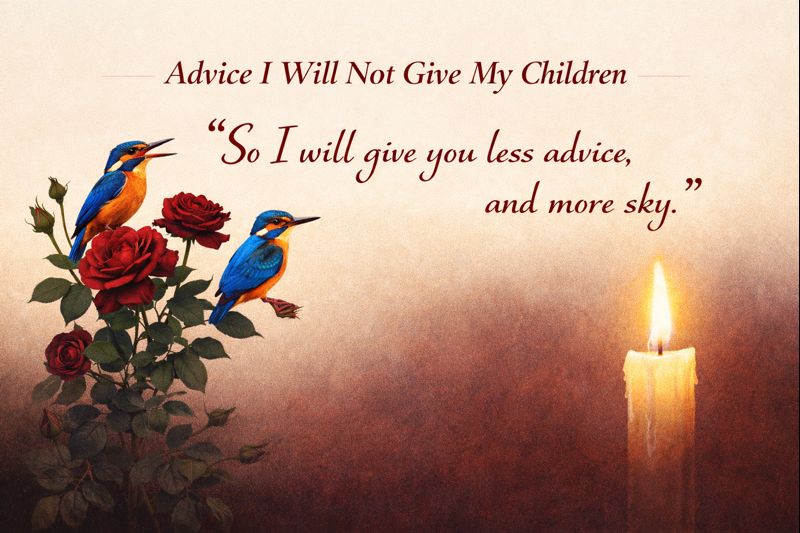
Advice I Will Not Give My Children
I have many words gathered like stones in my pockets,
smoothed by years, heavy with use,
and I will not hand them to you.
I will not tell you which road is safer,
because roads teach best when feet are unsure
and the light is already fading.
I will not warn you about every storm,
some rain must surprise you, soak your clothes,
and teach you the honest weight of being alive.
If I draw you a map, you may arrive,
but you will miss the trembling of choosing,
the quiet courage of standing alone at crossings.
I will not tell you whom to trust or whom to fear;
people reveal themselves like seasons,
not by being named, but by being lived through.
When you fall, I will not explain the fall.
The ground speaks its own language,
through bruises, through breath knocked loose,
through the slow grammar of getting up.
I will not lend you my regrets as warnings;
they are shaped for my hands and my hours
and would sit wrong in yours.
Instead, I will walk beside you like a sunset shadow,
long and quiet, never ahead, never pulling you back.
If one day you wonder why I was silent,
know this: my silence was not absence, but faith.
I learned to love you without steering the wind,
to watch your sails fill even when the direction
was not the one I chose.
I trust your questions more than my answers,
your errors more than my experience,
for they will teach you what I cannot.
If you lose your way, do not search for my voice in the noise;
listen in the calm that follows,
it will sound like trust.
I will keep the lamp lit, not to call you home,
but to remind you that light exists
even when you choose the dark.
If I have learned anything, it is this:
the heart grows best when it chooses
its own weather, its own wounds,
its own way of flowering.
So, I will give you less advice and more sky,
less instruction and more space to stumble.
Go.
Let life write on you in its untidy hand.
I will be here,
learning, as you do.
A Reflection on “Advice I Will Not Give My Children”
This poem is shaped by love that has learned restraint. It does not speak from authority or certainty, but from long watching, long waiting, and long learning. It is written from the place in life where one realizes that guidance, when given too tightly, can become a cage.
At its heart, the poem is about trust, not blind trust, but trust earned through years of observing how life teaches more honestly than any instruction.
The speaker carries advice “like stones in the pockets,” shaped by time and use. These are not light words. They are hard-won. And yet, the decision is made not to hand them over. This is not neglect; it is respect.
The speaker understands that wisdom borrowed does not sit well in another person’s life.
The refusal to point out safer roads is especially telling.
Roads are not merely paths here; they are metaphors for choice, uncertainty, and courage. The poem suggests that clarity without struggle robs a person of the experience that builds inner strength. Standing at a crossing alone, with fading light, becomes a necessary rite of becoming.
Storms and rain appear not as threats to be avoided but as teachers that must be met firsthand.
The poem recognizes that some lessons only enter the body when one is soaked, surprised, and slightly afraid. Protection from all difficulty would be a form of harm.
One of the poem’s most moving ideas is its rejection of maps. A map ensures arrival, but at the cost of discovery.
By not drawing a map, the speaker allows the child to learn the trembling that comes with choosing, a trembling that later becomes confidence.
The poem also shows a mature understanding of human relationships. People cannot be explained in advance.
Trust and caution must be learned through lived encounters, just as seasons reveal themselves over time. This reflects the speaker’s acceptance that disappointment and love are both necessary teachers.
When the poem speaks of falling, it resists the urge to soften or interpret the experience.
The ground is allowed to speak its own language. Pain is not dramatized, but neither is it dismissed. Falling becomes part of learning how to rise.
Perhaps the deepest love in the poem is expressed through silence. The speaker’s silence is not absence but faith.
It is the faith that the child will grow through their own questions and mistakes. The image of loving without steering the wind captures this perfectly. Love watches, waits, and trusts, even when the direction chosen is not the one the parent would have chosen.
The lamp kept lit is not a signal to return, but a quiet assurance that light exists. This distinction matters.
The poem does not pull the child back toward safety; it simply refuses to extinguish hope.
Ultimately, the poem redefines wisdom. Wisdom is not giving answers but offering space. Not control, but sky. Not instruction, but permission.
The speaker understands that growth requires room to stumble, to bruise, to wonder, and to discover.
The final gesture of the poem is humility. The speaker remains a learner too. Parenting is not portrayed as a finished role but an ongoing act of faith.
Both parent and child are shaped by the same untidy hand of life.
This poem does not tell children how to live.
It tells parents how to love,
by stepping back without stepping away.