
Konnappoovu at Dawn
Golden Shower Blooms At Dawn
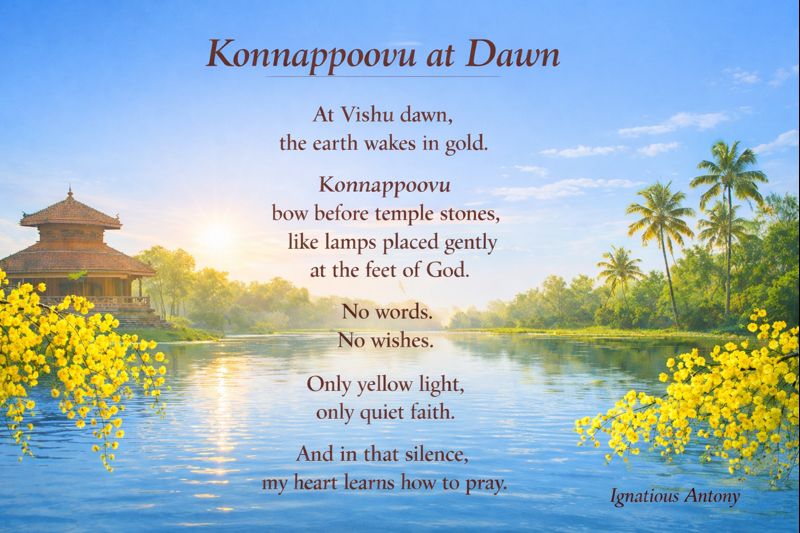
Konnappoovu at Dawn
I walked at dawn with folded thoughts
Along the paths the old gods know,
When suddenly the earth stood still
In rivers of Konnappoovu’s glow.
Before small shrines and temple gates,
They bowed in gold at heaven’s feet.
Like lamps lit soft on Vishu morn,
They lined the soil, serene and slow,
As if the earth itself had come
With humble gifts the gods bestow.
No voice they raised, no prayer they spoke,
Yet all their silence felt like hope.
The river paused to watch them pray,
The breeze moved gently, calm and mild;
Each flower swayed like folded hands,
The earth once more a trusting child.
No wealth, no wish, no urgent plea,
Just faith in bloom, so pure, so free.
I stood there long, my mind made still,
As bells rang faintly from far away;
The yellow light upon the ground
Felt like the gods had come to stay.
In that soft glow, my worries thinned,
My breath itself became a hymn.
Later, when the world grows loud,
And faith feels distant, worn, or small,
They rise again before my eyes,
Those golden blooms beside the wall.
Then quietly, without a sound,
My heart kneels like Konnappoovu.
Reflection on “Konnappoovu at Dawn”
This poem is not just about a flower or a morning walk. It is about how faith quietly enters the heart, without force, without words, and without demand.
The poem begins at dawn, a time that carries deep spiritual meaning. Dawn is neither night nor full day. It is a threshold, a moment when the mind is softer and more open.
The speaker walks “with folded thoughts,” suggesting a state of humility. The mind is not busy arguing or asking questions. It is simply present.
The “paths the old gods know” hint at ancient traditions, temple roads, and generations of silent devotion. This walk is both physical and inward.
When the poet sees the Konnappoovu, the earth seems to pause. This moment shows how beauty can stop our restless thinking. The flowers are described as “rivers of glow,” suggesting abundance, flow, and grace.
They are not scattered or random; they feel purposeful, as if placed there deliberately. The flowers appear before shrines and temple gates, turning nature itself into an offering.
The comparison of the flowers to lamps on Vishu morning is central to the poem. Lamps are symbols of light, hope, and divine presence.
Here, the earth becomes the devotee, offering light through flowers instead of flame.
This suggests a powerful idea: true devotion does not always come from ritual objects; it can come from nature itself.
A key theme of the poem is silent prayer. The flowers do not speak. They do not ask for anything. Yet their silence feels full of hope.
This reflects a deeper spiritual truth: the most sincere faith is often wordless. It does not bargain or beg. It simply trusts.
When the river and breeze seem to pause and participate, the poem shows harmony between all elements: earth, water, air, and spirit. The flowers swaying like folded hands is a beautiful image of surrender.
The earth is compared to a “trusting child,” reminding us of a faith that is simple, innocent, and free from fear.
The line “No wealth, no wish, no urgent plea” clearly tells us what this devotion is not about. It is not transactional. It is not asking the gods for favours. It is faith for its own sake, faith that exists because it is natural to believe, just as it is natural for flowers to bloom.
As temple bells sound faintly in the distance, the speaker’s mind grows still. The bells are not loud or commanding; they are gentle reminders. The “yellow light” of the flowers feels like a divine presence that does not overwhelm but comforts. The gods do not arrive with power or thunder; they arrive quietly and stay.
The poem then moves into memory. Later, when life becomes noisy and faith feels tired or distant, the image of the Konnappoovu returns. This shows how moments of true stillness stay with us. They become inner anchors. We may forget prayers and words, but we remember how faith once felt.
The final line, “My heart kneels like Konnappoovu”, is the essence of the poem. Kneeling here is not physical. It is emotional and spiritual. The heart learns humility from a flower. It learns that devotion does not need effort, drama, or explanation. Like the Konnappoovu, the heart simply needs to bloom, bow, and trust.
In the end, the poem reminds us that faith is not always found in temples or scriptures. Sometimes, it waits quietly by a river at dawn, glowing in yellow, teaching us how to pray without words.