
The River’s Secret
The River’s Secret
I was born one morning
high in the quiet hills,
a small silver brook
slipping out of the arms of a mountain.
At first, I was only a whisper of water,
a shy child of melting clouds.
The moss and wildflowers watched me
As I learned my first steps on the earth.
Soon I met my first stones.
They stood across my path,
old and stubborn as ancient kings.
I thought for a moment I must fight them,
push them away,
break their silent wall.
But the mountain wind laughed softly.
“Little brook,” it said,
“Water does not win by fighting.”
So I bent around the stones.
I curved gently past them,
singing as I went.
The stones stayed where they were,
But I was the one who kept moving.
Day after day
I wandered through forests and valleys.
Sometimes I met fallen trees,
sometimes deep rocks,
sometimes steep cliffs that tried to stop me.
Yet I never fought them.
I simply found another path,
a quieter way forward.
Around the stones, beneath the branches,
through narrow cracks in the earth.
And something strange began to happen.
Every stream I met
joined my journey.
Every drop of rain that touched me
made my voice stronger.
The brook that once whispered
began to sing.
Villages appeared along my banks.
Children played beside me.
Fishermen cast their nets
into my widening arms.
And one day, I looked at my reflection
in the evening sun.
I was no longer the shy brook
that left the mountain.
I had become a river.
Wide, deep, and patient,
carrying the stories of hills, forests, and storms.
And the stones that once stood in my way
were still there,
But they had never stopped me.
For I had learned the quiet secret of water:
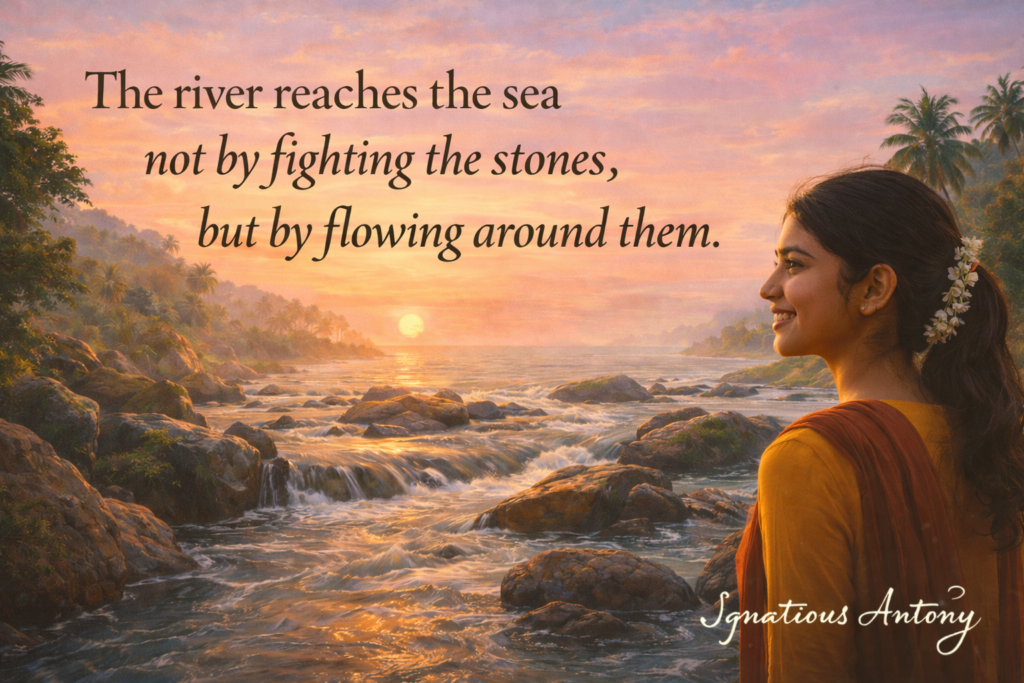
The river reaches the sea
not by fighting the stones,
but by flowing around them.
Reflection on “The River’s Secret”
This poem tells a gentle story about growth, patience, and the quiet strength of persistence. By allowing the river itself to speak, the poem turns a simple natural journey into a deep reflection on human life. The brook’s story becomes a metaphor for how people grow, face obstacles, and eventually discover wisdom through experience.
At the beginning, the brook is small and fragile. It is described as a “whisper of water,” a shy child of melting clouds. This image beautifully represents the early stage of life when everything is new and uncertain. Just as a young brook learns how to move across the earth, a young person learns how to move through the world.
Soon, the brook meets its first obstacles, the stones. They stand in its path like stubborn kings, strong and immovable. This moment reflects one of the most common experiences in life: encountering problems that seem impossible to overcome. At first, the brook thinks it must fight the stones and break through them. In the same way, people often believe that success requires force, struggle, and confrontation.
But the poem introduces a gentle wisdom through the voice of the mountain wind: water does not win by fighting. Instead of resisting the stones, the brook simply bends around them. This moment contains the central lesson of the poem. True strength does not always come from struggle. Sometimes it comes from flexibility, patience, and the ability to find another way forward.
As the brook continues its journey, it slowly grows stronger. Other streams join it, rain feeds it, and its quiet whisper becomes a song. This gradual transformation suggests that growth in life often happens quietly and slowly. We may not notice it day by day, but with time, our experiences gather like streams joining a river.
By the end of the poem, the small brook has become a wide and powerful river. What is remarkable is that the stones that once seemed like great obstacles are still there. They were never removed. Yet they never stopped the river from reaching the sea. The river succeeded not because it defeated the stones, but because it learned to move around them.
The poem, therefore, carries an important philosophical message about life. Many obstacles cannot be removed or defeated directly. But they do not have to stop us. With patience, adaptability, and persistence, we can continue moving forward until we reach our destination.
In this way, “The River’s Secret” reminds us that the greatest strength is often quiet and gentle. Like water flowing around the stones, the wisest path in life may not be the one that fights every obstacle, but the one that keeps moving with calm determination until the journey is complete.