The Bow of Hercules and the First Blood at Troy
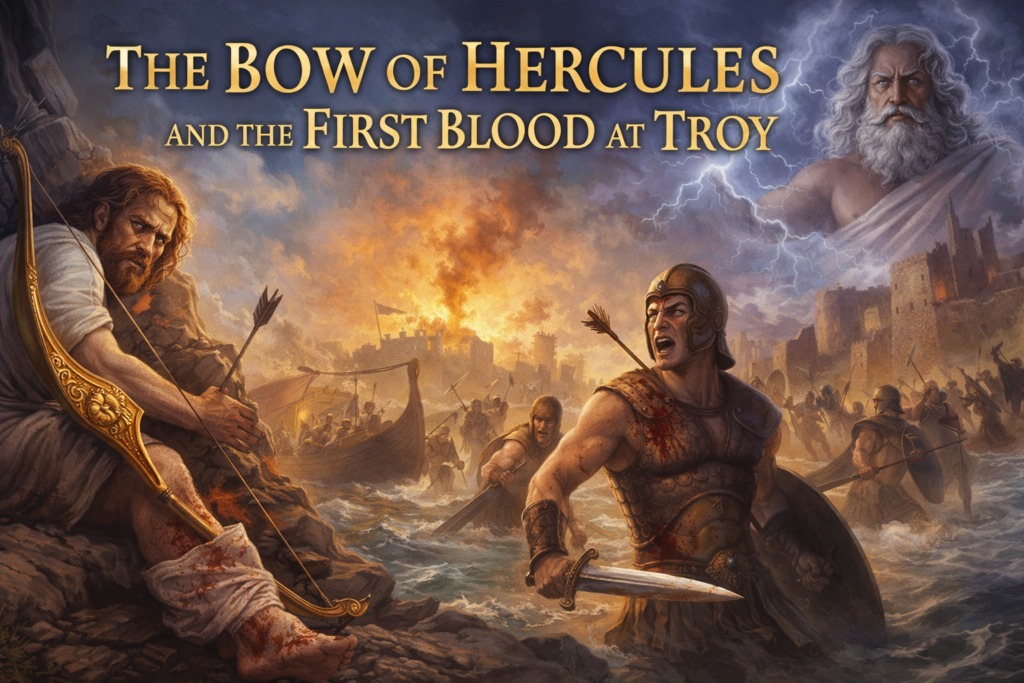
The Bow of Hercules and the First Blood at Troy
Introduction to Greek Mythology
Greek mythology is a collection of ancient stories about gods, heroes, and the struggles of human life. Long ago, the people of Greece believed that powerful gods lived on Mount Olympus and watched over the world. Sometimes they helped people, and sometimes they tested them. The heroes of these stories were brave men and women who faced danger, made difficult choices, and learned important lessons. These myths are exciting adventures, but they also quietly teach us about courage, patience, wisdom, and responsibility.
The Journey to Troy
Long ago, the kings and heroes of Greece gathered for a great war.
The war was to be fought against the powerful city of Troy, a rich and proud kingdom across the sea. The reason for the war was the abduction of Helen, the most beautiful woman in the world, from her husband, King Menelaus of Sparta.
Menelaus called upon the rulers of Greece to help him bring Helen back.
So a great fleet of ships was assembled.
The expedition was led by Agamemnon, king of Mycenae and the older brother of Menelaus. Agamemnon was a powerful ruler and a strong commander, chosen to lead all the Greek armies.
With him sailed many famous heroes.
One of them was Odysseus, the clever king of Ithaca. Odysseus was not the strongest warrior, but he was the most intelligent. His sharp mind and clever plans often saved the Greek armies from disaster.
Another hero was Diomedes, a young but fearless warrior from Argos. He was known for his courage and honesty.
And among them sailed a man who carried one of the most powerful weapons in Greek legend.
His name was Philoctetes.
Philoctetes was not just an ordinary soldier. Long before the Trojan War began, he had been a companion of the great hero Herakles. When Herakles was dying in terrible pain, none of his friends dared to light his funeral pyre. Only Philoctetes had the courage to do it.
Because of that act of loyalty, Herakles gave him his magical bow and arrows, weapons that never missed their target.
From that day onward, Philoctetes was known across Greece as the greatest archer alive.
True loyalty often reveals itself in moments when others step back in fear. Courage sometimes begins with a simple act of standing by a friend.
And so, when the fleet sailed from the harbor of Aulis toward Troy, Philoctetes sailed with them.
But the journey would not be easy.
Between Greece and Troy lay a sea scattered with islands. The ships had to sail carefully, stopping often for fresh water and food.
One such stop was the lonely island of Lemnos.
It was here that something terrible happened.
The Terrible Wound
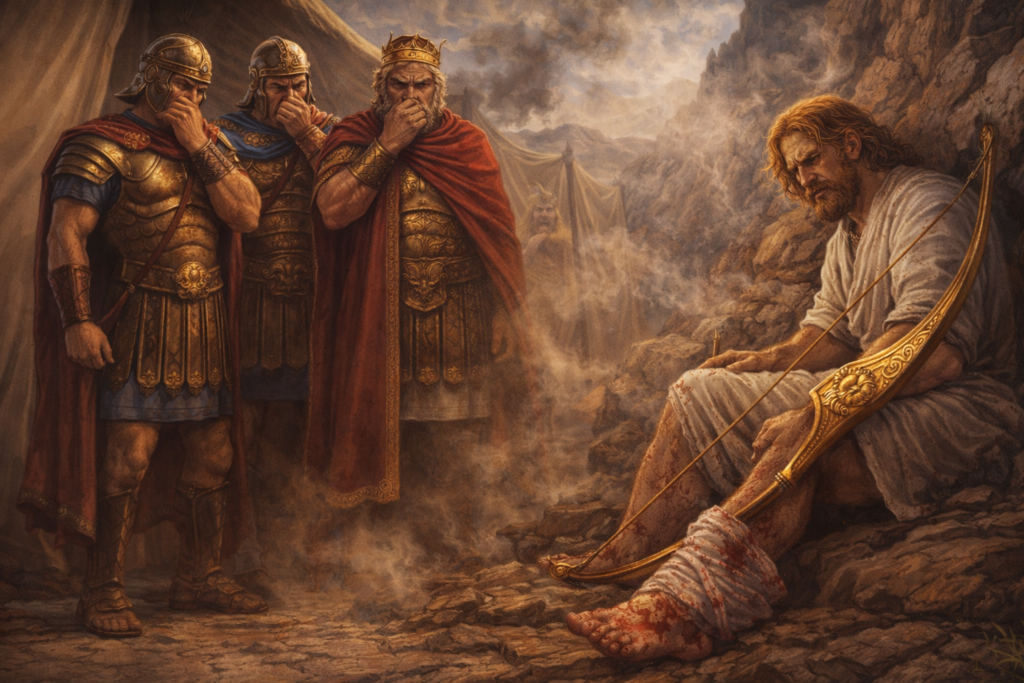
When the fleet reached Lemnos, the Greek leaders gathered outside the tent of King Agamemnon to discuss their plans for attacking Troy.
But as they approached the tent, something strange happened.
A terrible smell filled the air.
The odour was so strong that the warriors covered their noses and mouths.
Even men who had stood calmly on bloody battlefields stepped back in disgust.
“By the gods,” Diomedes muttered, “what is that smell?”
The men searched for the source.
Soon they found it.
Outside the tent sat Philoctetes.
His face was twisted with pain.
And his foot looked dreadful.
The skin had swollen terribly. It had turned dark green, and angry boils covered it. A foul infection oozed from the wound, filling the air with a sickening smell.
Philoctetes leaned against a wooden post, breathing heavily.
“I stepped into the bushes while searching for food for my men,” he explained bitterly. “Suddenly, I felt a sharp pain in my foot. A snake bit me, I think.”
The wound had not healed.
Instead, it grew worse each day.
The pain was unbearable.
And the smell was so terrible that many soldiers refused to come near him.
Sometimes life reminds us that strength and weakness can live in the same person. Even heroes can be brought low by the smallest creatures.
A Dark Suspicion
Soon, Calchas, the army’s prophet, arrived.
Calchas was a priest who could interpret signs from the gods. The Greek leaders often trusted his advice when making difficult decisions.
Agamemnon pulled him aside.
“What do you make of this wound?” the king asked.
Calchas studied the foot carefully.
His face grew serious.
“My king,” he said slowly, “this is no ordinary wound.”
Agamemnon frowned.
“What do you mean?”
Calchas lowered his voice.
“I believe this may be a curse from the gods.”
The words made the warriors uneasy.
In ancient Greece, a curse from the gods was a terrible thing. A cursed man could bring disaster to everyone around him.
Odysseus stepped forward thoughtfully.
“My king,” he said quietly, “we are about to begin the greatest war Greece has ever fought. If the gods are angry with Philoctetes, taking him with us may bring misfortune upon the entire army.”
Agamemnon looked troubled.
“What do you suggest?”
Odysseus answered calmly.
“We leave him here on Lemnos.”
Leadership often means making decisions that weigh heavily on the heart. What seems wise for the many may still bring sorrow to the one left behind.
A Secret Plan
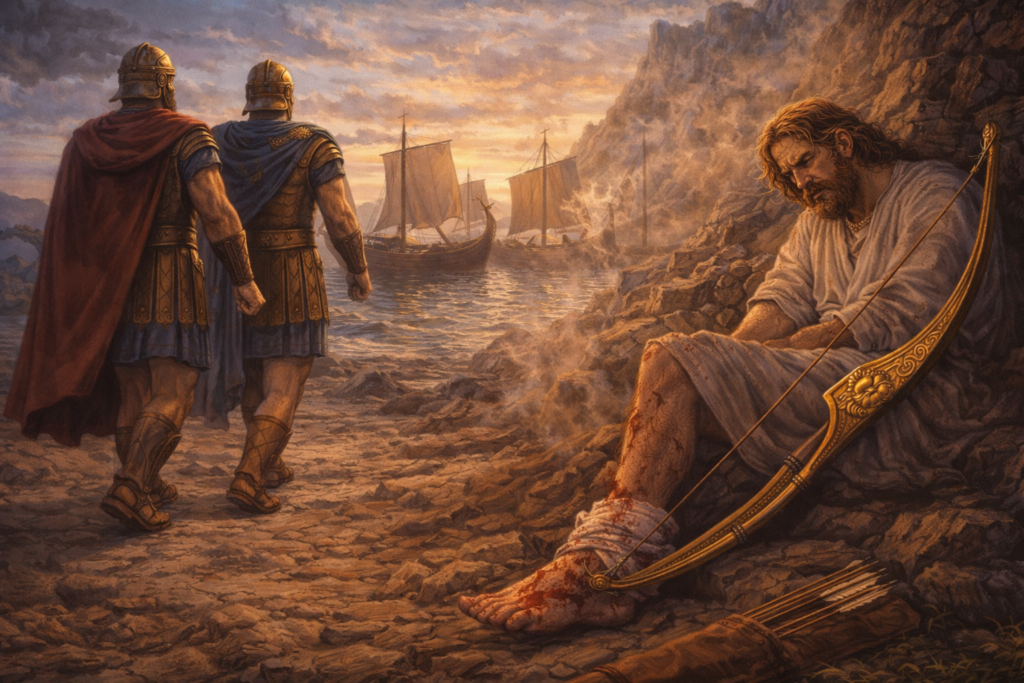
That evening, Odysseus and Diomedes quietly entered Philoctetes’ tent.
The smell inside was even worse.
Diomedes carried a small cup.
“Calchas prepared this medicine for you,” he said.
Philoctetes grabbed the cup and drank it quickly.
For a moment, nothing happened.
Then his eyes began to droop.
“You… tricked… me…”
His head fell forward.
He began to snore.
Odysseus smiled.
“I told you it would work. Now let’s take the bow.”
But Diomedes suddenly held his arm.
“No.”
Odysseus stared at him.
“What?”
“We are already abandoning him,” Diomedes said firmly. “We will not steal the gift that Hercules gave him.”
Odysseus frowned.
“But we may need that bow to win the war.”
Diomedes shook his head.
“Honour matters more.”
Odysseus sighed.
Finally, he nodded.
“Very well. Let’s go.”
Before sunrise, the fleet quietly sailed away.
And on the lonely island of Lemnos, Philoctetes was left behind.
Philoctetes Overhears
Suddenly, a loud voice came from behind them.
“I heard that!”
Philoctetes struggled to his feet, leaning on his spear.
“You think you can abandon me here?” he shouted angrily.
Odysseus met his gaze calmly.
“You are sick, Philoctetes. The army cannot carry a cursed man into battle.”
Philoctetes laughed bitterly.
“You fools! You need me!”
The warriors looked confused.
“There is a prophecy,” the archer continued, raising his famous bow. “Troy will only fall to an army that carries the weapons of Herakles. And I possess the bow of Herakles!”
Calchas looked puzzled.
“I have never heard of such a prophecy.”
Philoctetes shrugged stubbornly.
“Well, I have.”
Then he limped away slowly, clutching the legendary bow tightly.
His face showed anger, but also deep pain.
Not just from the wound.
But from the fear of being abandoned.
Few wounds hurt more deeply than the feeling of being left alone when we most need help.
A Troubling Dream
Several days later, the fleet approached the coast of Troy.
That night Odysseus slept uneasily.
Then he had a strange dream.
In the dream, he saw the ships landing on the Trojan shore.
He watched himself leap into the water bravely and run toward the beach.
He heard his own voice shouting to the soldiers.
But suddenly,
An arrow flew from nowhere.
It struck him in the chest.
He fell to the ground.
Odysseus woke suddenly.
Cold sweat covered his face.
Had he just seen his own death?
He lay awake the rest of the night, staring into the darkness.
Sometimes the mind sees truths in dreams that the waking heart is not ready to accept.
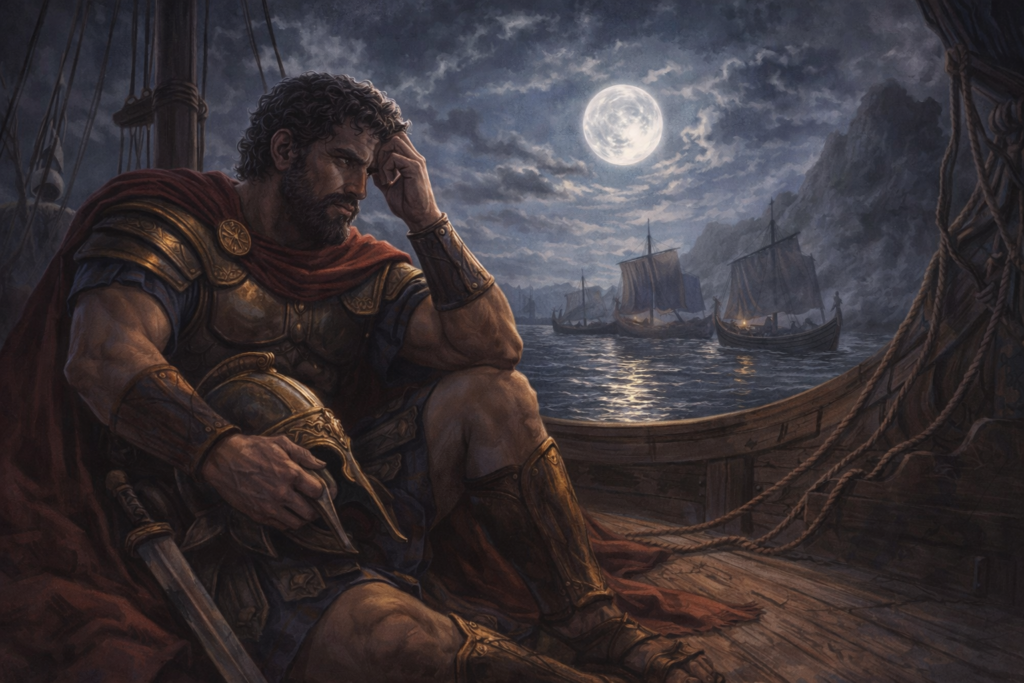
Illustration Idea 3
Odysseus sitting awake on the deck of his ship under the moonlight, troubled after his strange dream.
The First Landing at Troy
The next morning, a lookout shouted from the mast.
“Land ahead! Troy!”
Excitement spread through the fleet.
After months of sailing, they had finally arrived.
Odysseus carefully tightened the straps of his armour.
He turned to a young warrior standing nearby.
“Protesilaus,” he said.
Protesilaus was a brave young prince who had joined the war seeking honour. His beard was only beginning to grow, but his eyes shone with excitement.
“Come with me,” Odysseus said. “I need a strong man beside me.”
The ship scraped against the sand.
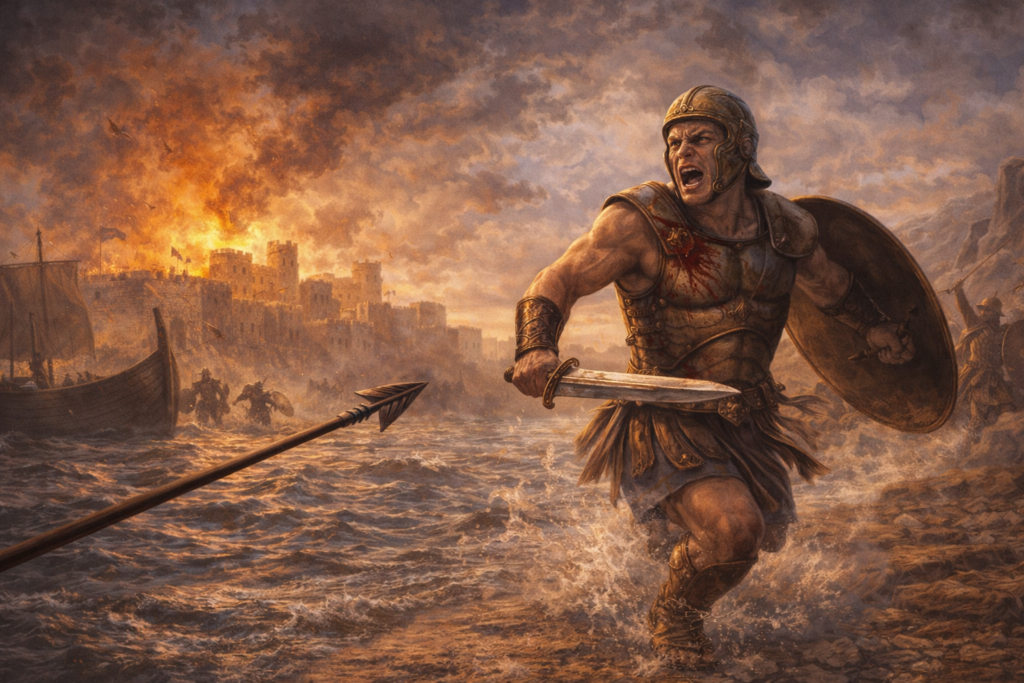
Odysseus jumped down first.
But his shield slipped from his arm and fell into the water.
He laughed awkwardly.
“My shield is braver than me!”
The soldiers laughed.
But the moment quickly passed.
Protesilaus leapt down beside him.
“For Greece and glory!” he shouted.
He ran forward across the shore.
Then suddenly,
An arrow flew from the walls of Troy.
It struck him in the chest.
Protesilaus fell.
He had become the first Greek to die in the Trojan War.
Glory often calls loudly to the young, but war rarely tells them how high the cost will be.
Odysseus knelt beside the fallen warrior.
“I’m sorry,” he whispered softly. “You were the first to step on Trojan soil… and the first to fall.”
For a moment, he bowed his head.
Then he stood up slowly.
He drew his sword.
“Forward!” he shouted to the army.
“Let Troy feel the strength of Greece!”
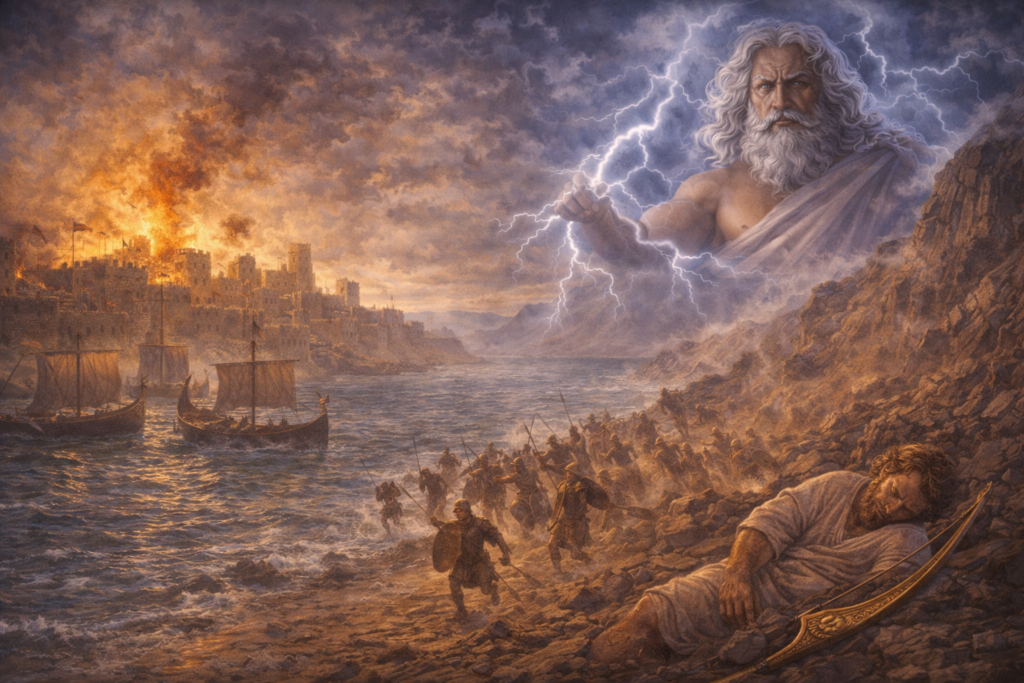
High above them, on Mount Olympus, the king of the gods watched.
Zeus, ruler of the heavens, looked down at the battlefield.
“These mortals believe they can easily change fate,” he said quietly.
But Zeus knew the truth.
The war for Troy had only just begun.
And many years of struggle still lay ahead.
Fate moves slowly, like a great river. Those who step into its waters rarely know where the current will finally carry them.
Pandora’s Box and Other Greek Mythological Stories
New Book Released!
I’m excited to share that I have published a new book on Greek Mythological Stories. This book brings to life the fascinating tales of ancient Greece,filled with gods, heroes, kings, and unforgettable adventures.
If you enjoy stories about Greek mythology, legendary heroes, and epic tales, I warmly invite you to explore this book.
✨ If you would like to read more stories like this, please take a look at my book.
Thank you for your support, and happy reading!