
Helen of Sparta and Paris of Troy
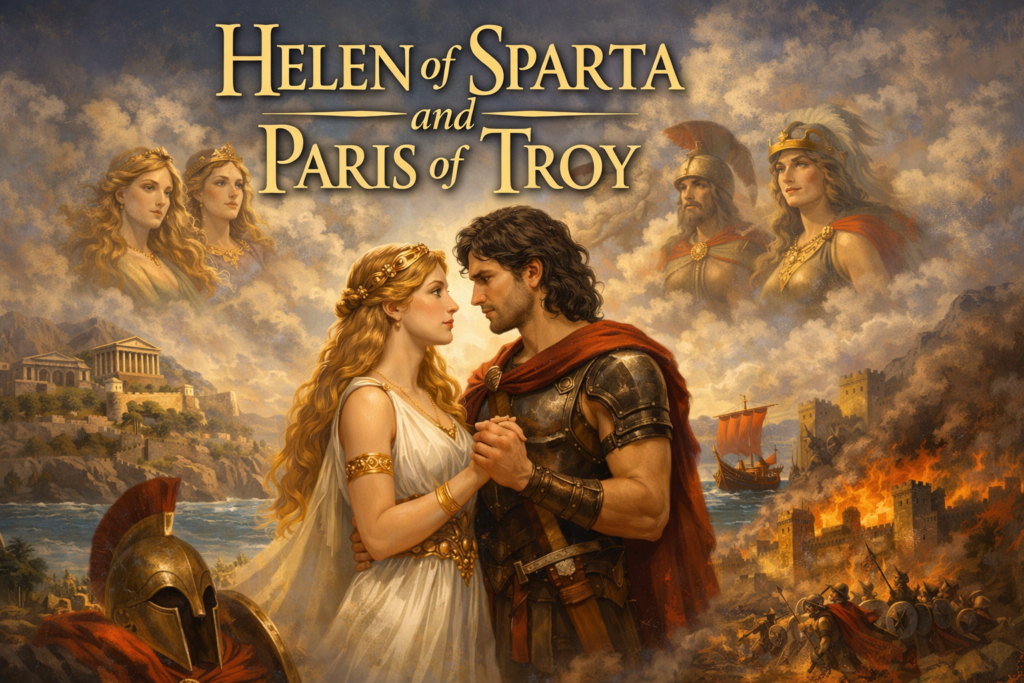
Helen of Sparta and Paris of Troy
Introduction to Greek Mythology
Greek mythology is a collection of ancient stories told by the people of Greece. These stories speak about powerful gods, brave heroes, clever kings, and the choices that shape their lives. The gods often guided or troubled humans, and the actions of kings and heroes could change the fate of entire nations. Greek myths are exciting adventures, but they also quietly teach lessons about pride, patience, wisdom, loyalty, and the consequences of our choices. One small decision can sometimes lead to events far greater than anyone expects.
Helen of Sparta and Paris of Troy
Long ago in the land of Sparta, a strong and disciplined kingdom in Greece, a king named Tyndareus ruled.
Tyndareus was known across Greece as both the most blessed and the most unfortunate of kings.
He was blessed because he once had four beautiful children, children any parent would be proud of. But he was also deeply unfortunate, because tragedy struck his family again and again. Three of those children died when they were still young.
Only Helen, his youngest daughter, survived.
Helen’s mother, Queen Leda, could not bear the sorrow of losing her children. Grief slowly weakened her heart, and not long afterwards, she too passed away. This left King Tyndareus alone with Helen, the only light remaining in his life.
And Helen was no ordinary girl.
Across all the lands of Greece, people whispered the same thing: Helen was the most beautiful mortal woman in the world.
Her hair shone like sunlight on golden wheat, and her eyes sparkled like the bright sea under a clear sky. Wherever she walked, people turned to look. Poets would later say that her beauty could launch a thousand ships.
But beauty can bring trouble as easily as admiration.
There was a law in Sparta. When King Tyndareus died, Helen could not rule the kingdom alone. She would need a husband to rule beside her.
And that created a dangerous problem.
Kings, princes, warriors, and noble lords from every corner of Greece began arriving in Sparta. Each one wished to marry Helen and become the future king of Sparta.
Some were famous heroes. Some were powerful rulers. All of them believed they deserved Helen’s hand.
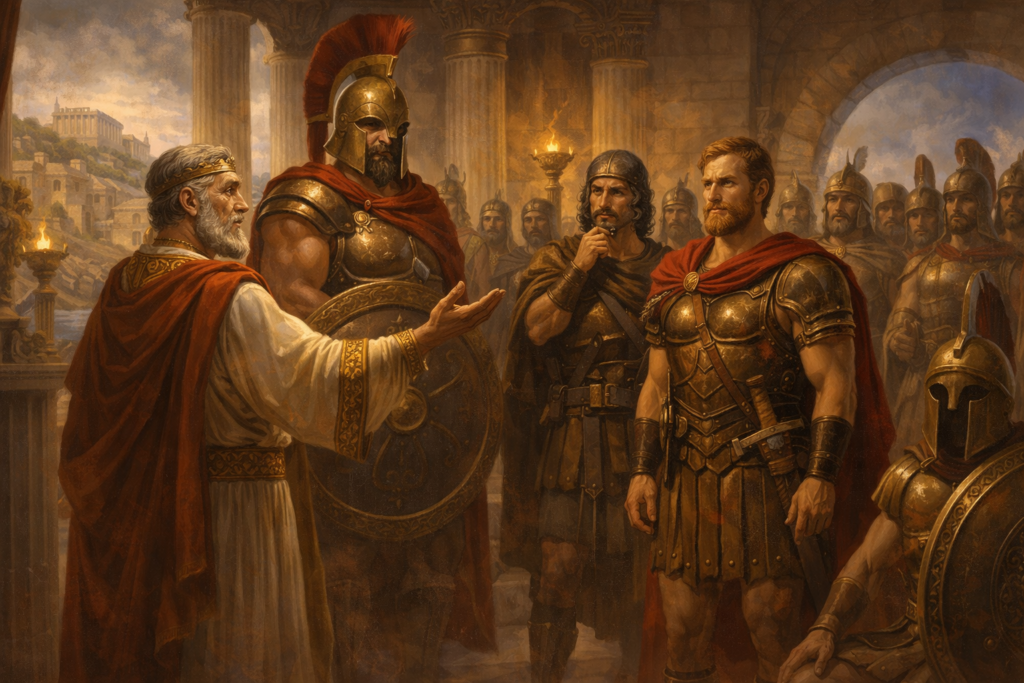
King Tyndareus worried deeply.
“If I choose one man,” he thought, “the others may feel insulted. Proud warriors do not easily accept rejection. Their anger could start a terrible war.”
A wise ruler knows when to seek advice. So Tyndareus turned to a man known for his clever mind.
This man was Odysseus, the king of the island of Ithaca.
Odysseus was not the strongest warrior in Greece, but he was perhaps the most cunning and intelligent. His mind was always searching for solutions where others saw only problems.
When Tyndareus explained his fear, Odysseus thought carefully.
Then a small smile appeared on his face.
“I have an idea,” he said. “But if my plan works, you must help me in return someday.”
Tyndareus agreed.
Soon after, messengers were sent across Greece, calling all of Helen’s suitors to the royal palace in Sparta.
When the day came, the palace hall was crowded with powerful men.
King Tyndareus stood before them and spoke loudly so that all could hear.
“Welcome, noble lords of Greece,” he said. “It honours me and my house that so many great men wish to marry my daughter Helen.”
The warriors listened carefully.
“I ask only one thing,” the king continued. “Before the gods and before one another, each of you must swear an oath. No matter whom Helen marries, you must promise to honour and protect that marriage. If anyone ever tries to steal her away, all of you must stand together to defend her husband.”
The hall grew quiet.
Each man looked at the others.
For a moment, they hesitated.
But deep inside, every suitor believed he would be the one chosen. Refusing the oath might make him seem unworthy.
So one by one, they agreed.
Each man swore before the gods to defend the future husband of Helen.
This promise would later be known as The Oath of Tyndareus.
King Tyndareus felt a great weight lifted from his heart. Now, whichever man he chose, the others would be bound by honour to support the marriage.
He looked around the room once more.
Many heroes stood before him.
There was Ajax, son of Telamon, a warrior as huge and strong as an oak tree.
There was Diomedes, a fearless fighter said to be as swift as the spear he threw in battle.
And there was Menelaus, brother of Agamemnon, the powerful king of Mycenae.
Menelaus was known as a brave warrior and a reliable leader.
Tyndareus breathed deeply.
Then he raised his head and spoke the name of the man he had chosen.
“Menelaus.”
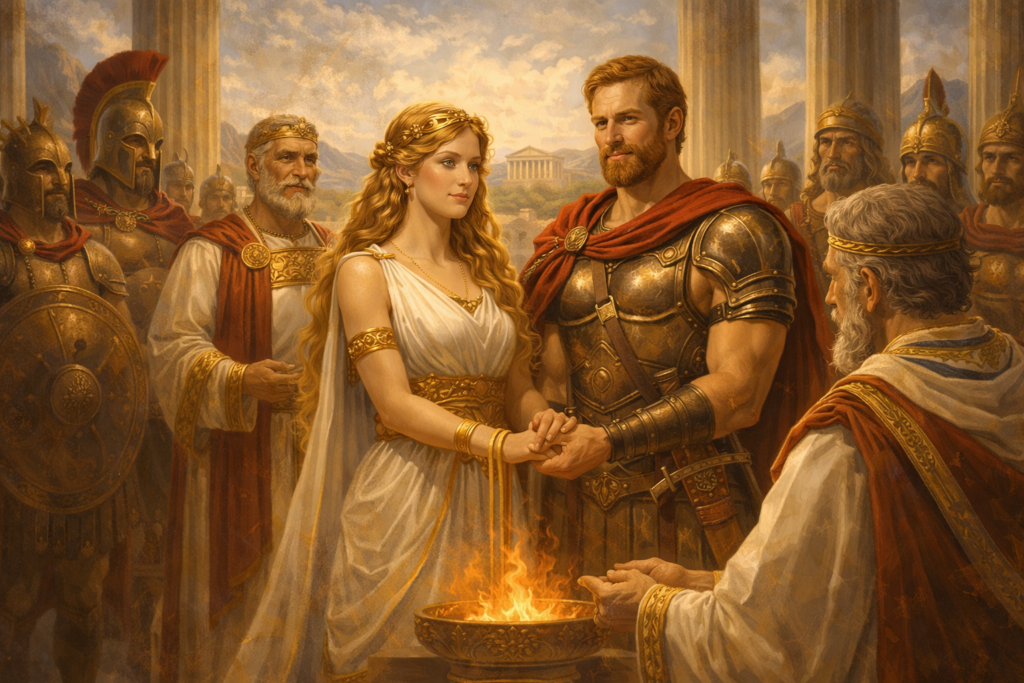
Helen married Menelaus, and he soon became King of Sparta.
For a time, peace filled the palace.
But the threads of fate were already beginning to tighten, quietly weaving events that would soon shake the entire world.
The Princes of Troy
Far away across the sea stood the great city of Troy.
Troy was ruled by King Priam, a wise but ageing king whose city sat beside a narrow strait of water called the Hellespont. This strait connected the Mediterranean Sea to the distant Black Sea, making Troy an important centre of trade.
Among Priam’s many sons was a prince named Paris.
Paris was tall and handsome, with dark curly hair and bright eyes. Unlike many warriors, he had a gentle charm and an easy smile.
Travelling with him was another noble Trojan hero: Aeneas, son of Anchises. Aeneas was respected for his bravery, loyalty, and sense of duty.
King Priam had sent the two young men on an important mission.
Years earlier, Priam’s sister Hesione had been taken prisoner by the Greek hero Herakles and the warrior Telemon. Now she was old, and Priam hoped she might return home before the end of her life.
But there was a problem.
Telemon had already died, and his sons, Ajax and Teucer, were rarely in one place for long.
So Paris and Aeneas sailed from island to island, city to city, searching for them.
Their long journey finally brought them to Sparta.
But when they arrived, another problem appeared.
King Menelaus was not home.
He had travelled away on business and was not expected back for several days.
Still, Paris knew it was wise to be friendly with the Greeks. Troy depended heavily on trade with them.
So, wrapping his finest cloak around his shoulders, Paris led Aeneas and several companions through the streets of Sparta toward the royal palace.
Meanwhile, in the Palace
Inside the palace, Queen Helen stood by a tall window.
She gazed quietly across the city.
Her father had died only three months after her wedding. Sometimes she wondered if he had held on to life just long enough to see her safely married.
She knew she should feel grateful.
But her heart was restless.
Menelaus was respected across Greece. He was brave and hardworking, and he spent much of his time strengthening Sparta’s army.
But he was often away from home, riding, hunting, or training soldiers.
And when he returned, he usually spoke of only one thing.
“We must have a son,” he would say again and again. “Sparta needs an heir.”
Helen sighed softly.
“Life as a queen is not life as a princess,” she murmured to herself.
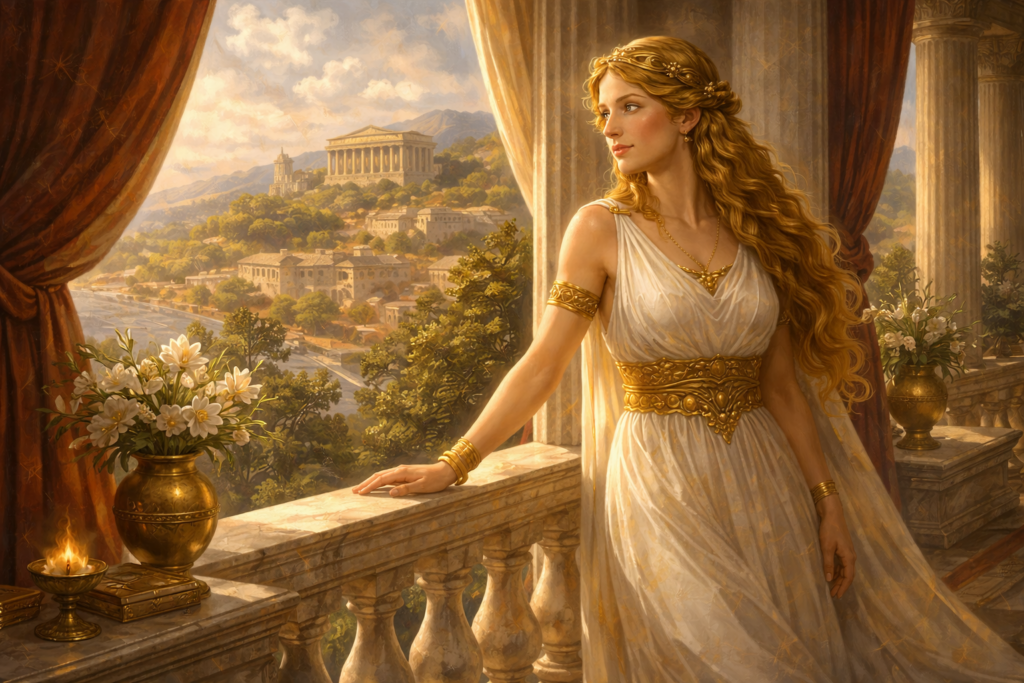
Just then, there was a knock at the door.
“Come in,” Helen called.
The door opened, and Palastor, the royal advisor of Sparta, entered. He was an older man who had served the royal family for many years.
“My lady,” he said respectfully, “a delegation from the city of Troy has arrived. Will you receive them?”
Helen frowned slightly.
She had little desire for another formal meeting.
But the law of hospitality was sacred among the Greeks. Guests must always be welcomed and treated with kindness.
So she nodded.
“I will receive them.”
Her handmaidens quickly helped her prepare, arranging her hair and clothing. Soon she was seated on her throne in the great hall when the visitors were announced.
Helen sighed quietly.
She expected the usual sight: dusty travellers with heavy armour and loud voices, eager to eat and drink all night.
Then the doors opened.
And she saw Paris.
He was as tall as Menelaus but more slender. His dark curls framed a calm, friendly face.
But it was his eyes and smile that caught her attention.
They seemed natural and warm, like someone who laughed easily and enjoyed conversation.
Not like a man who spent every day planning battles.
Helen felt something surprising.
She smiled, perhaps for the first time since her father’s death.
“Welcome, noble lords of Troy,” she said warmly. “Come, sit with us. Eat and drink. When you are rested, you may tell us of your journey.”
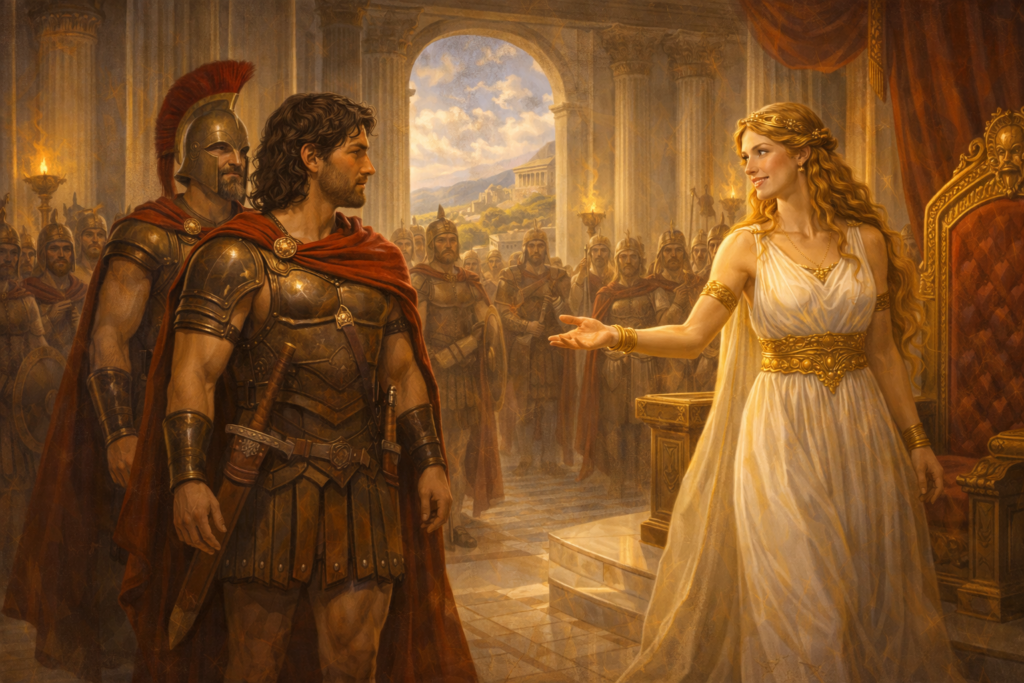
Paris could hardly look away from Helen.
During their travels, he had heard many stories about her beauty. But the stories had not come close to the truth.
Her hair flowed like liquid gold. Her eyes shone like tiny stars.
Paris had once judged the beauty of three goddesses, Hera, Athena, and Aphrodite, the goddess of love. Because he had given the golden apple to Aphrodite, she had promised him a reward.
Her words now echoed in his mind:
“I will give you the love of the most beautiful woman in the world.”
Looking at Helen, Paris realised the meaning of that promise.
The mission to find Hesione slowly faded from his thoughts.
Now there was only Helen.
She is the one, he thought.
If I cannot return to Troy with her… then I will not return at all.
The day passed with feasting, wine, music, and laughter.
The Trojans discovered they liked the Spartans.
And the Spartans discovered they liked the Trojans.
Aeneas and the advisor Palastor spent much of the evening talking. It turned out that Anchises, Aeneas’s father, had once known Palastor when they were young.
They shared many old stories of adventures from years long past.
As night deepened and the stars filled the sky, the guests slowly went to their rooms.
Everyone went to bed.
Everyone except Helen and Paris.
Neither of them felt sleepy.
The moon shone brightly over the palace gardens.
Helen turned to Paris.
“Would you walk with me for a while?” she asked.
They stepped outside into the cool night air and walked slowly along the palace walls.
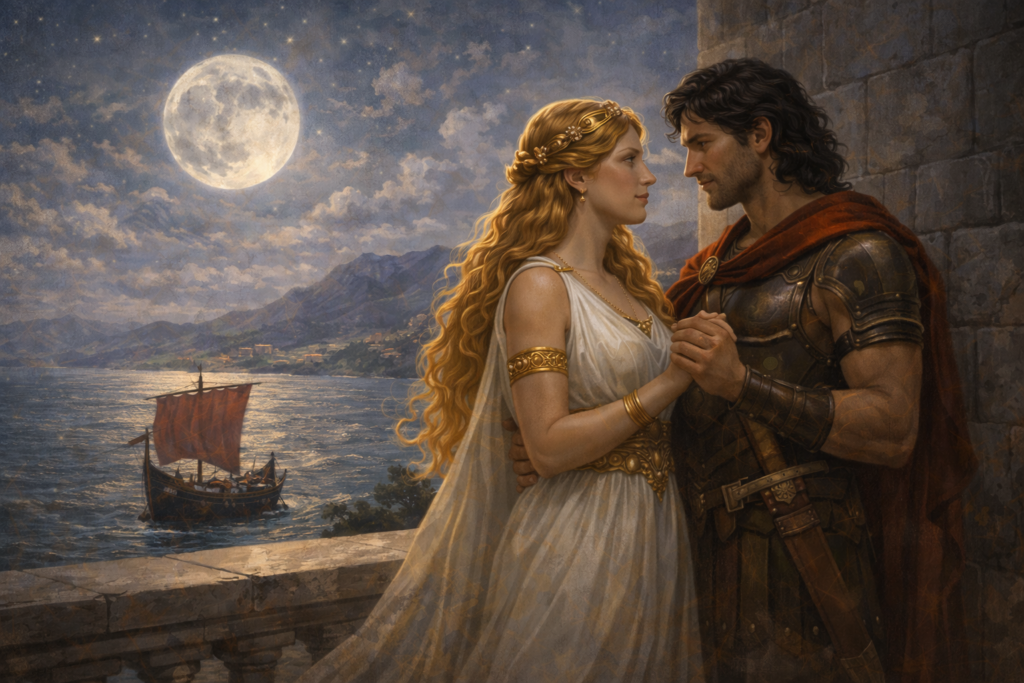
After a moment, Paris asked quietly,
“Do you like living here in Sparta?”
Helen hesitated.
“Like it? Yes… I have lived here all my life. It is my home.”
Paris studied her face.
“So you are happy here?”
Helen paused again.
Finally, she leaned gently against the stone wall and looked away.
“I was happy once,” she said softly. “When my father was alive.”
Paris stepped closer.
“And now?”
Helen turned toward him.
Moonlight shimmered across his face.
And she spoke the truth she had hidden inside her heart.
“No,” she said. “I am not.”
Paris suddenly took her hand.
“Then come with me,” he said. “Come to Troy.”
For a moment Helen could not breathe.
The moon hung high above them.
And under its pale light, the two of them stood together, hands clasped.
The next day, a ship sailed east across the sea.
On it were Paris of Troy and Helen of Sparta.
And though they did not yet know it, their choice would soon lead to one of the greatest wars in all of Greek mythology.
New Book Released
I’m excited to share that I have published a new book on Greek Mythological Stories. This book brings to life the fascinating tales of ancient Greece, filled with gods, heroes, kings, and unforgettable adventures.
If you enjoy stories about Greek mythology, legendary heroes, and epic tales, I warmly invite you to explore this book.
✨ If you would like to read more stories like this, please take a look at my book.
Thank you for your support, and happy reading!