
The Evening Bombay Performed a Little Magic
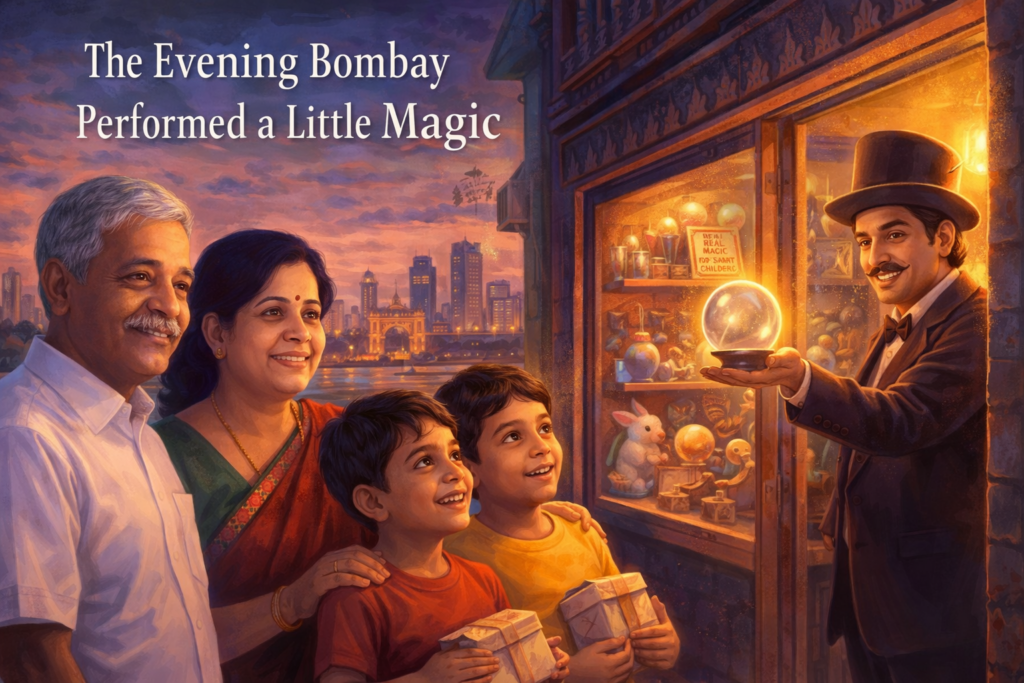
The Evening Bombay Performed a Little Magic
Our first trip to Bombay was meant to be an ordinary family holiday. Yet even now, when I sit quietly and let memory return in its own sweet way, I find myself smiling and wondering whether that journey was ordinary at all.
I had gone with my wife and our two grandsons, Arun and Varun.
Arun was twelve, sharp, curious, confident, and always ready to explain the world to everyone, whether they had asked for an explanation or not.
Varun was ten, bright-eyed, cheerful, and capable of being delighted by almost anything, from a pigeon on a wire to a man selling orange balloons at a traffic signal.
To them, Bombay was not a city. It was a grand moving picture. To us older people, it was also a moving picture, but one with more luggage, more caution, and a constant search for drinking water.
By the time we reached Bombay, the boys had already asked enough questions to fill a notebook.
“Apooppa, why are there so many people in railway stations?”
“Apooppa, do local trains really run like in the movies?”
“Ammoomma, do film stars ever travel like this?”
“Apooppa, if Bombay people are always running, when do they sit?”
At last my wife said, “First let us reach safely. After that, you may study Bombay like a research project.”
Arun laughed.
Varun said, with complete seriousness, “I am not studying Bombay. I am enjoying Bombay.”
That was Varun. He always seemed to know the right thing to say at the right moment.
From the first day, the city dazzled us. The roads were crowded, the buildings stood shoulder to shoulder like impatient men in a queue, and the traffic moved with the confidence of people who had no time to waste. Taxis darted past. Buses groaned. Local trains rushed by like long metal snakes. Even the air of Bombay seemed busy.
We saw Marine Drive, where the sea appeared to speak endlessly to the stones. We saw old buildings, elegant buildings, and some that looked as though they remained standing only because they had made up their minds not to fall.
We ate bhel puri by the roadside. Varun coughed after the first bite and cried, “It is tasty, but it is also attacking my tongue!”
Arun, wanting to sound like a grown man of experience, said, “That is called spice tolerance.”
Then he took a larger bite himself. In the next instant his eyes filled with water, and he began to fan his mouth with both hands.
My wife looked at me and said, “See your brave grandson.”
I replied, “Bombay has already defeated one hero.”
The boys laughed so loudly that even the bhel puri seller smiled.
That evening we were walking along a crowded shopping street, one of those Bombay roads that always seem as though a fair has been in progress there for a hundred years. Shops lined both sides, clothes, toys, watches, sweets, books, bags, shoes, and countless things nobody truly needed but everybody wanted to stop and admire.
Arun walked a little ahead of us like a self-appointed guide. Varun stayed beside my wife, pausing every few steps to look at something new.
Then suddenly Arun stopped.
Not merely stopped, he froze.
He turned sharply and shouted, “Apooppa! Apooppa! Come fast!”
That was not an ordinary call. It was the voice of a boy who had discovered either treasure, a tiger, or a cricket bat signed by Sachin Tendulkar.
We hurried toward him.
He stood before a small shop window, his eyes shining.
Inside were the strangest objects, glowing glass balls under yellow light, magic cards, trick boxes, funny masks, disappearing coins, and a hat from which a rabbit seemed ready to rise at any moment.
One notice said:
BUY THIS AND SHOCK YOUR FRIENDS
Another read:
REAL MAGIC FOR SMART CHILDREN
Varun pressed his nose against the glass.
“Apooppa… this is not a normal shop.”
Arun pointed eagerly. “Look at that disappearing coin! And that magic egg! Apooppa, that box is definitely original!”
“How do you know it is original?” I asked.
He replied at once, “Because fake things never look this mysterious.”
The answer made no real sense, but he said it with such conviction that even I felt he might be right.
Varun pointed to a magic wand and said, “If I get that, I will make Arun disappear for five minutes.”
“Only five?” Arun asked.
“After that Ammoomma will ask where you went,” Varun replied.
My wife laughed.
Then Arun did what children so often do when desire becomes stronger than speech. He quietly took my hand and pulled me toward the door.
It was not a rude pull. Not a demanding pull. Only a soft, hopeful pull.
Sometimes a child does not ask for a thing. He simply places his wonder in your hand.
And that is the kind of pull no grandfather can resist.
So I opened the door.
A small bell rang above us.
At once the noise of the street seemed to grow distant, as though the shop had gently closed its ears to the world outside. The place was narrow, yet somehow deep. The light was dim and golden. Shelves stood on either side, crowded with strange and alluring things. A ceiling fan turned slowly overhead, as if even it understood that this was not a place meant for haste.
On the counter sat a large paper tiger whose head moved slowly up and down.
Varun jumped back.
Then the tiger winked.
At least Varun insisted it winked.
“Apooppa! It saw me!”
Arun said, “Do not behave like a kindergarten child.”
The tiger nodded once again.
Varun folded his hands solemnly and said, “Namaste, tiger uncle.”
My wife laughed so hard that she had to hold the counter for support.
On the floor were magic mirrors. One made me long and thin like a bamboo pole. Another made me short and round like a stuffed pillow. A third gave me a huge head and a tiny body.
Varun clapped in delight.
“Apooppa! In this mirror, you look like a principal who ate too many laddus!”
Even Arun burst out laughing.
My wife stood before one mirror, studied herself, and declared, “If this mirror is telling the truth, I am not entering this shop again.”
At that moment, a voice came from behind the counter.
“What would you like to see, sir?”
We all turned.
A thin man had appeared so quietly that none of us had heard him approach. He had sharp eyes, a long face, and one ear slightly larger than the other. His fingers were long and graceful. He looked like the sort of man who might sell magic by day and speak to ghosts by night.
I cleared my throat.
“I would like to see some simple magic items for the boys.”
“For boys?” he asked. “For ordinary boys? Or for boys with imagination?”
Arun straightened at once. Varun also straightened, though I doubt he fully understood the distinction.
I smiled and said, “For boys with perhaps a little too much imagination.”
The man bowed slightly.
“Excellent,” he said. “That is the best kind.”
Then he scratched his head gently and from his hair drew out a glass ball.
He held it toward Arun.
Arun stared. Varun stared. My wife stared. I too stared, though I tried not to reveal it.
“That is good,” I said.
The man smiled. “Only good?”
Before I could answer, Varun reached for the ball.
It vanished.
His fingers closed on empty air.
“Ayyo!” he cried.
The man said calmly, “Check your shirt pocket.”
Varun slipped his hand into his pocket.
The ball was there.
He looked at me as though I had personally arranged the miracle with the government of Maharashtra.
“Apooppa! It came inside by itself!”
The shopkeeper then drew another glass ball from his elbow, another from behind his neck, another from his sleeve, and then, after a polite cough, one from his mouth.
Varun stepped back and whispered, “This uncle is not a normal uncle.”
Arun said nothing. He was too busy trying to understand.
The mind of a child does not reject wonder. It welcomes it and tries to make friends with it.
“How much for these?” I asked.
“Oh, these?” he said lightly. “These are free.”
“Free?”
“Yes. Small wonders must never be expensive.”
I laughed. “That is the first time in my life I have heard such a sentence in a shop.”
The man looked at me seriously.
“Sir, this is not a usual shop.”
Just then there was a commotion at the door. A little boy outside was crying loudly and tugging at the handle.
“I want to go in! I want to go in!”
But strangely, the door would not open. His father tried once, then twice, then a third time. Nothing.
The shopkeeper glanced at the door and said softly, “That door opens only for the right kind of children.”
Arun looked quietly pleased. Varun looked openly proud.
My wife murmured, “Then our fellows have received a certificate.”
The other boy was at last carried away by his weary father.
Varun whispered to Arun, “See? We are selected candidates.”
Arun nodded as though he had passed a national examination.
Then the shopkeeper looked at my cap.
“May I?”
Before I could protest, he took it and turned it upside down.
Out fell a marble. Then two toffees. Then a bus ticket. Then a spoon. Then three glass balls. Then, to my deep embarrassment, a folded hotel bill.
My wife looked at me.
“Very neat,” she said.
I replied with dignity, “That spoon is not mine.”
Varun laughed so violently that he nearly sat down on the floor.
The shopkeeper continued shaking the cap. More paper began to fall out until there was a small mountain on the counter.
As he shook it, he said politely, “Sir, people carry many things without they knowing it.”
People often carry more than they realise: objects, burdens, memories, and wonder.
My wife murmured, “Very true.”
I said, “But I did not know I was carrying half a kitchen.”
Then suddenly his voice stopped. The paper stopped moving. The fan itself seemed to slow.
Everything went silent.
The shopkeeper had vanished.
No footstep. No sound. No sign.
Only my cap lay on the floor.
And beside it sat a white rabbit, tired and thoughtful, as though life had treated it with some disappointment.
Varun whispered, “Apooppa… did that rabbit become the man, or did the man become the rabbit?”
Arun said, “Do not ask small questions at a big time.”
We went behind the counter. No one was there. Only the rabbit.
I picked up my cap. The rabbit moved aside with the sad dignity of an old government clerk.
Then a side door opened.
The same man appeared again, smiling as if he had merely stepped away for tea.
“Would you like to see the showroom?” he asked.
Before I could refuse, Arun caught my hand.
“Apooppa, please!”
Varun joined him at once.
“Apooppa, this is our Bombay adventure!”
That was true. How could I refuse?
So we followed him.
The showroom looked far larger than the front shop, which was strange enough in itself, because from outside the building had not seemed large at all. There were shelves and stands everywhere, magic swords, toy soldiers, trains, masks, invisible ink, flying rings, talking dolls, a monkey that saluted, and a top that spun without touching the ground.
Varun pointed to a magic sword.
“Can this defeat Arun?”
The shopkeeper replied gravely, “Only if Arun is under eighteen.”
Varun said, with sorrowful seriousness, “Then there is hope.”
The shopkeeper showed us a small train set. It began to move without a battery, without a wire, without anyone touching it.
Arun bent low, watching with complete concentration.
“How does it work?” he asked.
The shopkeeper smiled.
“With obedience. Trains work best when they are respected.”
It was such a strange answer that Arun became even more interested.
Then the man took down a box of toy soldiers.
“Say a magic word when you open it,” he told Arun.
“What word?”
“You will know,” said the man.
That answer was completely useless, but in that shop, even useless answers carried a mysterious authority.
Arun opened the box.
The tiny soldiers moved.
They marched.
Tiny feet. Tiny sounds. Tiny order.
Varun almost shouted, “Apooppa! They are alive!”
Even I felt my skin grow cold.
My wife quietly held my arm.
The shopkeeper shut the box at once and wrapped it in paper.
“We will take it,” I said immediately.
He nodded and handed it to Arun.
Then he offered Varun another box. Inside was a little magician doll that bowed, sneezed, and pulled flowers from its sleeve.
Varun said, “This one is like our neighbour when guests come.”
My wife laughed again.
Then came the strangest and funniest part of all.
The man brought out a large drum and said cheerfully, “Shall we play one small game?”
Before I could object, Varun said, “Yes!”
Arun said, “Yes!”
My wife said, “No!”
I said, “Wait,”
But in that shop, “wait” seemed to have no power.
The man placed the drum over Arun for just a second.
Then he lifted it.
The stool was empty.
Arun had vanished.
My heart leapt.
“Where is he?” I shouted.
Varun stared in shock for one instant. Then he said, “Apooppa… if he has disappeared fully, can I take his mango drink?”
“Not now!” I shouted.
The shopkeeper smiled in a way I did not like at all.
“There is no deception here, sir.”
I stepped toward him. He stepped back. I moved faster. He slipped through a door.
I ran after him and collided straight into a stout gentleman outside on the street.
He said something rapid in Hindi. I apologised.
Then I looked around wildly.
There was the street again. The crowd. The noise. The shops. The smell of food.
And a few feet away, Arun stood, calm and smiling, holding two neatly wrapped parcels. Varun stood beside him, holding two more. My wife emerged next, looking upset, relieved, and amused all at once.
I turned at once to look for the magic shop.
It was gone.
No door. No signboard. Nothing.
Only a plain wall between two ordinary shops.
I looked left. I looked right. Nothing.
Varun said softly, “Apooppa… Bombay itself is doing magic.”
We returned to the hotel in a taxi. For some time, none of us spoke.
Then Varun said, “If I tell this story in school, nobody will believe me.”
Arun replied, “That is because you tell stories badly.”
“Then you tell it,” said Varun.
My wife looked at me and said, “No, let Apooppa tell it. He will add ten extra things.”
I said, “That is called literary improvement.”
That night we opened the parcels.
One contained the toy soldiers.
One contained the funny magician doll.
One contained a pack of cards.
Months passed. The boys continued to speak of the shop.
Sometimes Arun would open the soldier box very carefully and look into it with a secret seriousness.
Once I asked him, “Do they still march?”
“Yes, Apooppa,” he said.
“Really?”
“Yes. But not when everybody is looking. Only when I say the magic word”
I smiled and nodded.
I have never seen the soldiers move.
But Varun says they do.
And sometimes…
when he thinks nobody is watching…
He whispers something to the box before opening it.
Perhaps the real magic of the world lives only in the eyes of children.
Years have passed since that first trip to Bombay. We saw many grand places after that: the sea, the lights, the crowds, the famous landmarks, the great sweep of the city. Yet what stayed deepest in the heart was not the biggest thing we saw. It was that small, impossible shop that appeared once and vanished forever.
Even now, I do not know what truly happened that evening. Was it a trick? Was it a dream? Was it Bombay amusing itself at our expense? Or was it something else altogether?
Perhaps life itself is like that.
When we are young, we think magic means things disappearing, toys coming alive, rabbits jumping out of hats, and strange men pulling glass balls from their ears.
But as we grow older, we begin to recognise another kind of magic.
A small boy calling “Apooppa” with trust in his voice.
A grandmother laughing until tears come to her eyes.
Two brothers sharing the same astonishment.
A family walking together in an unfamiliar city.
A memory that refuses to age.
The greatest magic is not in a shop. It is love that turns one ordinary evening into a story for a lifetime.
Places disappear. Shops vanish. Toys grow old. But a moment of shared wonder remains alive in the heart forever.
Perhaps that is why God gives children to families, not only to be raised, but also to reopen the closed windows of wonder in the hearts of elders.
And even now, when Arun and Varun are no longer the little boys of that Bombay journey, I still think of that vanished shop and smile.
For in truth, I did bring something precious home from Bombay.
Not the toy soldiers.
Not the cards.
Not even the white kitten.
I brought back a shining memory.
And that memory has never stopped doing magic.