
The Road to Town
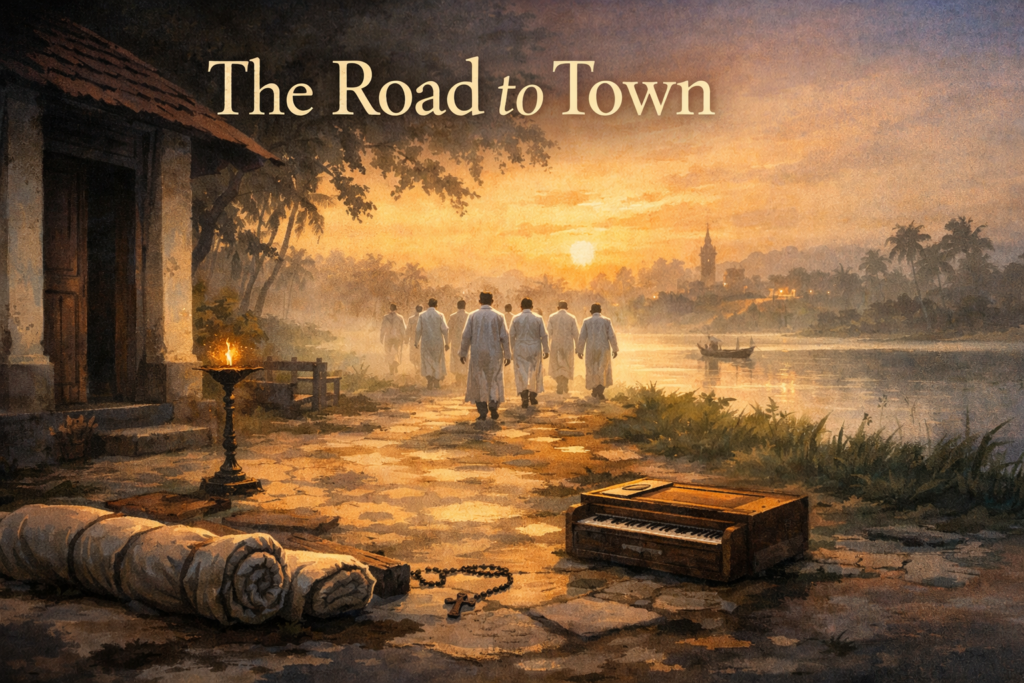
The Road to Town
In a quiet corner of Kuttanad, where the backwaters lay still as a sheet of glass and coconut trees leaned over narrow mud roads, there stood an old Christian monastery. It was not grand. The walls were simple white, a little cracked from many monsoons. Moss grew along the edges of the tiled roof. From far away, it looked like just another old building resting among the paddy fields.
Life there moved slowly.
Every morning, the sun rose the same way. First, a pale orange line appeared behind the coconut trees. Then the mist over the water began to disappear. Birds screamed and fluttered. The smell of wet earth mixed with the scent of jasmine from a nearby house.
Evenings were different. The sky turned purple. The frogs began their chorus. The world outside slowly sank into darkness.
One day was like another. One night was like another.
The priests worked in the small garden, grew vegetables, cooked simple food, and prayed quietly. They rarely had visitors. The nearest town was almost seventy kilometres away. To reach the monastery, one had to cross long roads, canals, and empty stretches where even buses came only twice a day.
At the head of the monastery was Father Mathew.
He was old, with soft white hair and bright, sharp eyes. His voice was deep and warm. In the evenings, he played the harmonium and sang old Malayalam hymns. When he played, even the oldest fathers, like Father Varghese, whose hearing was weak, felt tears in their eyes.
“Father,” young Brother Thomas once asked him, “how do you sing like that? It feels like the music is touching my heart.”
Father Mathew smiled gently.
“Music,” he said, “is not about notes. It is about truth passing through the heart.”
When he spoke about small things, the mango tree in the courtyard, the sea near Kochi, or the monsoon rain, everyone listened carefully. It felt as if something inside them vibrated with his words.
Sometimes, when he spoke about injustice or human suffering, his face would turn red, his eyes would shine, and his voice would rise like thunder before a storm. And in those moments, the others felt that if he asked them to walk into the sea, they would do it without hesitation.
His music and his voice were as important to them as food.
Years passed quietly like that. One Christmas after another. One Easter after another. The same prayers. The same meals of kanji and fish curry. The same view of the backwaters.
Sometimes, without admitting it openly, the fathers felt tired. The same trees. The same water. The same silence.
“When life becomes too peaceful, the mind begins to look for noise.”
Then one night, everything changed.
It had rained heavily. The courtyard was wet. Suddenly, there was loud knocking at the gate.
“Who could it be at this time?” Father Augustine whispered.
When they opened the gate, a man stood there. His shirt was untucked. His mundu was dirty. His eyes were red.
“Please,” he said, swaying a little. “I lost my way. Give me some food.”
They brought him inside. He ate quickly, like someone who had not eaten for hours. After drinking water, he leaned back and looked at them carefully.
“You fathers live quietly here, ah?” he said with a half-smile. “Praying, eating, sleeping. That’s all?”
Father Mathew looked at him calmly. “What is your name, son?”
“Shaji.”
“Shaji,” Father Mathew said softly, “you seem troubled.”
Shaji laughed bitterly. “Troubled? You people don’t know what is happening outside. In town, some people are dying because they have no food. Others are drowning in money and alcohol. Boys are addicted. Families are breaking. There is cheating everywhere. And you sit here peacefully.”
His words were rude. His voice smelled of alcohol.
“Who will guide them?” Shaji continued. “Me? I drink from morning to night. But you… you have knowledge. Why are you hiding?”
The courtyard fell silent.
The fathers looked at Father Mathew. His face had turned pale.
After a long pause, he said quietly, “Sometimes truth comes from unexpected mouths.”
The next morning, Father Mathew gathered everyone.
“My brothers,” he said, holding his walking stick, “we cannot ignore the suffering outside. I will go to the town.”
“Father, please don’t go alone,” Father Varghese said anxiously.
Father Mathew only smiled. “Faith must move, not remain still.”
And he left.
The days that followed felt empty. No music in the evenings. No powerful speeches. The harmonium remained closed.
One month passed. Then two. Then three.
At last, one evening, they heard the familiar tapping of a stick on the stone path.
“Father Mathew!” they cried and ran toward the gate.
But when they saw him, they were shocked.
He looked thinner. Older. His eyes were tired, as if he had not slept properly for weeks.
“Father, what happened?” Brother Thomas asked.
But Father Mathew did not answer. He walked straight into his room and closed the door.
For seven days, he stayed inside. No singing. No talking. Only silence.
On the eighth day, he came out.
His face was serious. His eyes were strangely bright.
He gathered them around.
“On my way to town,” he began calmly, “I felt hopeful. The rivers sparkled. The wind was fresh. I believed I would bring light.”
He paused.
“But when I entered the town…”
His voice trembled.
“I saw hotels full of men drinking expensive liquor. Bottles shining golden under bright lights. They laughed loudly. They spoke without shame. They feared nothing.”
The fathers listened without breathing.
“In one place,” he continued, “a young woman was dancing on a table. Beautiful. Confident. Men threw money at her. She smiled as if the world belonged to her. Desire filled the air.”
Some fathers lowered their eyes.
“I saw betting centres. Corrupt officials taking bribes openly. Theatres showing scenes that shocked me. Rich men wasting food while beggars waited outside.”
His hands shook.
“Evil is not always ugly,” he said slowly. “It is attractive. It smells sweet. It smiles.”
“Sometimes darkness does not frighten people; it invites them gently.”
As he described the lights, the music, the laughter, his words became so detailed that the fathers could almost see everything in their minds.
They imagined the shining bottles. The loud songs. The free laughter. The bright city lights.
A strange feeling grew inside them.
Curiosity.
What does that life feel like?
What does that music sound like?
Father Mathew ended quietly, “We must protect our hearts.”
Then he went back into his room.
That night, none of the fathers slept peacefully.
Early in the morning, when the sun rose over the backwaters, the monastery was silent.
The rooms were empty.
The beds were rolled up. The rosaries lay on tables.
One by one, every father had left.
They had all gone to the town.
The courtyard stood silent under the rising sun. Only the sound of crows filled the air.
And in that silence, one truth remained.
“The human heart is not pulled away by force. It walks away chasing what fascinates it.”