
When Silence Learned to Sing.
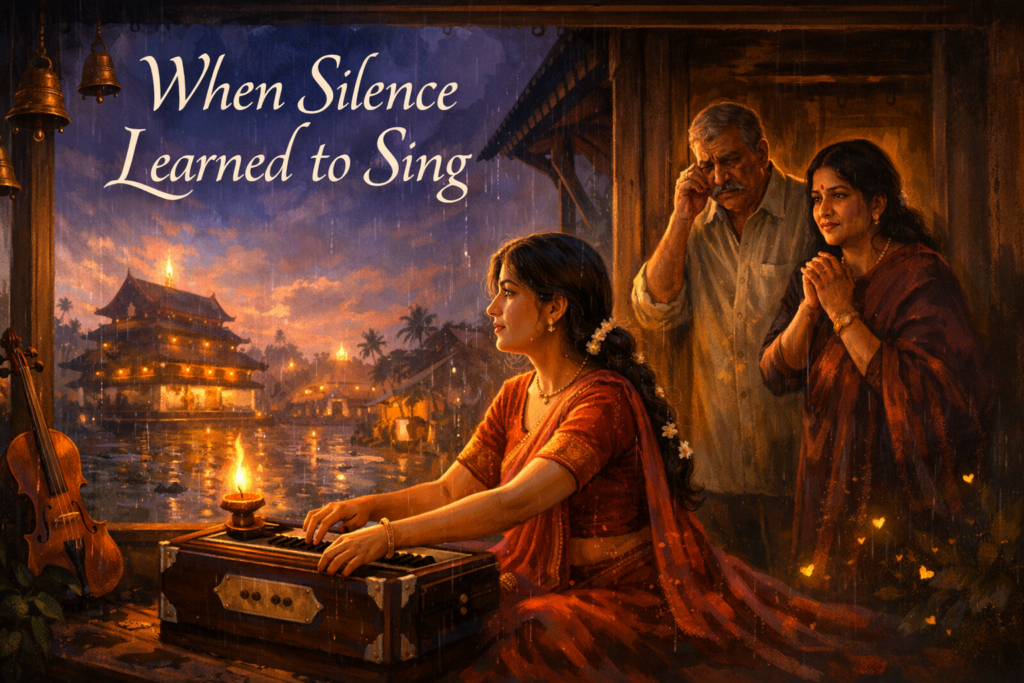
When Silence Learned to Sing.
On Sunday evenings in Thrissur, the town feels almost unbearably alive.
Temple bells roll outward from Vadakkunnathan Temple like waves striking old stone. Vendors shout above the hiss of frying oil. Jasmine sellers argue gently as they thread white blossoms into garlands. Buses cough and sigh at Swaraj Round. Children chase one another in widening circles, their laughter scattering into dusk.
The sky melts from molten gold into bruised violet.
Everything moves.
Everything breathes.
Everything seems to belong.
Except for the house behind the bakery, which always smells faintly of warm buns and sugar.
That house does not belong to the evening.
It does not belong to laughter.
It stands with its windows half-closed and its paint quietly peeling, as if tired of pretending. It is not abandoned. It is not broken.
It is simply quiet in a way that feels permanent.
A house that has forgotten how to expect joy.
Meera lives there.
When she pushes open the gate, it releases its familiar metallic cry, a sound so habitual it feels like an accusation. A stray cat leaps from the compound wall and disappears into the neighbour’s yard. Somewhere nearby, boys shout about a cricket score. A cracker bursts in premature celebration.
The world insists on existing.
Inside, the air thickens.
Her father and her elder sister, Janaki, are already seated at the dining table. The television flickers silently in the corner, newsreaders opening and closing their mouths without sound. The ceiling fan turns lazily, slicing the heavy air into slow circles.
Clink.
Clink.
Clink.
Steel spoon against steel plate.
Her father looks up briefly.
“You’re late.”
Not concerned. Not curiosity. A statement filed and stamped.
Meera washes her hands. The splash of water echoes too loudly in the narrow kitchen. She wishes it would stop making noise.
Janaki does not lift her eyes.
Janaki’s hands are beautiful, small, precise, and patient. They stitch golden mango motifs and peacock feathers into bridal blouses. They measure shoulders and adjust sleeves while mothers discuss horoscopes and gold weight. They once traced rangoli patterns at dawn beside their mother.
Now they sew brightness for other women.
Janaki herself avoids mirrors.
Years ago, at a cousin’s wedding, Meera overheard two aunties whispering near the wash basin.
“Poor Janaki… already twenty-eight.”
“Too quiet. Men don’t like girls who don’t speak.”
“And that house… after the mother died…”
Janaki had stood in the corridor pretending not to hear.
That night, she folded away her brightest saree and never wore it again.
Some humiliations do not shout. They settle like dust.
Their father, Krishnan Nair, once filled rooms with disciplined authority. For forty years, he stamped documents, corrected errors, and maintained order. His handwriting was admired; his files were precise.
When his wife died of a sudden stroke, something inside him collapsed without spectacle.
He did not scream in hospital corridors.
He did not curse fate.
He came home, removed her steel tiffin box from the kitchen shelf, washed it carefully, dried it, and placed it inside a cupboard.
He closed the cupboard.
He closed everything else with it.
Some grief does not erupt.
It calcifies.
All day, Meera teaches music to children who want applause without patience.
“Miss, can we sing a movie song?”
“Miss, this raga is boring.”
“Miss, why repeat again and again?”
Their careless notes follow her home like unfinished sentences.
Yet beneath her exhaustion that evening, something flickers, restless and bright.
Because that morning she had rehearsed with Madhav.
And when she thinks of him, even the suffocating air in the house thins.
She first met him at a modest cultural program near Swaraj Round, plastic chairs, a flickering microphone, and a alf-attentive audience. She had almost declined the invitation to accompany. Invisibility had always felt safer.
Then the announcer declared: “Violin recital by Madhav Menon!”
Applause rose unexpectedly strong.
Madhav stepped onto the stage in a simple cream kurta. No display. No arrogance. He placed the violin beneath his chin as though lifting something sacred.
When they began, something shifted.
She did not chase his melody.
She met it.
She sensed his pauses before he made them. She softened before he softened. She rose before he rose.
It felt less like performance and more like recognition, like two sentences completing one another.
When the final note dissolved, applause came generously.
But what remained was the way he looked at her afterwards.
Not through her.
At her.
Near the tea counter, amid paper cups and banana chips, he approached.
“Meera?”
She turned.
“That wasn’t accompaniment,” he said quietly. “That was understanding.”
Heat flooded her face.
“I just followed.”
He shook his head gently.
“No. You listened.”
No one had ever praised her for listening. They had praised her for obedience. For quietness. For adjustment.
Never for listening.
The word entered her like rain into cracked earth.
Weeks later, she visited his studio near the temple. The room smelled faintly of sandalwood and resin. A single window admitted a slant of evening light.
“I’ve been working on something,” he said.
He began to play.
The melody was drawn from a folk tune women sang while walking home from the fields in Wayanad, tired, unadorned, honest.
It began softly.
Then deepened.
The notes did not float politely.
They entered.
Suddenly, she was six again, sitting on the kitchen floor while her mother stirred saambar and hummed under her breath. She was twelve, standing outside a locked hospital ICU. Nineteen, watching her father stare at an untouched plate of food. Twenty-three, overhearing relatives say, “At least Janaki can stitch. What does Meera do? Music?”
Her chest tightened.
Tears came without warning.
Madhav stopped instantly.
“Meera…”
He knelt beside her.
The grief felt older than language.
He took her trembling hands into his.
“You don’t have to hold everything alone,” he whispered.
He pressed his lips gently to her knuckles, tender, reverent.
For one suspended second, she wanted to surrender, to allow warmth to replace winter.
Then fear struck.
What if this, too, disappeared?
What if she leaned and fell?
She stood abruptly.
“I have to go.”
“My father will worry.”
They both knew that was not true.
At the door, his voice was almost pleading.
“Tomorrow? The hills… we’re still going?”
She hesitated.
“Yes.”
And left before the tremor in her pulse betrayed her.
We beg life to change, and when it begins to, we panic.
Sunday in the hills was sunlight and wind.
They rode a bus toward the Western Ghats. Schoolboys laughed at the back. A baby cried and then slept. Banana chips passed from hand to hand in crinkled newspaper.
Away from the house, Meera felt strangely light.
At a roadside tea stall, the owner grinned.
“Newly married?”
She flushed. Madhav laughed softly.
For a fleeting moment, she allowed herself to imagine it, a small house filled with music instead of silence.
Evening descended violet and gold.
They walked without speaking.
This silence felt alive.
Not suffocating.
Breathing.
She felt, dangerously, hopeful.
The Grand Concert arrived weeks later.
Backstage, Meera trembled. She had invited her father and Janaki, an act of reckless courage.
They sat in the third row: her father rigid, umbrella across his knees; Janaki clutching the edge of her saree.
“Scared?” Madhav asked gently.
“Yes.”
“Good. That means it matters.”
The first notes shook.
Then something within her broke open.
She stopped playing for applause.
She played for her mother’s unfinished lullabies.
For Janaki’s folded brightness.
For the man who had forgotten how to say I miss her.
The music rose, not polished, not cautious, but raw.
She saw her father lean forward.
She saw his hand loosen its grip on the umbrella.
She saw Janaki’s shoulders straighten.
The final note lingered like a held breath.
Silence.
Then applause crashed like monsoon rain.
Backstage, her father stood before her.
For a long moment, he said nothing.
Then his lips trembled.
“When your mother was pregnant with you,” he began, voice unsteady, “she said you kicked whenever she sang.”
His eyes filled.
“I told her not to waste time on songs.”
He swallowed.
“I was wrong.”
The words fell heavy and late.
Janaki broke down.
“I stopped singing after Amma died,” she whispered. “I thought… what was the use?”
Something ruptured inside Meera, years of restrained grief finally given voice.
Her father’s hand, rough and trembling, rested on her head as it had when she was a feverish child.
For the first time in fifteen years, he wept.
Not neatly.
Not quietly.
He wept.
Grief that is finally spoken becomes love again.
That night, rain fell gently over Thrissur.
When Meera entered the house, it felt altered.
Her father cleared his throat awkwardly.
“Sing… something,” he said.
Janaki stood in the doorway, eyes shining.
Meera sat by the old window and began softly.
Her father closed his eyes.
Janaki joined in.
Their voices were imperfect.
They were human.
The house did not become joyful overnight.
But it began to breathe.
And as Meera lay down that night, tears slipping quietly into her pillow, she understood:
The house had never hated music.
It had been afraid of remembering.
And now, at last, it was remembering.
Her life was no longer a background score fading into the background.
It was a trembling, luminous melody,
fragile,
human,
and finally heard.
Top of Form
Bottom of Form