
Shadows Born of Light
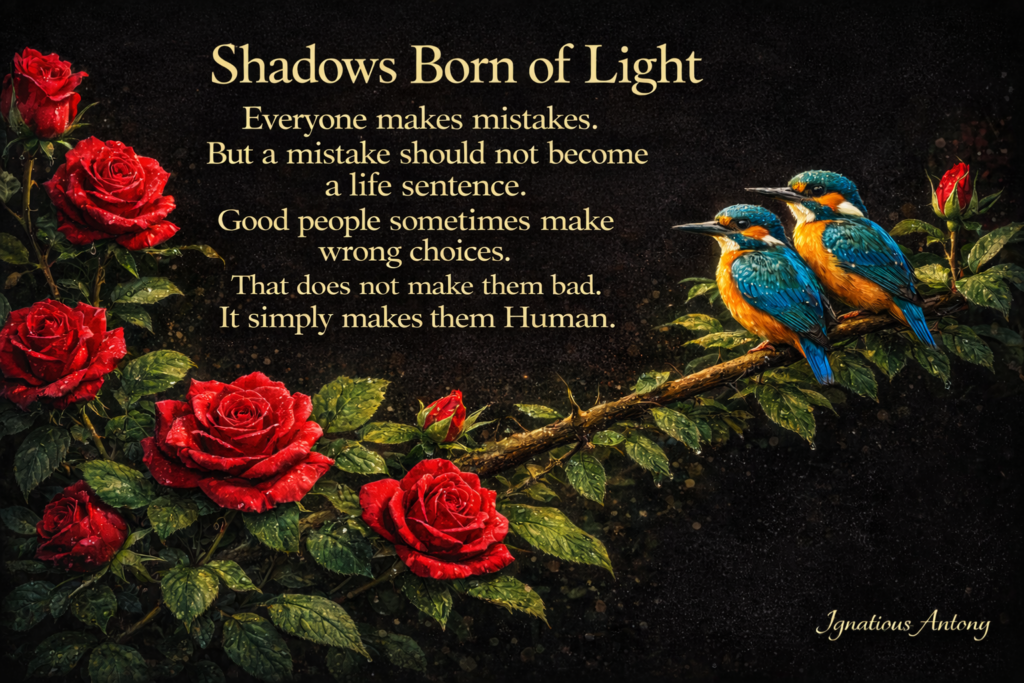
Shadows Born of Light
We move through life like sailors in a squall,
Our fragile hulls on dark, unsteady seas;
A sudden turn may tilt the compass needle,
Yet cannot drown the depths of who we are.
A fissure veining through a temple wall
Does not unmake the sanctity within.
A leaf blown sideways by a restless wind
Still turns its green face upward to the sun.
We falter, as an arrow loosed too soon,
Like hurried speech that bruises quiet air;
Yet hearts are fields where second seasons wait,
And mercy roots itself in hidden soil.
Mistakes are only shadows born of light,
Proof we have stood, and dared to face the blaze.
Reflection on the poem " Shadows Born of Light"
This poem is not about mistakes alone.
It is about dignity.
It begins with the image of sailors in a storm. Life is not presented as a calm lake. It is a restless sea.
We are fragile boats, yes, but we are still boats. We are built to float. A storm may shake us. A compass may tilt.
Yet the poem insists that a wrong direction does not mean a ruined voyage. A mistake is turbulence, not annihilation.
The temple wall image deepens this thought. A crack appears in something sacred. But does the crack destroy the sanctity? No.
The holiness remains. The structure still stands. In the same way, a flaw in character does not erase the goodness within a person.
A human being is larger than a single fracture.
Then comes the leaf in the wind. It is blown aside. It stumbles.
Yet it turns again toward the sun. This is quiet resilience. The poem suggests that growth is not the absence of disturbance. Growth is the decision to keep facing the light even after being shaken.
The arrow metaphor introduces responsibility. We falter like an arrow released too soon. There is an acknowledgement here.
Mistakes are not denied. Words can bruise the air. Choices can miss their mark.
The poem does not romanticise error. It simply refuses to let error define identity.
What follows is perhaps the heart of the poem: “hearts are fields where second seasons wait.” This is an agricultural image of hope. A field that once failed can bear fruit again.
A season lost does not cancel all future harvests. Mercy is not dramatic. It is organic. It roots quietly.
It grows slowly. It blooms again.
The closing lines are powerful. “Mistakes are only shadows born of light.” This is the philosophical core.
A shadow exists only because light exists. If we had no courage, no effort, no attempt, there would be no shadow.
The presence of error proves the presence of action. We stood in the light. We tried. We dared.
The poem, therefore, is not about excusing mistakes.
It is about separating identity from error. It is about understanding that imperfection is not moral collapse. It is human evidence.
In a world that is quick to label and slow to forgive, this poem invites a gentler view:
A crack does not collapse.
A storm is not drowning.
A shadow is not darkness.
It is, simply, proof that we were brave enough to stand in the sun.