
The Day I Met the Richest Poor Man
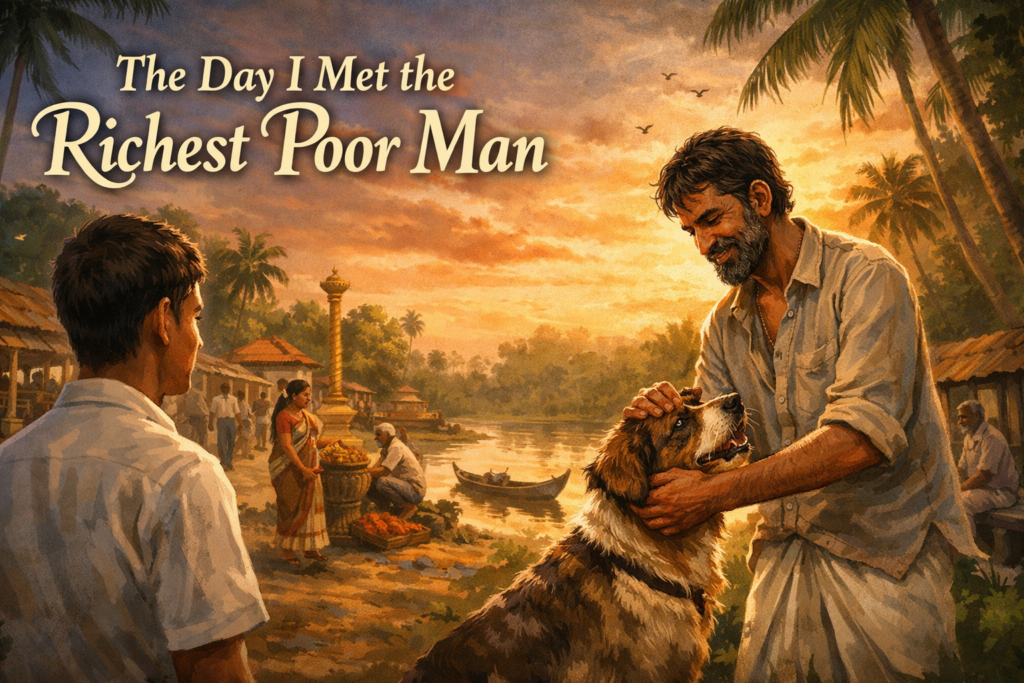
The Day I Met the Richest Poor Man
At that time, I was living at Kudappanakkunnu, Thiruvananthapuram
Red mud roads. Small tea shops with glass jars full of banana chips. Temple bells in the evening. The smell of jasmine from nearby houses. That was my world.
One hot afternoon, I took my dog, Tiger, for a walk along the canal road. The sun was sharp. Even the crows were silent.
Suddenly, Tiger began behaving strangely.
He rolled on the ground.
He scratched himself against a coconut tree.
He howled loudly.
“Hey! Tiger! What happened to you?” I shouted, worried.
He growled and scratched harder.
Just then, I noticed someone standing beside me.
He was around thirty. Dark-skinned. Thin. Wearing a faded mundu( dhothi) and an old shirt open at the neck. His beard was uneven. He had no slippers.
I thought he might ask for money.
Before I could speak, he smiled.
His eyes were calm. Clear. Kind.
“The poor fellow is missing something,” he said, pointing at Tiger. “Come. Let’s check.”
He spoke as if we were already friends.
He gave a sharp whistle.
“Tiger… come here, moné…”
To my shock, my usually suspicious dog walked straight to him and rested his head on the man’s knee.
The man gently searched through Tiger’s fur.
“Aha…” he whispered.
Suddenly, Tiger cried out.
“Hold him,” the man said calmly. “It will hurt only for a second.”
He pulled out a long thorn stuck deep in the dog’s skin.
Tiger yelped… then jumped up happily and ran in circles.
“There,” the man smiled, holding up the thorn. “Now you can run again.”
Before I could even thank him, he stood up and said softly,
“Daivam nannayi nokkatte.”
(May God look after you.)
And he walked away quickly.
I did not even ask his name.
“That Is Sasi…”
When I reached home, I told our old cook, Thankamma chechi, what had happened.
She laughed gently.
“That must be Sasi.”
“Sasi? Who is he? What does he do?”
She looked at me as if I had asked something silly.
“Do? Nothing.”
“Nothing? How does he live then?”
“Everyone gives him what he needs. He doesn’t care about money.”
I was confused.
In our town, everything needed money: rice, bus tickets, rent, and school fees.
How could someone live without worrying?
I decided to watch him.
The Man Who Belonged to Everyone
After that day, I began noticing Sasi everywhere.
One morning near the bus stand, he shouted,
“Chetta! That back tyre is loose. Tighten it before going to Guruvayur!”
The driver checked.
He was right.
Another day, he told a shopkeeper,
“Your roof tile is cracked. Next rain, water will enter.”
Sometimes people would say jokingly,
“Sasi, since you saw it, you repair it also!”
And he would.
I saw him:
Fixing slippers in a cobbler’s shop.
Serving tea during rush hour.
Carrying sacks of rice for an old woman.
Taking children safely across the road during the temple festival.
Once I saw him selling tomatoes in the market.
“The lady is in hospital,” someone told me. “He is helping her.”
But here was the strange thing.
No matter how much he worked, he never took more than needed for one day.
If someone gave him 500 rupees, he would say,
“Too much. Give me 100. Enough for today.”
If they forced money into his hand, he would quietly leave it behind.
Some people save money in banks.
Some people save kindness in their hearts.
That was Sasi’s bank.
When you need less, you fear less.
The Wireless System
One day, a pipe in my house started leaking.
“Call Sasi,” I told Thankamma chechi.
“You can’t call him like that,” she said. “But I’ll tell someone.”
In our town, news travelled faster than mobile phones.
By evening, Sasi appeared at my gate.
As if the wind had carried the message.
He repaired the pipe, checked my fence, and even tied a support to my mango tree.
After finishing, I told Chechi to give him 300 rupees.
Later, I asked, “Did he take it?”
She smiled.
“I gave 300. He took 80.”
“Only 80?”
“Yes. He said that is enough for two meals.”
Then she added,
“He also asked if you have an old shirt.”
For the first time, he had asked for something.
I ran after him.
“Sasi! Wait!”
He stopped and looked at me calmly.
“I have some clothes. Come.”
He came back without surprise, as if it were the most natural thing in the world.
I brought out my old shirts and mundus.
He carefully looked through them.
“This one is good,” he said, choosing a simple cotton shirt.
Then he pointed at another.
“That blue shirt, Rameshan, near the temple needs one.”
“And these slippers? Give to Basheer in Market Road.”
“If you don’t mind, I’ll give them.”
He spoke as if he was doing me a favour.
I felt something move inside my chest.
Before leaving, he looked at me and said,
“You are a good man. You share.”
The Girl Who Waited
Behind the temple pond lived a young widow named Leela.
She stitched blouses for women in town.
Her house stood alone under a jackfruit tree.
One evening, I saw Sasi repairing her broken window.
“You don’t have to do all this,” she said softly.
“If rain comes, water will enter,” he replied without looking up.
Soon rumours began.
“They sit together every evening.”
“She gives him tea.”
“When is the wedding, Sasi?” men teased at the tea shop.
“There is no wedding,” he would say calmly.
But Leela’s eyes told another story.
One rainy evening, I happened to pass by her house.
I heard her voice, trembling.
“How long will you walk like this, Sasi? No house. No savings. No plan.”
Silence.
“If you want… we can live here. Together.”
My heart beat fast.
Sasi’s voice was steady.
“Leela… you deserve a man who can promise tomorrow. I cannot.”
“But I don’t want tomorrow. I like you,” she said.
Long silence.
Then he said softly,
“If I marry you, I must earn more. Save more. Fear more. I will stop belonging to everyone.”
Her sobs cut through the rain.
“Am I not enough for today?”
“You are more than enough,” he said quietly. “That is why I must leave.”
That night, he left the town.
The Hardest Freedom
One night, I found him sitting near the canal road.
“You could have married her,” I said.
He looked at the dark water.
“If I take one person as mine, I will stop being free.”
“That is foolish,” I said angrily.
He smiled faintly.
“I am afraid of becoming afraid.”
I did not understand.
He continued,
“If I own something precious, I will begin fearing its loss. Fear makes men selfish.”
He threw a small stone into the canal.
It is easy to give up money.
It is harder to give up love.
He gave up both.
What He Taught Me
Years passed.
I faced loan tensions. Sleepless nights.
Whenever fear entered my heart, I remembered Sasi.
He trusted people.
And people never failed him.
True freedom is not doing what you want.
It is not being owned by what you want.
I do not know if he was foolish or brave.
Maybe both.
But I know this.
The day my dog went mad, a man pulled a thorn out of his skin.
Years later, I realised,
He was also pulling thorns from my heart.
And even today, when temple bells ring in the evening wind, I whisper to myself:
The richest man I ever met
Owned almost nothing.
.