
The First Rain on the Hill
The First Rain on the Hill
The first rain came before dawn.
Not loud.
Not angry.
Just a soft, steady rain, falling as if it had all the time in the world.
When Parvathy woke, the hill outside her window had changed.
The red mud path had turned dark.
The jackfruit tree near the compound wall looked newly washed.
Mist sat low on the slope, hiding the valley like a secret kept well.
Her knees spoke before her eyes did.
“Ayyo…” she murmured, slowly sitting up.
The ache was familiar. Rain always found old injuries before the mind woke.
The body remembers what the heart tries to forget.
She moved closer to the window. Her breath fogged the glass.
Below the small tiled house, the slope dipped into wild shrubs, rubber trees, and a thin stream that usually laughed loudly. Today, it was silent. Even water knew when to keep quiet.
Everything felt paused,
as if the world had stopped in the middle of a thought.
“It’s time,” she said aloud.
No one answered.
Some decisions are answered only by silence
The urn sat on the small wooden table near the stove.
Plain. Steel. Cold.
It did not belong there.
It sat awkwardly among old steel tumblers with dented rims, cracked white plates with blue flowers, and a wall calendar still stuck on last year’s Onam wishes.
Jayakrishnan would have laughed the moment he saw it.
“Steel urn aa?” he had said once from the hospital bed, the oxygen tube resting lightly against his cheek.
“Couldn’t they find an old Horlicks bottle? Or at least a coffee tin? That red one.”
Even then, sick and tired, his humour had refused to leave him.
Some people lose strength before they lose kindness
“Don’t keep me on some shelf like a god,” he had said, coughing after the sentence.
“No lamps. No flowers. No Monday prayers.”
Then, after a pause, softer,
“When the first proper rain comes, take me up the hill,” he said.
“You know which rock.”
Parvathy had not replied.
She had not needed to.
There was only one.
A long, flat rock above their house, smooth in the middle, rough at the edges. The place where the wind always arrived first. From there, the river bent like a silver thread, the temple tower stood steady, and far away, red buses appeared and vanished on the main road like passing thoughts.
Now Parvathy picked up the urn.
It was heavier than she expected.
Not because of weight, but because of memory.
For a moment, she held it close, her fingers tracing the cold metal. Without thinking, her thumb rested exactly where it used to rest on his wrist while crossing the road.
“Wait,” she used to say.
“Let the bus pass.”
“I’m not a child,” he would reply.
But he never pulled his hand away.
Love often lives in small permissions.
She had thought grief would cut like a knife.
Instead, it came like rain, slow, soaking, changing everything without noise.
Outside, a crow landed on the jackfruit tree near the compound wall. It shook rain from its wings, tilted its head, looked in through the window, and flew away.
Life did not wait. She lit the stove again. Two dry sticks. Old newspaper. A match.
The flame caught.
Habit is a strange kindness. It keeps us alive when the heart refuses to move.
She boiled water and made tea in his chipped blue cup, the one with the faded Kathakali face, its eyes almost erased by years of washing.
“Strong tea,” he used to say.
“Otherwise, why bother?”
She dressed slowly. An old saree.
The woollen shawl she wore only on cold mornings.
Her rubber chappals waited near the door, but she pushed them aside and wore the boots.
The boots he had insisted on buying.
“Rain doesn’t respect age,” he had warned.
“And mud respects nobody.”
Outside, the rain thickened.
And with it, memory returned.
In the hospital
The nurse had stepped out of the hospital room for a moment.
Machines breathed.
Light hummed.
Time loosened its grip.
Jayakrishnan lay with his eyes closed.
Parvathy sat beside him, her fingers resting lightly on the sheet, close to his hand but not touching. Touching sometimes made his breathing uneven.
After a while, he spoke.
“You’re sitting very straight.”
She looked at him, surprised.
“You can see that?”
“I can hear it,” he said.
“Your back becomes stiff when you’re worried.”
She tried to laugh. It came out thin.
“Don’t imagine things.”
He opened his eyes slowly and turned his face toward her. His eyes were sunken, but still clear.
“Did you eat?” he asked.
She nodded.
“Tea and biscuit.”
“Liar,” he said gently.
“You haven’t eaten since morning.”
Her throat tightened.
Love often reveals itself as concern, not romance.
After a pause, he said, “Do you remember the first rain after we built this house?”
She swallowed.
“How can I forget? The roof leaked everywhere.”
He smiled faintly.
“You stood there with a bucket, shouting at me like I ordered the rain.”
“You did order it,” she said.
“Who builds a house on a hill and expects mercy?”
He breathed carefully.
“When that rain comes again,” he said, “take me up.”
She stiffened.
“Stop talking like this.”
“Listen,” he said softly, but firmly.
“I’m tired of pretending with myself.”
She looked away.
“That rock,” he continued.
“That’s where I understood things.”
“What things?” she asked.
“That life doesn’t stay,” he said.
“And that it doesn’t need permission to leave.”
Acceptance often arrives quietly, long before courage does.
Footsteps sounded in the corridor.
“First proper rain,” he said quickly.
“Promise me.”
Promises made in hospitals are dangerous things.
But she had said it anyway.
“I promise.”
He closed his eyes.
“Good,” he said.
“Then I can rest.”
Now the hill waited.
Parvathy placed the urn inside his old canvas bag, the one he had used for every walk, every climb. It smelled of sweat, rain, and dried leaves. The zip stuck halfway, as always.
She tugged at it gently.
“Even now,” she said softly, smiling through her throat,
“You’re stubborn.”
She opened the door.
Cold rain touched her face immediately.
Some goodbyes arrive before we are ready.
The first step sank into soft mud.
The path began behind the firewood stack. Jayakrishnan had walked it so often that even the grass remembered his feet.
She walked slowly.
One step.
Then another.
The earth received her without complaint.
As she climbed, another memory rose.
Years ago, on a rain-washed evening, they had stood on that same rock.
The stone was wet.
Mist curled up from the valley like breath.
Jayakrishnan climbed first and held out his hand.
“Careful,” he said.
“This stone looks smooth, but it remembers rain.”
“You talk as if stones have memory,” she laughed.
“They do,” he replied.
“They remember who stood on them without fear.”
They stood side by side.
Below them, the river curved gently. A temple bell rang. Somewhere far away, a bus horn sounded.
“Do you know why I like this place?” he asked.
She shook her head.
“Up here,” he said, “everything looks small enough to forgive.”
She looked at him.
“The house, the fights, money worries,” he continued.
“Even fear becomes manageable.”
“And people?” she asked.
He smiled.
“People become precious.”
Distance teaches value better than closeness ever can.
A wind passed over the rock. He moved closer instinctively, shielding her.
“If I go before you,” he said casually,
“Bring me here.”
She slapped his arm.
“Don’t talk nonsense.”
“I’m serious.”
“You always choose difficult places,” she said.
“Easy places don’t teach anything.”
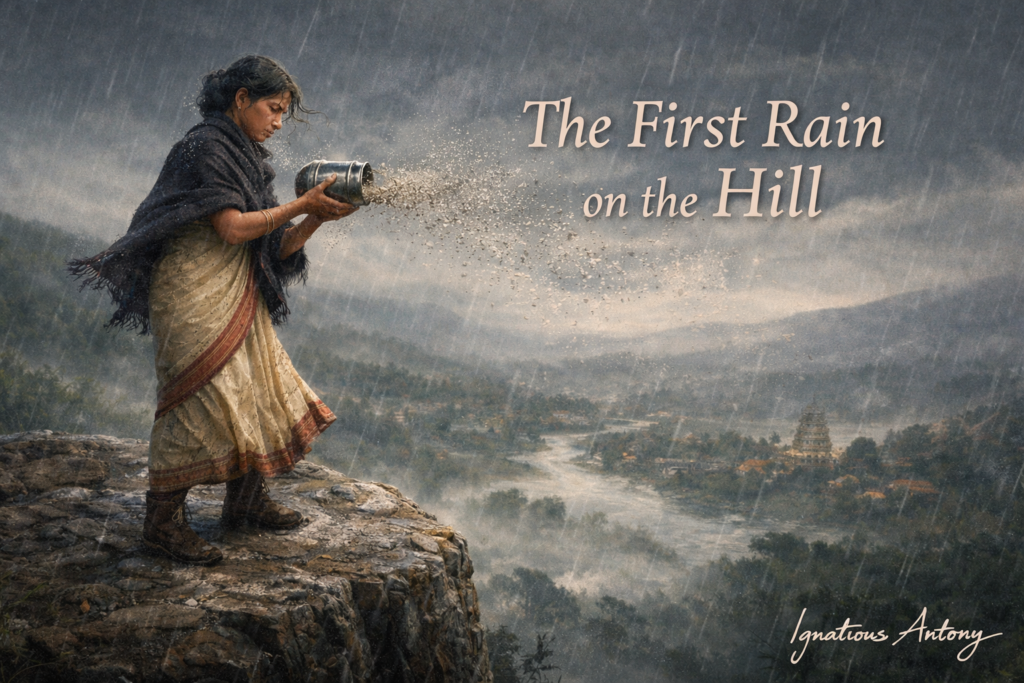
Now she reached that same rock.
The rain lashed sideways.
She removed the bag and took out the urn. Her fingers burned with cold.
“How should I do this?” she asked the air.
“Speech venam? Poem venam?”
Only wind replied.
Some moments refuse decoration.
He had never liked speeches.
At their wedding, his cousin had spoken for twenty minutes.
Later, Jayakrishnan had whispered,
“Marriage itself is long enough. Why add explanation?”
She opened the urn.
Inside, the ashes were pale and fine, lighter than she imagined.
“So this is you,” she murmured.
“So quiet at last.”
She stepped closer to the edge.
“Here,” she said.
She tilted the urn.
The ashes rose immediately, caught by the wind. They did not fall.
They danced.
They scattered.
Some returned to touch her face, her shawl, her hair.
She did not move.
Letting go is not an action; it is a stillness.
Three months earlier, she had sat beside his bed, counting his breaths.
Once, without opening his eyes, he had said,
“You’re watching too closely.”
“It’s my duty.”
“No,” he had whispered.
“Your duty is to live after me.”
She wiped her face with her shawl.
The last of the ashes vanished into rain, rock, leaf, and air.
Nothing truly ends. It only changes its address.
She closed the urn.
It felt empty.
She considered throwing it away.
But she didn’t.
Some things are carried back, even after their purpose is done.
Some vessels are kept, not for use, but for memory.
Her chest shook once.
Then again.
A sound escaped her, half laugh, half sob.
“You fool,” she whispered.
“Making me promise.”
The rain grew stronger.
She turned back.
The descent was harder.
She slipped once, landed on her side, and lay still for a moment.
“All right,” she told herself.
“That’s enough drama for one day.”
By the time she reached home, the light had faded.
She unlocked the door.
Cold air greeted her.
Inside, the house felt larger.
Quieter.
She lit the stove again.
Boiled water.
Changed into dry clothes.
Old slippers waited near the door, his slippers.
She slipped into them.
They still knew his feet.
She stood by the window with her tea.
Outside, rain erased shapes.
The hill disappeared.
Somewhere above, he was already part of the soil, the stream, the root of a tree.
“I did it,” she said softly.
The house did not answer.
Alone was still alone.
Tomorrow would come.
And the next day.
Grief does not end with promises kept.
But the fire warmed the room.
Tea warmed her hands.
She watched the rain fall.
Patient.
Unhurried.
Like life itself.
“Goodbye,” she said.
And the rain went on.