
The Golden Cage
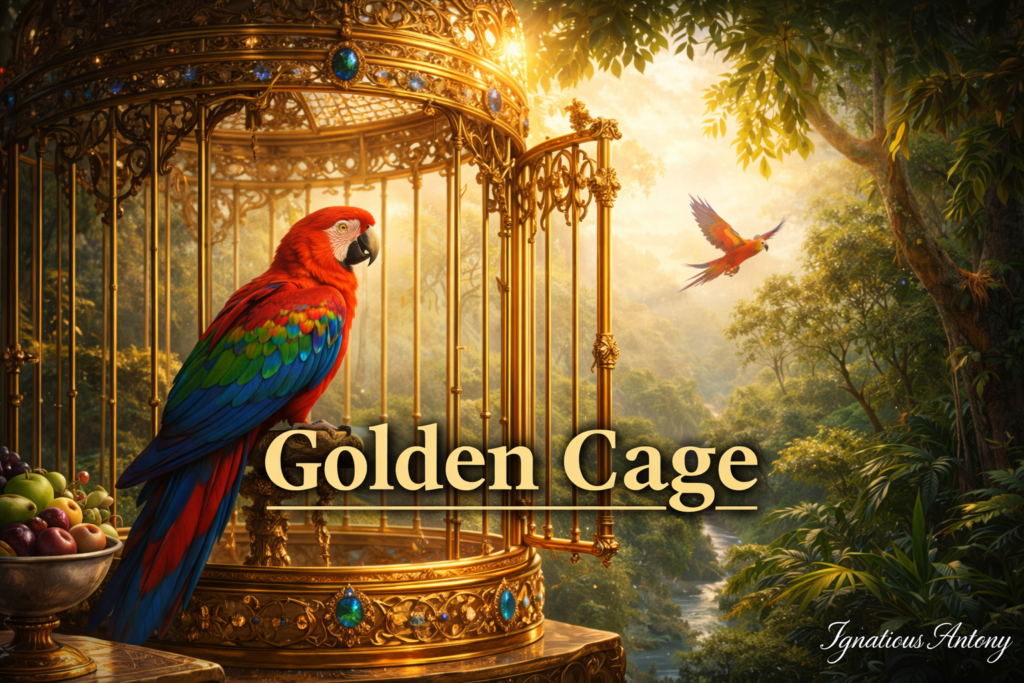
The Golden Cage
In Africa’s deep green, living wild,
a parrot sang, bright-feathered, free.
Its voice was wind and whispering leaves;
Its heart knew only company.
Two souls in flight, through sun and moon,
they shared the sky, the dawn, the night,
till one dark day, a merchant came
and stole one song from open light.
A golden cage, rich fruits, soft care,
Yet none could heal the aching loss.
Each song it sang was grief made sound,
Each breath, a longing never crossed.
Inside the bars, the parrot thought
of leaves that moved without command,
of winds that chose their own direction,
of flying just because it can.
It dreamed of wings that asked no leave,
of skies untouched by fear or trade.
The cage grew smaller with each thought.
each comfort felt like borrowed shade.
Inside the bars, the parrot sat
and argued with its beating heart:
Is this a prison if I’m safe?
Is this a gift if I’m torn apart?
It ate the fruit, then tasted shame.
It slept, yet dreamt of falling skies.
It feared the pain of broken wings,
Yet feared still more a life of sighs.
It watched the door and learned to wait,
then hated how waiting felt like peace.
The cage grew kind. The bars drew close.
Freedom began to feel like a risk.
“Tell my love I live in gold,
Yet miss the sky, the forest wide.”
The message reached the waiting bird,
who closed its eyes, and fell, and died.
Back came the word. The captive heard.
Its heart knew truth before its mind.
It stilled its breath, let fear go loose,
and left its careful life behind.
It fell as dead, then rose in flight,
The cage left open, life released.
For some must die to comfort first
before they learn what freedom means.
Some cages shine. Some feed us well.
Some never strike, yet slowly bind.
And love, at times, must teach us this:
to lose a life, to find a sky.
It was not the cage that held the bird.
It was fear, dressed softly as comfort.
And when that fear was left behind,
The sky did what it always does, opened.
.
Reflection On the poem "The Golden Cage"
The Golden Cage is not a poem about a bird.
It only uses a bird because human truth often becomes clearer when spoken through feathers.
At its surface, the poem tells a simple story of love, loss, and escape.
But beneath that narrative runs a quieter question, one that follows us long after the final line: What do we call freedom when comfort replaces choice?
The parrot’s captivity is not brutal. There is no hunger, no physical harm, no visible cruelty. The cage shines. The fruit is plentiful. The care is gentle.
And this is precisely what makes the captivity dangerous. The poem reminds us that the most enduring prisons are not built of iron but of safety, routine, and reward.
What sharpens the poem’s tension is the parrot’s inner argument. It does not rage. It reasons. It negotiates with fear. It begins to doubt its own longing. When freedom starts to feel like risk, and captivity begins to feel like peace, the poem quietly shows us how easily the soul can be trained to accept less than it was made for.
The act of “dying” in the poem is not physical death, but symbolic surrender, the death of fear, of dependency, of the comforts that dull our instincts.
The mate’s fall in the forest becomes a wordless message, teaching that liberation does not come from opening doors, but from letting go of what keeps us kneeling inside them.