
On A Cold Christmas Night
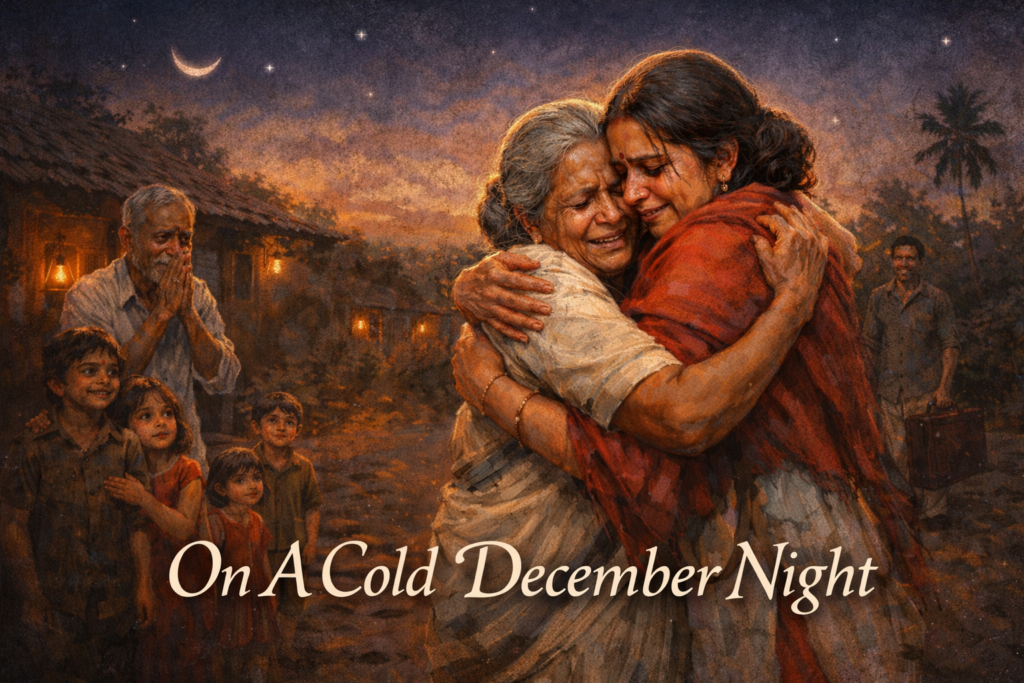
On A Cold December Night
A Memory That Still Warms the Bones
This happened when I was young.
In those days, in our small village far away from Thrissur, many people couldn’t read or write. Illiteracy wasn’t shameful; it was simply ordinary. Words lived in the mouth, not on the page. Feelings travelled through voices, not through ink.
And because of that, many loves remained unsaid.
Many aches were locked behind quiet ribs.
This is one such memory. It has stayed with me like the scent of wet earth after the first rain.
I remember that Christmas.
Not the joyous kind, with cake, candles, and new dresses. But the kind that makes old people sit still for long hours, staring at doors that do not open. A Christmas of aching absences.
In our village lived Marykkutty and Kochouseph, a quiet, God-fearing couple who carried their sorrows like a shawl worn too long.
They had not seen their daughter, Annie, in four years.
She had gone to Bombay after her marriage to Thomas Chacko, a man who had once served in the army and now worked in a hospital there. In the beginning, she sent letters, two or three. And then, silence.
No letter.
No phone call.
No visiting relatives who might casually mention her name.
Whether Marykkutty was lighting the evening lamp, scrubbing the brass pot at the well, feeding their old cow, or lying sleepless on the coir cot, listening to the insects chirp in the dark, one question circled inside her like a moth trapped in a jar:
Is my child alive?
She longed to write to Annie.
But Kochouseph could not read or write.
And in those days, to find someone who could write a letter was like finding rain in April.
Illiteracy does not just close books; it keeps love from travelling.
That December, something in Marykkutty snapped.
She walked, determined, to the toddy shop by the junction, where Lonappan, a retired army man with ink-stained fingers and a heart for money, sat most afternoons. Word was that Lonappan could write letters for two rupees.
And so they paid.
That afternoon still flickers in my memory.
The kitchen was hot, steamy. A pot of pork curry simmered on the fire, and the smell of spice hung thick in the air.
Lonappan sat at the crooked table, pen in hand.
Marykkutty stood like a statue, hands clasped.
Kochouseph stood beside her, silent, shrinking into himself as if ashamed to speak in a place where letters were born.
“What should I write?” Lonappan asked lazily.
“What should you write?” she snapped. “You’re being paid. Just write.”
Her voice cracked only once as she dictated:
“To our dear son-in-law Thomas Chacko and our only beloved daughter Annie Thomas. With love, we bow our heads before you and send our blessings.”
“Now write,” she added, her voice lower now,
“We wish you a happy Christmas. We are alive and managing. May God keep you well.”
And then she stopped.
She wanted to say more.
About the empty kitchen shelf.
About the cow they had sold.
About Kochouseph’s heart, now racing too easily.
About the fear that someday Annie would hear of their deaths, not through a letter but from a stranger in the bazaar.
But the words choked her.
Pain does not always know the grammar of speech.
She whispered again, “May God keep you well,” and broke into tears.
Lonappan wiped the sweat from his brow, half embarrassed, half impatient.
“Is that all?”
“What does your son-in-law do now?” he asked.
“He was a soldier,” Kochouseph said quietly. “Now he works in Bombay. In a hospital. He helps with water. Some big place.”
Marykkutty took out a yellowing envelope from her blouse. “This was the last one we got. Long ago.”
Lonappan scribbled on.
“I’d like to see the grandchildren,” Kochouseph mumbled.
“What grandchildren?” Marykkutty snapped. “Who knows if there are any?”
But he smiled faintly.
Old men hold on to hope like rosary beads, one thread at a time.
When the letter was finished, they thanked Lonappan, paid him, and walked home wordless.
That night, Marykkutty did not sleep.
At dawn, she bathed, tied her saree tightly, and walked nearly three kilometres to the post office. Her legs trembled. But she walked.
The postmaster squinted at the address.
“Bandra, Bombay?”
She nodded.
He hesitated.
“There was a fire last month in the sorting centre there. Some letters were lost. But… maybe yours will reach.”
He stamped it and dropped it in the metal box. The lid slammed shut like a verdict.
Marykkutty flinched.
She walked home slowly, her feet blistered, the box’s sound echoing in her ears.
Months later, in a kitchen far away in Bombay, a cricket ball rolled under a cupboard and knocked something loose.
A yellowed envelope.
Burnt faintly at the edge.
Annie picked it up, puzzled.
She read just a few lines.
And the walls around her broke.
She sat on the floor and sobbed, her tears falling freely, wetting the ink her mother had paid two rupees to speak with.
Thomas walked in and stood frozen.
She looked up, her eyes raw.
“How many letters did they send before this?”
He didn’t answer.
Instead, he opened a drawer, pulled out two unopened envelopes, older, thinner, unsent.
“I forgot,” he said.
Annie pressed them to her chest.
“My children have never seen their grandparents,” she whispered. “We’re going. I don’t care how. We’re going.”
Thomas simply nodded. Some guilt does not speak; it only follows.
The Journey Home
Train tickets in December were gold.
But Thomas had once helped a hospital clerk, and kindness, unlike letters, sometimes circles back.
He waited in line for hours and returned with five tickets for the Netravati Express.
They packed in haste.
Annie folded the white saree her mother had gifted her before the wedding. She bought new shirts for the boys and a red frock for little Elsy. Thomas packed a single suitcase, just enough for five days.
They carried idlis wrapped in banana leaves, a flask of coffee, and an old tin of biscuits.
The children fought over the window seat.
Elsy slept across Annie’s lap.
And Thomas stared long out the window, remembering a silence he had allowed to grow.
The train thundered across bridges, forests, and fields.
By the time they reached Palakkad, Annie was already weeping softly, head turned so the children wouldn’t see.
When they stepped out at Thrissur, it was evening.
The light was the colour of old memories.
The Meeting
The rickshaw rattled down the narrow lane, past the banyan tree, the empty school, the crumbling church wall.
When the house came into view, Annie saw him.
Kochouseph, sitting by the well, is tying a rope around a broken bucket.
He looked smaller now, as if the wind had carved bits off him. But his hands were steady.
Marykkutty emerged from the cowshed, her saree damp, her brow lined with time.
They didn’t notice the rickshaw.
Not until Annie stepped down, Elsy in her arms, the boys at her side, and Thomas behind her, suitcase in hand.
She said it softly.
“Amma.”
Marykkutty froze.
She turned.
And then she ran.
Old bodies do not run fast.
But they run true.
They run with the memory of the child they once held at the breast.
She reached Annie and collapsed into her arms, sobbing.
Annie dropped the suitcase, dropped the past, and held her mother like a prayer.
They cried together. Loudly. Openly.
All the silence of the years spilling out in a flood.
Kochouseph walked over slowly. He did not say much. He simply touched Annie’s head, as he had when she was five.
“So… there are grandchildren,” he said.
And smiled.
The silence that had haunted their home cracked open.
Laughter entered. So did light.
That Christmas
That Christmas, the old house came alive.
Neighbours came bearing gifts. Someone brought homemade wine. Someone else got a plum cake from the bakery in town.
Thomas helped Lonappan slaughter a pig. They cooked pork curry in the backyard, thick with pepper and love.
The children ran around lighting sparklers under the jackfruit tree.
Marykkutty brought out a blue shawl she had saved for Annie all these years.
Annie stood beside her at the stove, frying banana fritters, wiping her eyes again and again.
Thomas sat with Kochouseph, reading one of the old letters aloud, his voice shaking, but firm.
That night, they lit a clay lamp at the doorstep.
The stars above seemed brighter.
The house was full.
And silence, real silence, was finally at rest.
Even now, when I think of those days, my chest fills with something too large for words.
Illiteracy never meant people were ignorant.
It only meant that their love had no handwriting.
But when love finally arrived,
It brought with it cake, wine, pork curry,
And the sound of children’s laughter filled every hollow the silence had once claimed.
This story belongs to that time.
And to all those mothers whose hearts waited,
Not for words,
But for footsteps coming home.