
I Did Not Choose This Life, But I Loved It
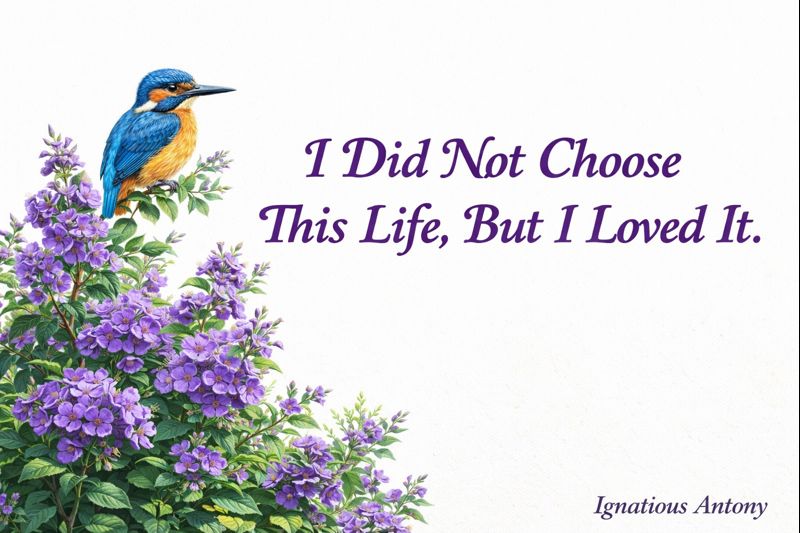
I Did Not Choose This Life, But I Loved It
I did not choose this life,
It came like monsoon rain to a waiting field,
unasked, unstoppable,
yet knowing exactly where to fall.
Some days it felt like a train at dusk,
moving through small stations and long silences,
Its whistle carries both arrival and departure
across the wet breath of evening.
Other days it opened
like a sudden clearing in a forest,
light falling without warning,
my heart widening
like a window thrown open to the wind.
I was handed joys
the way birds are handed wings,
without instruction,
only the urge to trust the air
and leap.
Pain arrived more slowly,
shaping me the way rivers shape stones,
patient, repeated,
until resistance became a form.
I learned that holding on
is like gripping smoke,
the tighter the fist,
The faster it disappears.
So I opened my hands,
and let life pass through.
Gratitude arrived quietly,
like evening lamps being lit one by one
along a village road,
not bright enough to blind sorrow,
but enough to walk by.
I stopped asking life to explain itself.
I listened instead,
as one listens to rain on tiled roofs
or oars dipping into backwater silence.
knowing that not every wave must be understood
to be honoured.
In the end, I did not conquer this life.
I lay my head against it
the way tired travellers lean into trees,
trusting their strength
without naming it.
I did not choose this life.
But I loved it,
as the earth loves the weight of rain,
as the shore loves the leaving wave,
as the heart loves even what breaks it
because it once made it whole.
A Reflection on “I Did Not Choose This Life, But I Loved It”
This poem speaks from a place of quiet maturity. It is not the voice of someone who is still fighting life or trying to shape it according to desire. It is the voice of someone who has lived long enough to see that life does not ask for permission. It arrives. It moves. It leaves marks. And yet, it deserves love.
The opening lines make this clear at once. Life is compared to monsoon rain, something that cannot be controlled, delayed, or negotiated with. Rain does not ask the field whether it is ready. Still, the field knows how to receive it. In this image, life is not cruel or random. It “knows exactly where to fall.” There is a quiet faith here: even when life feels overwhelming, there is a sense that it is not careless.
The image of the train at dusk deepens this feeling. Trains move forward whether we are ready or not. They stop briefly, then continue. Small stations and long silences suggest phases of life that seem insignificant at the time but later carry meaning. The whistle holding both arrival and departure reminds us that every beginning already carries an ending within it. Joy and loss travel together. The poem does not resist this truth. It accepts it gently.
Then the poem opens into light. The forest clearing is a powerful image of unexpected grace. Sometimes life suddenly gives clarity, beauty, or peace without warning. The heart widening like a window suggests surrender rather than effort. The poem tells us that some of the best moments in life are not earned or planned. They simply arrive when we stop bracing ourselves.
Joy, in this poem, is not taught. It is handed, like wings to a bird. There are no instructions. No guarantees. Only trust. This is an important insight: joy is not something we master; it is something we dare to enter. The leap matters more than certainty.
Pain is treated with equal honesty, but without bitterness. Pain arrives slowly, like a river shaping stone. The word patient is important here. Pain does not hurry. It returns again and again, not to destroy, but to shape. Resistance slowly turns into form. This suggests that suffering, while unwanted, gives depth and character to a life lived fully.
The poem then reaches a turning point: the realisation that holding on does not protect us. Gripping smoke is a perfect image for control. The tighter the grip, the quicker it disappears. This is where surrender begins, not as defeat, but as wisdom. Opening the hands allows life to pass through instead of breaking us.
Gratitude appears quietly, not as a celebration, but as lamplight. It does not erase sorrow. It does not pretend darkness is gone. It simply makes the path visible. This is a very human kind of gratitude, humble, practical, and sufficient. Enough to walk by. Enough to continue.
One of the most important moments in the poem is when the speaker stops asking life to explain itself. This is not resignation; it is peace. Listening replaces questioning. Rain on tiled roofs and oars in backwaters are sounds that do not demand meaning. They only ask for presence. The poem reminds us that not everything must be understood to be honoured. Some things are sacred simply because they exist.
In the final lines, the poem rejects the idea of victory over life. There is no conquest here. Instead, there is rest. Leaning into life like a tired traveller leans into a tree is a beautiful image of trust. The tree does not speak. It explains nothing. Yet it holds.
The ending returns to the opening truth, now transformed. The speaker still did not choose this life. That has not changed. What has changed is the relationship with it. Love is no longer conditional. It is like the earth loving rain, even when it is heavy. Like the shore loving the wave, even as it leaves. Like the heart loving what once broke it, because breaking also meant being opened.
This poem is ultimately about acceptance without bitterness, gratitude without denial, and surrender without weakness. It does not romanticise pain or glorify struggle. It simply says: this life came, it shaped me, it stayed, it left, and through all of it, I loved it.
That quiet declaration is the poem’s greatest strength.