
A Perfect Speech, One Minute Too Early
A Perfect Speech, One Minute Too Early
I still remember that evening very clearly.
It was the send-off meeting for our parish priest.
The meeting was fixed for four o’clock in the evening, which in village time usually means anytime between four and five. Everyone knows that clocks move faster than people in the high ranges.
By four sharp, almost the entire parish had gathered.
Children occupied the front rows, swinging their legs and whispering secrets that could not wait till home.
Sunday school students came in neat uniforms, already tired because it was not Sunday.
Women sat in small groups, softly discussing who cooked what for lunch and whose curry turned out better.
Older men chose seats near the sides, adjusting their mundu again and again, just to look busy and important.
Plastic chairs were arranged in straight lines, though within five minutes none of them were straight.
A microphone stood proudly on the stage and was tested at least five times.
“Check… check…” echoed through the parish hall, frightening a few children and one sleeping old uncle.
The meeting finally started around 4:30 pm, mainly because the MLA had not arrived yet.
He was supposed to make a speech and present a memento to the priest.
The welcome speech was done neatly and quickly.
Everyone clapped politely.
Now it was time for the MLA to speak.
But the MLA was not there.
People started looking at the gate.
Nothing.
Someone looked down the road.
Still nothing.
After some waiting, someone suggested that the secretary of the women’s wing( Mathruvedhi) should speak meanwhile.
She stood up confidently, adjusted the microphone twice, and began.
She spoke very well.
She spoke about the priest’s kindness, his simplicity, his love for the poor, and, most importantly, his punctuality.
She spoke for fifteen minutes.
People listened patiently.
Some children counted the ceiling fans to stay awake.
Even after that, the MLA had not arrived.
Then the outgoing Vicar stood up and said calmly,
“I will make my speech now. I hope before I finish, the MLA will come.”
Everyone smiled.
In village life, hope is often used when time is missing.
Father adjusted his cassock, cleared his throat, and began.
“My dear sisters, brothers, elders, and children,” he said gently.
“This is my first assignment as a parish priest after I was ordained.”
People leaned forward.
“To be honest,” Father continued, “I was very afraid to come here as Vicar.
This is a big parish.
I felt I was too young and inexperienced.”
He paused and smiled.
“Only after much encouragement from my Bishop did I agree to come.
Your previous Vicar was a very good man. He told me many good things about you.
At the same time, he cautioned me too.”
Then Father became a little serious.
“On the very first day,” he said, “I sat in the confession room.
A man came to me for confession.
He was the first person I heard confession from in my priestly life.”
Now everyone was listening carefully.
“He told me it had been more than a year since his last confession,” Father said.
“He also told me that there was no sin that he had not committed.”
People looked at each other.
“Then,” Father continued slowly, “he told me that once, as part of a crowd, he was involved in a murder.”
The hall fell silent.
Even the ceiling fans seemed to slow down.
Sometimes silence speaks louder than the microphone.
Father paused.
“I became very frightened,” he said honestly.
“After that confession, I wanted to run away from this parish.”
Some people smiled nervously.
“But the Bishop did not allow me to leave,” Father said.
“So I stayed.”
Then his face brightened.
“But I want to tell you something today,” he said.
“In all these years here, I had only one such incident, and that was that one.”
People relaxed.
“After that,” Father said warmly, “every person I met in this parish was a good person. Very good people.”
Everyone clapped.
“I will not tell you who that person was,” Father added.
“I should not, and I cannot.”
He smiled again, folded his hands, thanked everyone, and ended his speech beautifully.
The hall was filled with applause.
People felt proud.
Some even wiped their eyes.
In village gatherings, emotions travel faster than facts.
Just then, a car stopped outside.
The MLA came running inside, sweating and breathless.
He was in his early fifties, slightly tall and stout, with a face that showed both apology and hurry.
He climbed the stage quickly and apologized again and again.
“I am very sorry, Father.
I am very sorry, dear brothers and sisters,” he said.
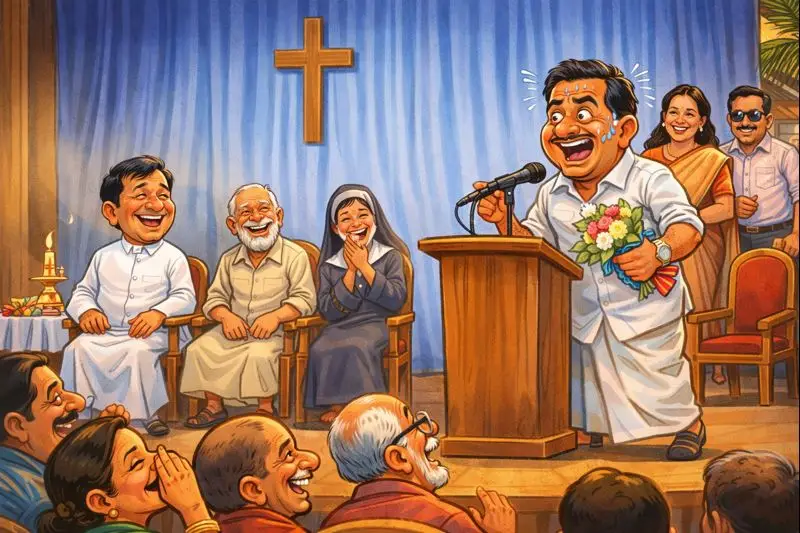
Then he began his speech.
“I have never seen such a holy priest in my life,” the MLA said.
“So simple.
So kind.
So pure.”
Father smiled politely.
“I had many opportunities to interact with him,” the MLA continued.
“A very practical and mature priest.
A loving and caring person.”
Then he added confidently,
“Actually, I was the first person to go for confession to this priest in this parish.
It was on the very first day he took charge.”
For one second, there was silence.
Then the entire hall exploded with laughter.
Grown-up children laughed loudly.
Women covered their mouths and laughed.
Older men shook their heads and laughed silently.
The MLA stood smiling, not knowing why everyone was laughing.
Father looked down at the microphone and smiled to himself.
That day, everyone learned a simple truth:
Truth has a sense of humour.
And timing, like confession, matters a lot.
And above all,
Always come to meetings and functions on time.
“Some truths wait patiently; others arrive exactly on time.”
.