
The Room With One Window
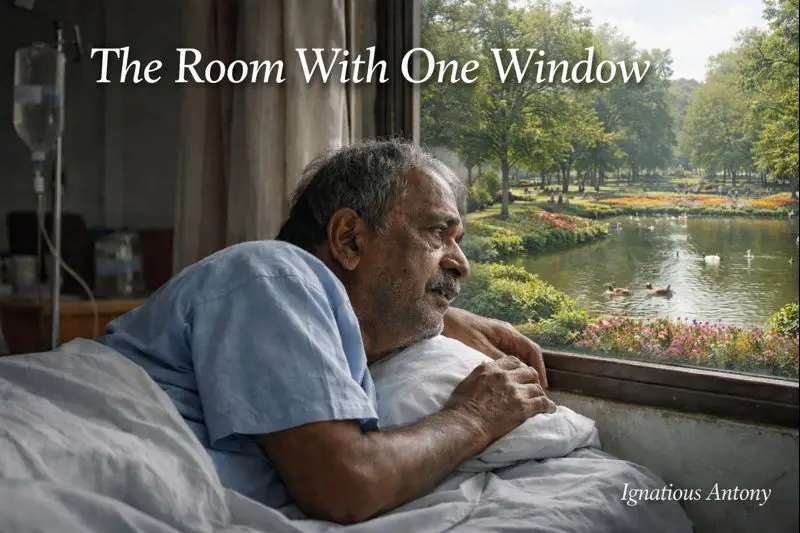
The Room With One Window
Joseph Mathew was admitted to the hospital just before midnight.
At that hour, the corridors were hushed, as if even illness had learned to whisper. The fluorescent lights glowed softly, not harsh like the daytime ones, but tired—like they too had seen too much suffering and were trying to be kind.
The nurse wheeled him into a narrow room with two beds. One was empty. The other stood beside the only window in the room. Without ceremony, Joseph was placed there.
Joseph was sixty-eight, a retired schoolteacher who had once spent his days explaining the mysteries of language and numbers to restless children. Now his lungs had turned against him. Fluid had slowly filled his chest, pressing against every breath, making even silence feel heavy. Speaking left him breathless. Laughing ended in coughing fits. Yet his face carried an alertness, as if some part of him was still looking outward, still curious about life.
“You’ll need to sit up for one hour every afternoon,” the doctor told him gently. “It will help drain the fluid from your lungs.”
Joseph nodded. He did not ask why his bed was beside the window. At that hour, when one is too tired to argue with the body, fate rarely explains itself, and we rarely ask.
Four days passed.
On the fifth morning, another bed was rolled into the room.
Bhaskaran Nair arrived quietly, almost apologetically, as though he did not want to disturb the air already thick with illness. He was fifty-five, once strong, once known for his long walks and restless energy. A spinal illness had taken that life away. He could not sit up. He could not turn without sharp pain. Flat on his back, he lay staring at the ceiling, a white, unchanging surface that had slowly become his sky.
As the nurses adjusted tubes and whispered instructions, Joseph turned his head slightly.
“Looks like I’ve finally got company,” he said, his voice soft but warm.
Bhaskaran Nair moved his eyes toward the sound.
“I was beginning to think I’d forgotten how another human face looks,” he replied faintly.
Joseph smiled, then paused to catch his breath.
“What brings you here?” he asked.
“My back,” Bhaskaran Nair said. “Or what’s left of it. And you?”
“Lungs,” Joseph answered. “They don’t know how to let go anymore.”
There was silence for a moment. Not the awkward kind. The kind that settles gently between two people who understand pain without explanation.
“Well,” Bhaskaran Nair said at last, “at least we can talk.”
And so they did.
They spoke slowly at first, in broken pieces, between coughs, between waves of pain. They spoke of wives waiting at home, pretending to be strong on phone calls. Of children sending messages they could not properly reply to because typing hurt too much. They spoke of small things: the smell of morning tea, the sound of rain on tiled roofs, the strange comfort of sleeping without fear, once, long ago.
Each afternoon, nurses helped Joseph sit up.
“Oof,” he would say, gripping the bed rail. “Another appointment with gravity.”
Bhaskaran Nair listened intently.
“What do you see today?” he asked one afternoon.
Joseph turned his face toward the window.
“There’s a park,” he said slowly, carefully, as if opening a door with words. “A wide one. And a lake in the middle. The water is calm today—like it’s holding its breath.”
Bhaskaran Nair closed his eyes.
“Please… go on.”
“There are ducks,” Joseph continued. “They splash about noisily, arguing over nothing. And swans, quiet, dignified. They move as if they belong to another world.”
Bhaskaran Nair smiled faintly.
“I think I’d like the swans,” he said.
From that day, the hour by the window became sacred.
One afternoon, Joseph said, “Children today. They’re sailing toy boats. One boy keeps losing his. His father pretends not to notice, but quietly brings it back.”
Bhaskaran Nair swallowed.
“Some lessons,” he said softly, “are taught by silence.”
On warmer days, Joseph spoke of flowers, reds and yellows and blues, so bright they seemed unreal against hospital white. He spoke of young couples swimming hand in hand, walking slowly, as if time itself might break if rushed.
“Funny thing,” Joseph once said, “how people outside walk as though life is endless.”
Bhaskaran Nair replied, “Maybe that’s how life protects itself, from thinking too much.”
One afternoon, Joseph grew animated.
“There’s a parade today,” he said. “Bands, drums, flags. People clapping, smiling.”
Bhaskaran Nair breathed deeply.
“I can almost hear it,” he whispered.
Joseph shook his head gently.
“No. But you can see it. Sometimes, seeing is more than enough.”
Weeks passed.
Pain did not leave. But something else stayed, companionship. The kind that does not demand strength. The type that quietly says, You are not alone.
One night, Bhaskaran Nair spoke in the dark.
“These afternoons… they remind me that life is still happening somewhere.”
Joseph was quiet for a long moment.
“That’s why I tell you,” he said at last. “Because life is meant to be shared. Otherwise, it disappears unnoticed.”
The next morning, the nurse entered the room and stopped.
Joseph lay still. Peaceful. As though he had stepped into one of his descriptions and chosen to remain there.
Later that day, when the bed by the window stood empty, Bhaskaran Nair spoke.
“May I… move there?” he asked quietly.
The nurse nodded and helped him, slow and careful.
When she left, Bhaskaran Nair gathered all his strength. His heart raced. His breath trembled. He lifted himself slightly and turned his head toward the window.
And saw only a wall.
Grey.
Bare.
Close.
When the nurse returned, Bhaskaran Nair asked, his voice barely holding together,
“There was never a park… was there?”
She shook her head gently.
“No,” she said. “Joseph was blind.”
Bhaskaran Nair lay back slowly, staring upward.
He understood then.
Sight is not what lets us see.
Love does.
And sometimes, the greatest kindness a human being can offer is to give another person a world,
even when they themselves have never seen it.