
Where Rockets Rose, and Lives Stayed Still

Where Rockets Rose, and Lives Stayed Still
This morning, at seventy-one, my day began like any other quiet day in my retired life.
I woke up slowly, rubbing my eyes and sitting on the edge of the bed for a moment, letting my body adjust to the new day.
The house was still peaceful, the kind of silence you only get after crossing seventy.
I did my small morning routines — a few stretches for my stiff back, a short round of breathing exercises, and then my usual walk through the narrow lane outside my house.
The air was cool.
Crows were calling from the electric wires.
A few newspaper boys were cycling past, throwing rolled papers onto verandas.
I walked at my slow, steady pace, greeting the familiar faces of other retirees who walked with their hands behind their backs.
After the walk, I came home, washed my face, and sat at the table for breakfast — a simple meal of idlis, coconut chutney, and my one unavoidable cup of hot, strong tea.
Breakfast is always unhurried these days.
No office to rush to, no deadlines, no files waiting.
Just time… gentle, slow time.
Then I moved to my favourite spot — the old relaxing chair near the window.
Every retired man has one such chair.
Mine creaks a little when I sit on it, but it holds me like an old friend.
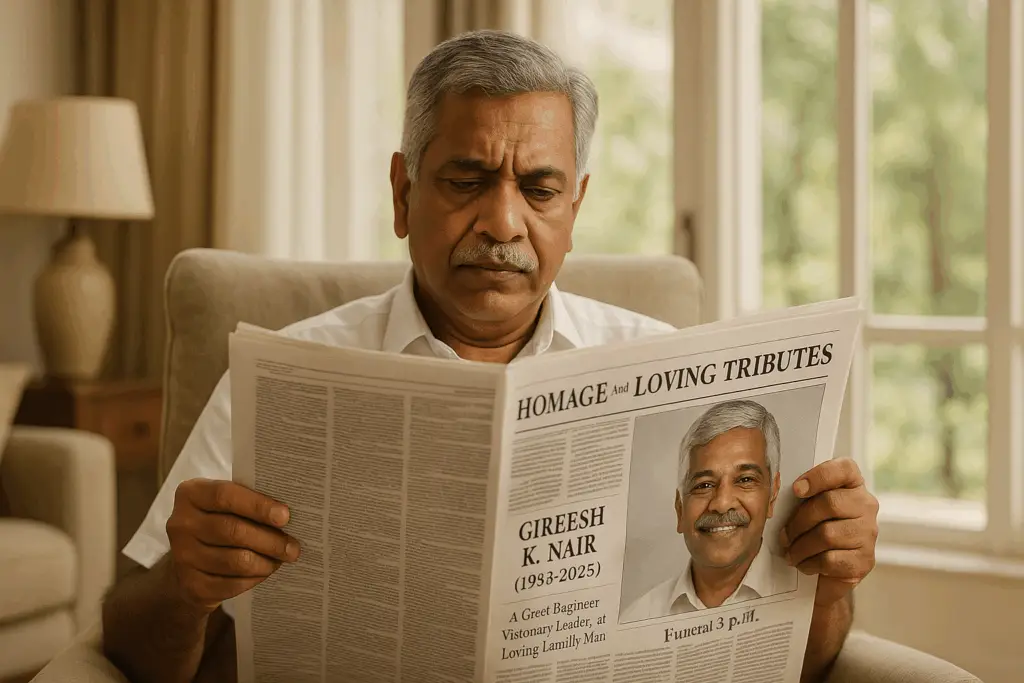
As always, I picked up the morning newspaper, folded neatly by the gate, and opened it with slow, sleepy care.
I expected the usual — politics, local events, maybe some cricket news.
At this age, you learn to move gently through the day, without expecting anything surprising.
But then my eyes froze.
On the right side of the front page, there was a huge photograph.
A familiar face.
Sharp jaw. Confident smile. Well-combed hair, still thick even with grey.
My breath caught for a moment. Below the picture, in bold, heavy letters:
Homage and Loving Tributes to
“Gireesh K. Nair – (1953–2025)
A Great Engineer, Visionary Leader, and Loving Family Man.
Funeral at 3 p.m. today…”
I felt the world around me turn still.
It was my Gireesh. My old colleague. My old friend.
Gireesh and I worked together at the Space Centre in Thiruvananthapuram, that sacred place where dreams of fire and sky were quietly shaped, far from public applause.
For seven long years, he sat beside me, sharing the same bench, the same solder fumes, the same frustrations, and the same thin pay packet that barely kept rice in our tins and light in our homes.
He was my thickest friend—my brother in white shirts and low salaries, my companion in those hungry young days when ambition was big but pay was small.
Two young men trying to build machines for the sky, while our own pockets barely touched the ground.
And yet, we were happy. We shared bench space, test benches, jokes, frustrations, and even small dreams. There was a strange, sweet innocence in those days.
We were both engineers in a prestigious organisation, handling delicate rocket parts, with hands that sometimes trembled, not because of fear, but because our lunch break had been skipped again.
We were two young men, yet our salaries were so low that our pockets often felt like empty temple bells—hollow, echoing, promising sound but producing none.
He was the boy who laughed loudly in design meetings, who teased seniors without fear,
who borrowed money from me and eventually paid it back, who ate extra vadas from the canteen and made me pay.
But I never minded. He had a charm that made even irritation feel like friendship.
And then he became the man who flew into the Gulf sky, while I remained rooted on Kerala soil, safe, stable… and maybe a little foolish.
Now, this morning, when I saw his obituary photo in the newspaper, a large portrait staring at me from the front page, I placed the paper on the table slowly, as if it were made of glass.
I leaned back in my old chair, closed my eyes, felt something heavy sit inside my chest, and time loosened its hold on me.
And then a memory, soft as a curtain moved by the wind, opened before me. Memories opened themselves like an old film reel. Slowly, gently, showing me a boy I once was.
I saw myself again, not as a seventy-one-year-old retiree, but as a thin, serious, twenty-eight-year-old engineer with neatly combed hair, a pen always in the shirt pocket, a salary barely strong enough to carry me through the month, and a heart full of quiet, hidden dreams.
I saw the old lab. The oscilloscope glows, the soldering iron’s smell.
The endless design reviews where we fought over reliability, redundancy, margins, bit flips, power budgets, and vibration profiles.
The failure analysis meetings were where a single burnt chip could keep twenty engineers awake for three nights. The long days when the clock hit 11 p.m., and the guards asked,
“Sir, ithiri polum poyi rest edukkande?” (“Sir, shall we at least go rest now?”)
I remembered how we celebrated small victories, a corrected waveform, a stable test,
a subsystem passing thermo-vac. We cheered like schoolboys because our names were rarely in newspapers, and our successes were hidden behind seven walls of secrecy.
And in the middle of all those intense, exhausting, beautiful years, there was always Gireesh.
Always dreaming big. A little louder than the rest of us. A little more mischievous. Always joking, always laughing, always talking about “big life” and “foreign chance.”
Always saying, “Anto, nammal evideya? We can do much more. Big life awaits. Foreign chance undengil adi polikkam!”
(“Anto, what are we doing here? We deserve more. If we get a foreign chance, life will explode beautifully.”)
And then one day, when I was soldering a connector, he burst in, he walked into the office with shining eyes. Eyes that were too excited to hide anything.
“Anto… I got it,” he whispered breathlessly.
“Got what?” I asked, without looking up.
“A Gulf posting. Dubai.”
He paused, letting the word “Dubai” fall like a golden coin. “Big company. Big money.”
My hand froze over the solder joint.
I still remember the way he leaned on my table. His voice was trembling with joy, his shadow shaking slightly under the fluorescent tube light.
He told me about his uncle. His connections. The recommendation letters. The interviews.
The promises. The starting salary is eight times our pay.
Eight times. He said it casually, but that number stayed in my ears like a humming transformer.
“I’m resigning,” he said, just like someone saying, “I’m stepping out for a tea.”
I forced a smile. “That’s good, Gireesh. You have courage.”
But deep inside, my heart was shivering like a leaf in December wind.
I had a wife. A baby on the way. Ageing parents.
Loans. Responsibilities shaped like chains.
Dreams shaped like birds with tied wings.
He had wings. I had weights. Within a month, he was gone.
We gave him a small farewell in a stuffy meeting room, plastic chairs borrowed from the canteen, tea in steel tumblers, Samosas that tasted more of onion than potato, and a cheap wooden memento with his name misspelt.
He laughed loudly through the whole thing, slapping backs, cracking jokes, already dreaming in dirhams.
On his last day, I went to Thiruvananthapuram Airport to see him off.
The departure hall was full of young men like him, shiny new suitcases,
fresh passports, perfumed shirts, and mothers wiping tears with their saree pallus.
He wore a slightly better shirt than usual, tucked in neatly, and held a brown leather bag as if it contained his future.
Before leaving, he pressed my shoulder and said,
“Don’t worry, Anto. I’ll come back like a king. You wait and see.”
I nodded, smiling. I wished him all the best.
Then, with that familiar half-joking grin, he added: “Next time you see me, you’ll want my autograph!”
I laughed. I thought it was just a joke. But when I opened today’s newspaper, Forty-three years later, And saw his photograph, huge, grand, decorated with words of praise…
I realised something: Maybe he had not been joking at all.
Seven years passed.
Not loudly, not dramatically, just one quiet day lying over another, like thin sheets slowly forming a thick file.
I continued in the same Space Centre, in the same laboratories where the smell of solder, flux and hot cables felt like the scent of my second home.
Where rockets grew one, bolt at a time, and engineers grew one sleepless night at a time.
I got a few promotions, slow, careful, spaced out like rare stars on a monsoon sky.
Enough to run a home decently, to pay school fees, to buy vegetables without bargaining too much, to give my family a life of dignity, not luxury, but dignity.
My work became deeper, my responsibilities heavier.
I designed circuits that whispered to rockets. I built test systems that caught failures before they became disasters. I sat through countless design reviews, where one senior would praise me in the morning, and another would tear my diagram apart in the afternoon.
But still, when a subsystem passed its final test, my heart swelled like a balloon in a child’s fist.
Many nights, I walked out of the Main Gate at 10 p.m., Shirt wrinkled, eyes burning,
but with the quiet pride of a man who had contributed something to a machine that would one day touch the sky.
Outside the Space Centre, life unfolded at its own slow rhythm.
We rented a small house in Thiruvananthapuram—
two rooms, one hall,
a kitchen facing a mango tree that dropped unripe fruits on rainy nights.
My wife Anitha, a lovely girl from Aluva with soft eyes and a smile that calmed storms, and I had a happy, uneventful life, with small pleasures. Our little boy and girl came soon after. They had bright eyes, restless legs, running around the house as if trying to outrun the limits of our small income.
Life was simple. Sometimes sweet like jaggery, sometimes tight like a shirt after too many washes.
Books and poetry remained my secret refuge. On Sundays, when the ceiling fan hummed and the house settled into its afternoon lull, I would take out an old English poetry book,
its pages are yellowed like dried jackfruit chips, and let the words fill my small life world
with beautiful sadness.
Then, on an ordinary afternoon, while I was writing a report on a failed test, the black office telephone rang.
Personal calls on that phone were rare, so rare that my heart jumped like a schoolboy caught by the headmaster.
“Hello?” I said. A loud, polished voice boomed across the line:
“Anto boy! Recognise the voice, or should I send a visiting card through the wires?”
My heart stopped for a beat. “Gireesh!” I blurted out.
His laughter filled the receiver, full, rich, carefree.
“I’m in Thiruvananthapuram, macha! Landed yesterday. Only for a few days.”
I could almost see his wide grin through the phone.
“Tonight we meet. Seven p.m. sharp. Front of Hotel Sea Crown at Kovalam Road.”
Sea Crown…
I had passed that place many times, foreign tourists, jasmine-scented women,
Men who walked in wearing wealth on their wrists and necks.
A world far from my salary, my life, my possibilities.
“Seven o’clock sharp,” he said again.
For the rest of the day, my pen wrote, but my mind floated.
How would he look? What stories would he bring from Dubai?
Would he still be my Gireesh, or a polished stranger wearing foreign perfume?
I looked out of the Space Centre window.
Engineers stood arguing with diagrams in their hands.
A soft sadness came and sat beside me, resting its head on my shoulder.
Had I been too safe? Too timid? Too afraid to leap?
Then another voice whispered gently inside me:
“You have a family. You have respect. You have stability. You are not great,
but you are safe.”
Both thoughts lived inside me, like two old crows sitting on the same branch—
quietly fighting, never leaving.
By 6.30, I was walking fast toward Sea Crown. The Thiruvananthapuram sky wore its evening colours, orange bleeding into pink, pink melting into purple.
Couples walked along the beach railings. Children chased balloons. Vendors called,
“Chips! Groundnut! Masala kadala!”
I reached the hotel porch.
Immediately, I felt like a small village man, lost in a palace courtyard.
Expensive cars glided in. Men in crisp shirts.
Women in shimmering sarees. Perfume drifting in the air like a foreign wind.
I looked down at myself, a light-blue shirt, old trousers, and polished but tired shoes.
I felt suddenly very…small.
Behind me, a voice laughed: “Anto, is it you or your ghost?”
I turned. There he stood. Gireesh!.
Not the thin young engineer I had worked with, but a man shaped by wealth and foreign winds.
Broader chest, fuller face, fairer skin, gold on his wrist and at his neck, confidence flowing from him like perfume.
But his smile, his smile, remained unchanged. Wide, bright, overflowing with life.
He hugged me firmly, patted my back as if he were a victorious warrior returning home.
“Come, come,” he said, “This is not a place to stand like KSRTC conductors.”
Inside, cool air kissed my face. Soft Western music drifted around us.
Shelves filled with colourful bottles shone under dim lights, like jewels waiting to be chosen.
He ordered whisky with the swagger of a king. He laughed loudly.
He spoke as if the world were in his pocket.
And I watched, a quiet engineer from Thiruvananthapuram trying to fit into a world built in Dubai.
He talked of multi-crore projects, foreign trips, Cars that moved like silent tigers,
weekends in five-star hotels, circles of friends where money flowed like water.
I listened, proud of him, yet shrinking inside.
Inside me, two Antonys wrestled,
the one who was happy for his friend,
and the one who felt painfully small.
Much later, when we parted,
he hugged me once more.
“Don’t work too hard for that small salary, Anto,” he laughed.
His big car came and took him away like a ship leaving the shore.
And I walked to the bus stop, the same bus stop that had carried my tiredness for years.
When I reached home that night, the house felt smaller than usual,
as if my footsteps had grown too big after walking through the shining floors of Sea Crown.
The tube light flickered once before settling into its tired glow.
The plastic chairs looked old. The curtain near the kitchen swayed in the fan breeze, showing tiny tears at the edge that I had promised to stitch months ago.
Anitha was waiting. Not with anger, but with that quiet disappointment
that hurts more than shouting.
“You forgot the tea powder,” she said softly, her voice flat from waiting too long.
I looked at the empty kettle, the cups placed neatly on the tray, as if they had been waiting for me to bring home a little warmth.
Before I could even explain, she took her small purse, placed our sleeping son gently into my arms, and said,
“Don’t wake him. I’ll get the tea.”
She stepped out, and the door closed behind her with a soft but painful click.
I sat in the small hall, holding my son. His little breath brushed my neck,
warm and trusting. His hair smelled of coconut oil, fresh powder, and something pure,
a smell that reminds you that life is more than your salary slip.
On the table,
beside the steel tumbler and the poetry book, stood a framed photograph of Anitha.
She was wearing the light blue blouse I had once bought for her, after sweating for half an hour in the ladies’ section of a crowded shop near East Fort.
That day I had felt like a thief in a queen’s palace, not knowing where to look,
how to stand, how to speak.
The salesgirl had piled blouse after blouse in front of me. My fingers had trembled
when I handed over the money.
I had forgotten to collect the change, and the cashier had to call me back.
When Anitha wore it for the first time, her smile had filled the whole house.
She kissed me and said, “It’s pretty. Very pretty.”
But when I looked at that same photograph now, after listening to Gireesh speak of foreign wives, foreign clothes, foreign holidays, the picture suddenly felt…ordinary.
A slight shame pricked my heart. Shame not for her, but for myself for letting such a thought even visit my mind.
I forced my eyes away and opened an old poetry book lying on the table.
The pages smelled of time and dust and forgotten dreams.
The lines were beautiful, full of moonlight and musicnand sadness that seemed too large
for my little rented house.
Could I ever write like that?
Could I write about my life?
the lab reports,
the test benches,
the late-night buses,
the silence after my son sleeps,
and the soft pain of comparing myself
with someone who flew too high?
Before I could read further, my son suddenly woke. His small body stiffened.
His lips trembled. And then he cried, loud, sharp, as if the whole weight of my confusion
had settled on his tiny chest.
I tried to rock him gently. “Shh… shh… pappa’s here…” But he cried harder.
The sound hit my ears like stones thrown at a tin roof. The whisky in my blood, the comparison in my mind, the guilt in my heart, everything rose like fire.
Without knowing what I was doing, I shouted,
“STOP!”
For one second, the world froze.
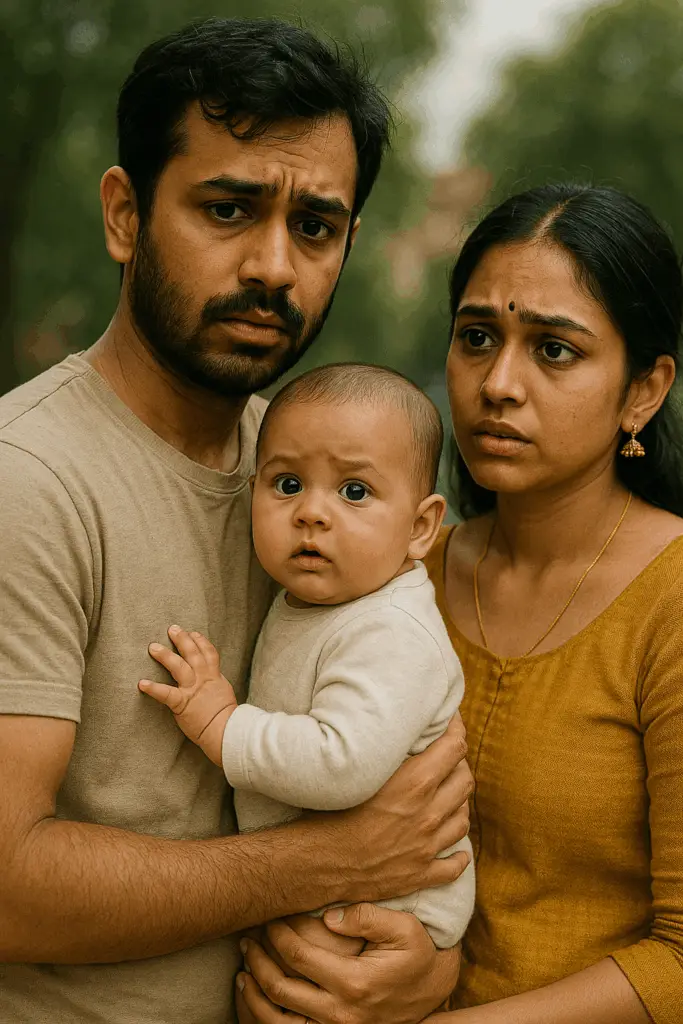
The child’s eyes widened in pure fear. His tiny mouth opened, no sound came.
Then a louder, heartbreaking cry burst out.
My heart cracked. I stood up, walking fast across the small hall, whispering “Sorry… sorry… sorry…” again and again.
But the crying grew harder, shaking his whole little body.
Just then, the door swung open.
Anitha rushed in, panting. “What happened?” she cried.
She grabbed the child from my arms. He clung to her like a frightened kitten. His sobs tore the silence of our tiny home.
She looked at me with eyes full of fear and accusation “What did you do to him?”
“I… I… I didn’t…” I stammered, the words stumbling out like broken stones.
“He just cried… and I… I shouted…”
She didn’t listen. Her whole world was in her arms, rocking, comforting, whispering,
“Ente kunje… my little one… Amma is here…Amma’s here…”
I stood against the wall, half in the yellow light, half swallowed by shadow.
Tears filled my eyes, but not just for the frightened child, not just for Anitha.
I cried for myself,
for the young engineer who had never left Thiruvananthapuram,
for the man who watched his friend return as a prince,
for the small life I had chosen
with trembling hands out of fear, duty, and love.
I felt like a prisoner. Not trapped by my family, nor by my job, nor by my income.
Trapped by my own timid heart.
Now, at seventy-one,
I sit in my old, relaxing chair near the window, today’s newspaper spread open before me.
The morning sunlight falls across the page like a soft, tired blessing.
And there he is.
A large photograph, smiling at me from the obituary column.
A familiar face, yet distant now, like a star you once saw up close but can never touch again.
“Gireesh K. Nair (1953–2025)
A Great Engineer, Visionary Leader, and Loving Family Man
Funeral at 3 p.m. today…”
For a long moment, I simply looked at his photograph without breathing.
His confident smile, his sharp jaw, his hair is still thick despite the grey, even in death,
he looked successful.
He looked like a man who had conquered the world and left behind a story big enough
for people to print in thick, bold letters.
I slowly placed the paper on the table and leaned back.
My eyes closed on their own, not in sleep, but in surrender.
And instantly, that evening at Sea Crown, the shouting of my little son, Anitha’s frightened face, and the ache in my heart, all returned like a monsoon wind I had tried to forget.
I sat there quietly,
listening to the ceiling fan turn and to the distant sound
of a temple bell ringing somewhere far away.
Seventy-one years behind me. So many moments lost. So many moments saved.
A life lived slowly, deliberately, on Kerala soil.
As I stared again at Gireesh’s photograph, a strange feeling rose inside me,
not jealousy,
not regret,
not pride,
not anger.
Just a deep, soft sadness.
And beside it, surprisingly, a gentle gratitude.
Because now, after so many years, I can finally see our lives clearly, side by side,
like two parallel lines drawn on a school notebook.
Gireesh’s life soared high, with gold bracelets, foreign postings, multi-crore projects, international awards, photographs in newspapers, and a funeral that would gather crowds.
My life stayed low, file bundles, rocket tests, a rented house turned into own house, evenings of rice and curry, a wife who waited with warm tea, two children who grew under coconut trees.
He lived like a firecracker, loud, bright, burning fast.
I lived like a small oil lamp, quiet, steady, glowing even when the wind was strong.
Who won? Who lost?
Perhaps such questions have no relevance.
But I do know one thing:
Today, as an old man, when I look back, I feel no bitterness in my chest.
Only a soft ache, like an old injury that no longer hurts but still remembers.
And yes… a warmth.
A deep, unexpected warmth.
Because somewhere between
Gulf dreams and government files,
between hotel lights and tube lights,
between big money and small joys…
I remained Anto,
a small man, maybe,
but a man who loved and was loved in a very simple home
on the red-soiled land of Kerala.
And something tells me that is also a kind of success.
A quiet success. A humble success. A success without noise.
One that never appears in newspapers… but lives forever in the hearts of the people who walked with me.