
The Saucer That Sold 547 Cats
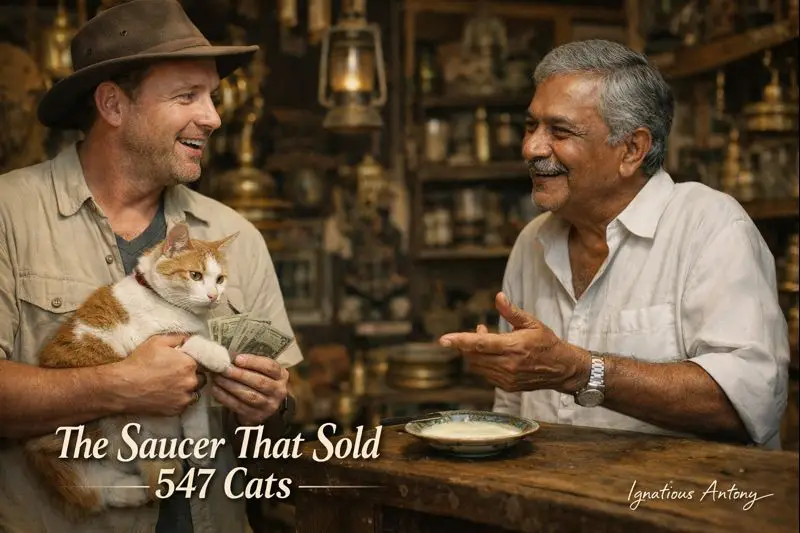
The Saucer That Sold 547 Cats
John Smith was a foreign visitor from Australia. He had come to Kovalam, a beach tourist destination near Thiruvananthapuram, Kerala, India, for a quiet holiday, to walk along the beach, watch the waves, and escape the noise of city life. John also had a private hobby.
Wherever he travelled, he searched for old things. Antiques fascinated him, not just because they were valuable, but because they carried stories.
One afternoon, while wandering through the streets of Trivandrum, he noticed a small antique shop tucked between two buildings.
The shop looked old, unpolished, and almost forgotten. A simple board hung outside. Curiosity drew him in.
The shop belonged to Krishnan Nair, a veteran shopkeeper with neatly combed grey hair, a calm face, and simple clothes.
He did not look like a man who dealt in valuable antiques. He looked more like someone who had seen many seasons and had nothing left to prove.
John walked around the shop carefully. Brass lamps. Wooden chests. Old clocks that had forgotten time. He examined each item closely but found nothing special.
Nothing worth carrying back to Australia, he thought.
As he turned to leave, his eyes fell on a cat sitting near the door.
The cat was drinking milk from a saucer placed on the floor.
John’s steps slowed.
The cat was ordinary.
The milk was ordinary.
But the saucer was not.
John’s heart beat faster. He recognised it instantly. The shape. The glaze. There is a fine crack along the edge. This was no ordinary dish. This was a rare antique, quietly resting on the floor, doing the work of a milk bowl.
What luck, John thought.
This man has no idea what he owns.
Sometimes the best treasures hide where knowledge does not.
He reminded himself to stay calm.
Do not rush. Do not smile. Do not let excitement speak, he warned himself.
Appear casual. Appear bored.
Turning back, he spoke gently to Krishnan Nair.
“That’s a nice cat you have,” John said, pointing casually.
“Would you be willing to sell him?”
Krishnan Nair looked at the cat, then at John.
“Well,” he said slowly, “five hundred rupees, perhaps.”
John did not bargain. He paid immediately. He picked up the cat, feeling satisfied.
The saucer will come next, he thought. This will be easy.
Then, as if it were an afterthought, John said,
“I might as well take the saucer too, since the cat is used to drinking from it.”
Krishnan Nair shook his head calmly.
“No, sir. The saucer is not for sale.”
John smiled politely.
“I’ll pay more.”
“No.”
“But why?” John asked, now truly curious.
Krishnan Nair smiled, not proudly, not sharply, but with the quiet confidence of a man who knows exactly what he is doing.
Then he said:
“Because with that old saucer, I have already sold more than five hundred and forty-seven cats.”
For a moment, John stood silent.
The sea breeze from Kovalam suddenly felt less clever.
In that instant, John understood something important.
“Wisdom does not always announce itself.”
And another truth gently settled in his mind:
“Never judge a man by the simplicity of his clothes or his shop.”
John left the antique shop holding a cat, but carrying a lesson far more valuable than any souvenir.
The message is clear:
We often take people for granted.
We mistake simplicity for ignorance.
We forget that experience quietly sharpens the mind.
As an old saying reminds us:
“The sharpest knife is often kept in the simplest sheath.”
And somewhere in Trivandrum, in a small antique shop, an old saucer continued doing its work, teaching lessons, one visitor at a time.