
The River’s Gift
The River’s Gift
That summer, I was staying in a small, fading country house near Arattupuzha, where the Karuvannoor Puzha bends quietly through coconut groves and paddy fields.
The house stood a little away from the road, half hidden behind areca palms and a moss-covered laterite wall. In the evenings, after spending the day in town, I returned there simply to sleep. It was a peaceful place.
The river flowed silently behind the house, and at night the air carried the smell of wet earth, river grass, and jasmine from a neighbour’s garden.
By day, the river looked gentle and ordinary. But before that summer ended, I learned that a quiet river can hold more stories, and more secrets, than a roaring sea.
Often, the most silent places in the world carry the deepest histories.
After a few days, I became acquainted with one of the men who lived nearby.
He was about forty, dark from the sun, broad-shouldered, and always dressed in a faded shirt with the sleeves rolled up and a white mundu folded above the knees. His name was Thomachan, though everyone in the village called him Vallam Thomachan, Boat Thomachan.
The name suited him perfectly. That man seemed to belong more to the river than to the land. If he was not sitting beside the water, he was in his small vallam. If he was not rowing, he was standing knee-deep in the river fixing a net. He rowed as naturally as others walked. Watching him, I sometimes felt he must have been born in a boat, and would one day die in one too.
Some people belong to a place so deeply that their life seems woven into its wind, its water, and its silence.
One evening, we were walking slowly along the riverbank. The sun had just set. The western sky still held streaks of orange and pink, trembling across the water’s surface. Egrets stood among the reeds like white-robed monks in meditation. Somewhere far away, a temple bell rang. Then silence settled again.
I said to him, “Thomacha, you must have many stories about this river.”
He stopped walking and looked at the flowing water as if it were an old friend.
“Stories?” he said softly. “Aiyo, sir… this river is full of them.”
We sat down on the grass by the reeds. For a moment, he said nothing, only watched the slow current sliding past.
Then he spoke.
“People who live among roads and buildings do not understand rivers. To them, it is only water moving from one place to another. But for people like us, boatmen, fishermen, men who travel at night on the water, it is something else.”
He picked up a dry reed and broke it slowly.
“In the daytime the river looks gentle. It shines in the sun. Children swim in it. Women wash clothes at the steps. Men stand nearby and talk politics. But at night…”
He paused and looked toward the darkening water.
“At night the river becomes another being.”
His voice dropped lower.
“The sea roars when it is angry. It shouts its danger openly. But the river is silent. And what moves in silence enters the heart with fear.”
Fear often walks quietly. It rarely announces itself with noise.
I listened carefully. There was something in his tone that made even the evening air feel colder.
He smiled faintly and looked at me.
“You asked for a story,” he said. “I will tell you one. It happened about ten years ago. Even now, when I remember that night, I feel a chill in my bones.”
He pulled his mundu tighter around his knees and began.
“At that time, I was living in Arattupuzha, in an old tiled house owned by a widow called Mariyakutty Amma. My closest friend Joseph lived in the next village downstream. Every evening one of us would visit the other. We ate tapioca and fish curry, talked nonsense, laughed at village gossip, and returned home late by boat under the moon.
“One night, after dinner at Joseph’s house, I was rowing back alone. My shoulders ached and my palms burned from rowing against the current. When I reached a quiet bend of the river where reeds grew thick along the bank, I decided to stop and rest.”
“It was a beautiful night.”
“The moon shone brightly. The river lay like a long silver cloth spread in silence. The air was soft and still.”
“But such peace can be dangerous, sir.”
When the world becomes too quiet, the human mind begins to fill the silence with its own shadows.
“When the world becomes too quiet, the mind begins to hear what does not exist.”
He laughed softly.
“I thought, ‘Let me sit here a while, smoke a beedi, and then go home.’
“So I dropped the anchor into the river. The boat drifted gently with the current until the rope tightened. Then I sat at the stern on a coir mat and made myself comfortable.”
At first, I enjoyed it.
There was no sound except the faint touching of water against the bank. In the moonlight, the reeds looked tall and strange. Sometimes they seemed like old women whispering to one another. Sometimes they looked like men standing still and watching.
The frogs were silent. The crickets were silent. Even the night birds were silent.
Then suddenly, close to my right side, a frog croaked.
I jumped.
Not because of the frog alone, but because of the silence before it. When everything is silent, even a small sound can strike the heart like a hammer.
Silence can make the smallest noise sound like thunder.
I told myself, ‘Thomacha, don’t be foolish. It is only a frog.’
To calm myself, I lit a beedi. But somehow, I could not smoke. The taste became bitter in my mouth. I tried humming an old boat song, but my own voice sounded so strange in that quietness that I stopped at once.
Then I sat still again.
After some time, I began to feel that the boat was moving strangely. Not with the water, but as if something was pushing it from side to side. I felt as if the boat was swinging from one bank to the other. Then, for a moment, I even imagined that some unseen force was lifting it and dropping it again.
I stood up at once.
The water was calm. The moonlight was steady. Nothing had changed.
‘My nerves are playing games,’ I told myself.
So I decided to leave immediately.
I bent down, caught hold of the anchor rope, and pulled.
The boat moved a little. Then it stopped.
The anchor would not come up.
I pulled harder.
Nothing.
The anchor had caught on something at the bottom.
Now irritation replaced fear.
‘Eda, come up!’ I muttered, pulling at the rope as if it were some stubborn animal.
Still, it held fast.
I took the oar and tried turning the boat in another direction, hoping the anchor would loosen. It did not. I pulled, twisted, cursed, sweated, and nearly tore the skin off my hands. But it would not move even an inch.
At last I sat down, tired and angry.
Then I thought, ‘No use fighting the river tonight. Some fishermen will come in the morning. The weather is good. Let me wait.’
There are moments in life when struggle is useless, and patience becomes the only oar that can carry us forward.
That thought calmed me a little.
I had a small bottle of arrack with me. I took a few drinks. Warmth spread through my body. My courage returned. I even laughed a little.
‘See, Thomacha,’ I told myself, ‘you are frightened by reeds and frogs like a small child.’
For some time, I was all right.
Then, all at once, I heard a small knock on the side of the boat.
Just one knock.
Tak.
That was enough.
My whole body went cold.
I knew it could have been a floating piece of wood. I knew that very well. But fear does not listen to reason. The mind may know the truth, yet the heart may still tremble before shadows.
The mind may understand reality, but the heart often believes its fears.
I nodded. He looked at me as if he was glad, I understood.
“So again I pulled at the anchor in desperation. But it remained stuck.
“After a while, a white mist began rising from the river. At first it was thin, like smoke from damp leaves. Then it grew thicker and thicker until it lay all around the boat. Soon it covered the water like a white sheet.
“When I stood up, I could not even clearly see the front of my own boat.
“I could still see the tops of the reeds. Far away I could see the faint shapes of trees standing black against the moonlight. But below that there was only fog, thick, white, silent fog.
“It was as if I had been buried waist-deep in a cloud.”
Then my mind began to create things.
I felt that something was trying to climb into the boat.
I felt that the water all around me was full of unseen creatures.
I imagined pale hands beneath the river grass.
I thought, ‘Should I jump into the water and swim to the bank?’
But at once another thought came: ‘And what if you lose direction? What if the reeds trap your legs? What if the mud pulls you down?’
No, I could not jump.
So I remained there.
I tried to reason with myself. I said, ‘Thomacha, there is nothing here. Nothing. Sit quietly.’
But inside me, there were two men.
One was brave.
The other was frightened.
And the frightened one was stronger that night.
Inside every human being there are two voices, one made of courage, the other made of fear. Life is often the story of which one we obey.
He fell silent for a moment. The river beside us made a faint swirling sound.
Then he continued.
“My fear kept growing.
“I listened for sounds.
“I did not know what I was listening for. But I was sure something terrible was about to happen.
“I took the bottle and drank again. Then I started shouting toward the shore.
‘Oiii! Is anyone there? Oiii!’
“I shouted in every direction until my throat ached.
“After some time, very far away, a dog began howling.
“That sound made the night feel even lonelier.”
“The warmth came again.”
“My thoughts became slower.”
“Then something happened.”
His voice trembled very slightly now.
“Through the mist…”
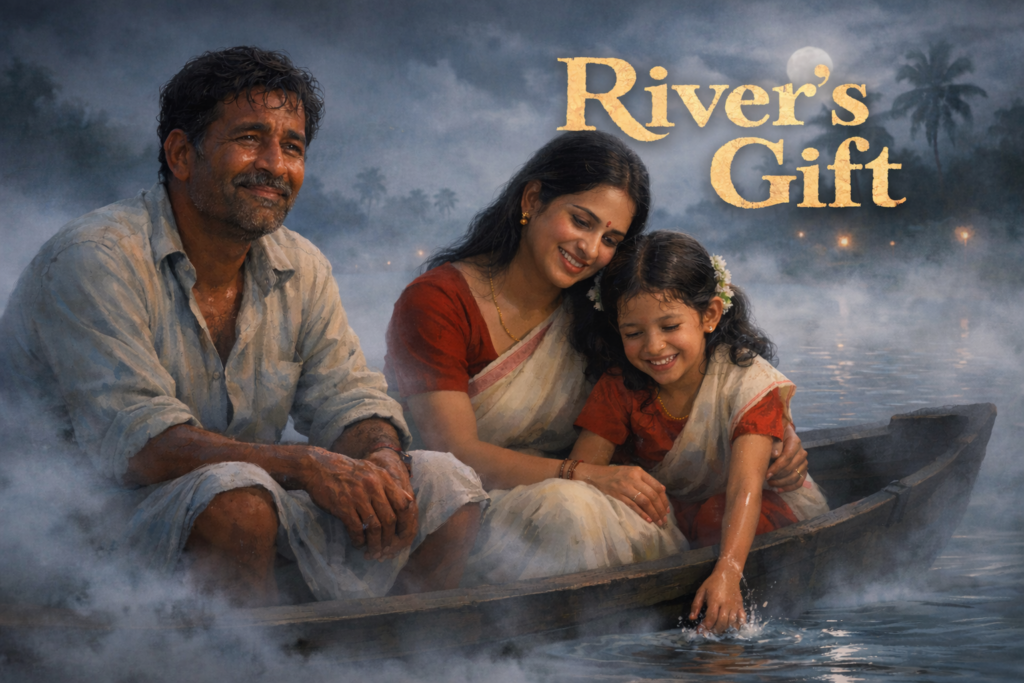
“I saw two figures step into the boat.”
I felt the hair rise on my arms.
“At first, I thought, this is the arrack.
“But the shapes became clearer.”
His eyes glistened in the fading light.
“It was my wife.”
“And beside her…”
His voice softened.
“My little daughter.”
The river moved quietly beside us.
“They both died years ago, in a boat tragedy.
“But there they were.”
He smiled, a smile full of pain and tenderness.
“My wife sat beside me just the way she used to sit when we travelled together long ago.
“My daughter…”
He looked at the water.
“She laughed.
“She dipped her fingers into the river like she did when she was small.”
For a moment, his voice broke.
“And suddenly I remembered one evening…
“A festival day in the village.
“We were returning home in the boat.
“My daughter was singing loudly…
“Clapping her hands.
“And my wife kept scolding her softly.
‘Ayyoo mole, stop shouting!’ she said.
“But she was laughing while saying it.”
He closed his eyes for a moment.
“And sitting there in that misty boat…
“I felt that night had come back.
“The river was quiet.
“The moon was shining.
“And happiness…”
His voice trembled.
“Simple happiness… filled the boat again.”
He wiped his nose roughly with the back of his hand.
“Memories are strange travellers, sir.
“They come when the heart is lonely.
“And sit beside us like old friends.”
Love does not always leave when people leave; sometimes it stays behind as memory, waiting for a silent hour to return.
He sighed.
“The arrack and the night made my eyes heavy.
“I stretched out at the bottom of the boat.
“And I slept.”
Morning
“When I woke up…
“The moon was gone.
“Dawn was coming.
“The mist had disappeared.
“The river looked ordinary again.
“And then I heard voices.
“Two fishermen rowing nearby.”
He smiled faintly.
“I shouted, ‘Chetta! Come help me! My anchor is stuck!’
“They came closer.
“When they heard my story, they laughed.
‘Looks like the river kept you for the night,’ one said.
“Together we pulled the rope.
“At first, nothing happened.
“Then slowly…”
He made a lifting motion.
“The anchor came up.
“And when it came out of the water…”
He burst into quiet laughter.
“All three of us laughed like fools.
“The anchor had caught not on some ghost or monster…”
He wiped his eyes.
“But on an old bicycle frame lying at the bottom of the river.
“Some drunk fellow must have thrown it there years ago.”
He shook his head.
“That bicycle kept me prisoner the whole night!”
Many of the monsters that hold us captive are only ordinary things seen through the darkness of fear.
Thomachan fell silent.
The river beside us had turned almost black now. Crickets had begun their slow, endless song.
After a long time he spoke again.
Very softly.
“Sir… rivers are strange places.
“They frighten you.
“They comfort you.
“And sometimes…”
He looked into the dark current.
“They bring back the people you miss the most.”
He stood up slowly and dusted the grass from his mundu.
Before leaving, he said one last thing.
“The river carries many things: boats, fears, laughter, memories.”
Then he looked at me with a quiet smile.
“But if you sit beside it long enough…
“It will return at least one gift.”
Perhaps that is what all sorrow teaches us: if we remain still long enough, even pain may return something precious.
That night, as I walked back to my small house, the wind moved through the reeds with a long whispering sound.
And for the first time, I wondered whether Thomachan had truly been alone in that misty boat.
Or whether, for one silent night, the river had simply returned his family to him.
There are truths that cannot be proved, only felt. And sometimes the heart accepts what the mind cannot explain.