
The Marriage Without Music
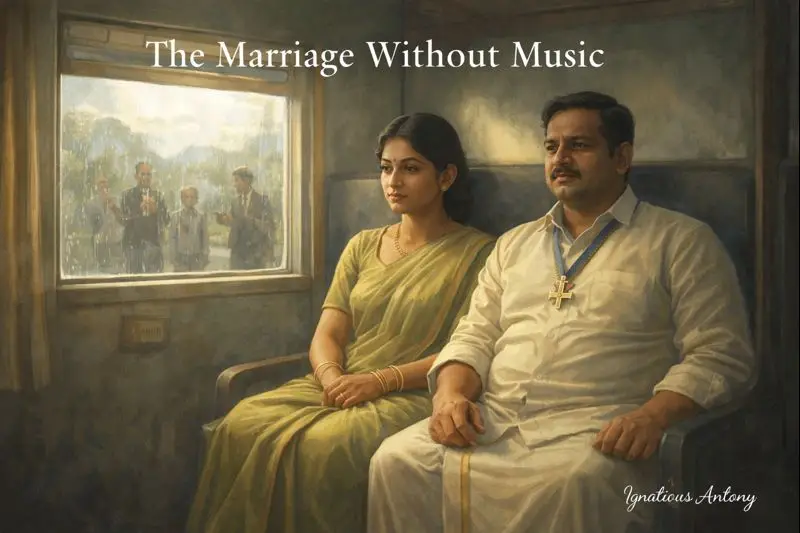
The Marriage Without Music
I remember that wedding day not for what happened,
but for what never did.
There was a church, yes.
White walls that had absorbed prayers for generations. Wooden pews polished smooth by years of folded hands. The smell of incense floated gently, mixing with jasmine pinned carelessly into hair.
The choir sang well, too well, perhaps, as if trying to fill a silence they sensed.
The priest spoke kindly. He smiled often. He used words like adjustment, understanding, and faith.
And the photographer kept saying,
“Smile, chechi… yes… just like that… one more.”
Sheela smiled. Of course she did.
She had learned long ago that smiling costs less than explaining.
But no joy stayed.
After the final blessing, there was no proper reception. No long tables covered in white cloth. No relatives fighting over who would serve the cake. No laughter that spilt into the churchyard. No children running between chairs. No second helping.
Just a few cups of tea. A few dry snacks. One small cake was cut quietly, almost apologetically.
Someone from Raju Thomas’s office brought two small glasses of wine.
“Just symbolic,” he said, smiling.
Sheela and Raju Thomas sipped it, changed into travelling clothes, and left quietly in a hired car for the railway station.
No one said, “Stay a little longer.”
Instead of a wedding feast, instead of music and celebration, they were travelling to a distant Marian shrine, Velankanni, nearly six hundred kilometres away, to pray.
People approved immediately.
“Raju Thomas is a very disciplined man,” someone said with satisfaction.
“He is a senior government officer. Not a young fellow to make noise.”
“And Sheela is already twenty-seven. This is not a teenage wedding. Dignity suits them.”
Another woman nodded knowingly.
“Yes, yes. This quietness is better. More holy.”
Someone else added, lowering her voice as if sharing wisdom:
“He planned the pilgrimage deliberately. He wants his wife to understand that faith and duty come first, even after marriage.”
In Kerala, especially among Christians, restraint is often mistaken for holiness.
At the Railway Station
At the station, a small crowd gathered, relatives, neighbours, and Raju Thomas’s office colleagues. Tea was poured into paper cups. Steam rose briefly, then vanished.
A few men stood aside, pretending the tea was enough.
And then there was Joseph Master.
Sheela’s father.
A schoolteacher all his life. Malayalam and English. Neatly spoken. Carefully ironed clothes, even when life was falling apart.
That day he wore an old coat, pressed sharply, and a faded tie that once meant promotion and pride.
He was already drunk.
Not loud. Not argumentative.
Just soft. Broken. Slipping.
The most dangerous kind.
He kept walking near the compartment window, holding his glass with a trembling hand, calling out again and again:
“Sheelu… mole… one word… just one word…”
Sheela leaned out.
“Achaa…” she said gently.
He bent close. His breath smelled of old alcohol and tired regret. He whispered something she could not make sense of, half prayer, half apology, then lifted his hand and made the sign of the cross on her forehead, her chest, her hands.
As if blessing could compensate for everything he had failed to give.
Behind him, her brothers Nikhil and Akhil tugged at his sleeve.
“Achaa… please… enough… people are watching…”
“Achaa, come back… please…”
Joseph Master pulled his arm free.
When the train finally began to move, he ran a few steps behind it, spilling tea, stumbling, shouting words that broke in his throat:
“God bless you… God bless you, mole…”
Sheela closed her eyes.
That voice stayed with her long after the station disappeared.
Some blessings weigh heavier than curses.
The Husband Beside Her
Inside the first-class compartment, Raju Thomas settled in comfortably. He arranged his bag neatly on the rack, folded his shawl, adjusted his seat, and looked around with approval.
“Good compartment,” he said. “Clean.”
He was fifty-two. Well-fed. Controlled. Medium height, slightly stout. His cheeks were soft, his upper lip neatly shaved, his side-whiskers trimmed carefully. He smelled faintly of aftershave, files, and routine.
He smiled at Sheela.
“I suddenly remembered something,” he said.
“When a senior officer received an honour some years ago, the Bishop joked, ‘Now you have three blessings, one on your chest and two at home.’”
He chuckled quietly, pleased with his own memory.
“I hope when my next promotion comes, no one makes such jokes about me.”
Sheela smiled back.
She always smiled back.
Inside, something tightened.
She was twenty-seven. Not a child. Not inexperienced.
Yet she felt the same discomfort she remembered from school, when a headmaster stood too close, correcting her posture without touching her.
Raju Thomas changed into his mundu and loose shirt.
“That’s better,” he said, sitting beside her.
The seat felt suddenly narrow.
What the Wedding Felt Like
That morning in church, Sheela had noticed the looks.
Not cruel.
Not openly judging.
Just questioning.
Why him?
Why now?
Why this quiet wedding?
She was not young, but she was still seen as “good.” Educated. Graceful. Responsible.
People thought she could have waited for something else.
That morning, she had told herself, Everything is arranged. I am safe now.
But sitting in that train, she felt something else.
She had married a man with money and position, yet she herself had no money. Her wedding saree was partly bought on credit. Her father’s house held nothing in reserve.
She remembered her brothers’ faces at goodbye.
Tonight, Nikhil and Akhil would eat whatever was left.
Her father would likely drink again.
And the house would feel hollow, like it did after her mother’s death.
“Oh God,” she thought.
“Why do I feel poorer after marrying a rich man?”
How Her Family Reached Here
After her mother died, Joseph Master slowly collapsed inward.
He still went to school. Still corrected notebooks. Still spoke beautiful English in the classroom.
But at home, the bottle appeared.
“Just one peg,” he said at first.
“Only at night.”
“Only when the heart feels heavy.”
Poverty followed quietly.
The shoes wore out. Fees were delayed. Notices arrived. Once, a local official came to list furniture for unpaid dues. Neighbours watched without pretending not to.
Sheela learned to stitch, mend, and stretch food. Compliments about her elegance only made her more aware of her worn sandals and carefully repeated dresses.
At night, fear sat beside her.
If her father lost his job, he would not survive it.
Some people lose income and recover.
Some lose dignity and never stand again.
The ‘Right Match’
Church women stepped in.
“We must find her a settled man,” they said gently.
“A responsible one.”
And they found Raju Thomas.
Not handsome. Not warm. Not romantic.
But stable. Senior clerk in the Secretariat. Close to higher officers. Respected.
“He can protect your father’s job,” they told Sheela.
“He has influence.”
So the marriage happened.
Not from love.
From fear wrapped in respectability.
The Moonlit Station and the First Spark
As Sheela drifted through these thoughts, music floated in through the open window.
The train had stopped at a junction.
Outside, a small Christmas programme was happening, harmonium, drum, carols sung badly but sincerely. People strolled with tea and banana fritters.
And among them stood a man who did not belong in small places.
Rajan Varma.
A wealthy businessman. Known flirt. Surrounded by stories.
He looked at Sheela, not like an elder, not like a judge, but like a man seeing a woman.
Raju and Sheela stepped onto the platform.
“Why are we stopping?” she asked.
“Mail train crossing,” Raju Thomas replied.
She smiled at a few familiar faces. Spoke lightly. Let the moonlight rest on her dress.
For a brief moment, she felt alive.
When the train moved again, they returned to their seats.
She was humming softly.
Hope has a habit of arriving when it should not.
The Flat, the Dinners, the Silence
They lived in a rent-free government flat.
When Raju Thomas went to the office, Sheela read novels, played the keyboard, stared at the ceiling, or cried quietly.
At dinner, he spoke like a notice board.
“Family life is duty, not pleasure.”
“Faith and morality come first.”
“Everyone must do their duty.”
Sheela listened and ate little.
After dinner, he slept heavily.
Life continued like a cracked record.
December and the Club Hall
December arrived.
The District Club Christmas Feast and Charity Bazaar was announced.
Lights. Music. Stage programme. Tea stalls. VIP guests.
Raju Thomas grew restless.
“You must dress properly,” he said.
“Try to meet the Collector’s wife. It is important.”
Sheela prepared quietly.
When he saw her that evening, his eyes shone, not with love, but pride.
“I made your life safe,” he said.
“Now help my career.”
The Night Everything Turned
The club hall was bright. Loud. Alive.
Sheela danced.
Once.
Twice.
Again.
She felt admired. Seen. Desired.
Her father appeared briefly, proud, fragile, offering ice cream, promising repayment.
Then the Collector arrived.
Power entered the room.
Behind the charity stall, Sheela learned something dangerous:
Her smile could command money.
Her glance could bend men.
And then Rajan Varma came.
Paid too much. Said little. Looked deeply.
She felt chosen.
By afternoon, visitors came.
And then Raju Thomas stood beside her with that obedient smile he wore before powerful men.
Something snapped.
She moved closer and whispered, calmly:
“Please don’t stand there like a fool.”
And he stepped aside.
After That
After that, life moved fast.
Programs. Picnics. Club dinners. Late nights.
Money flowed.
Her father drank more.
Her brothers grew thinner.
Sheela moved through the city like a rumour.
Because when a woman starved of dignity tastes attention,
she may mistake it for freedom.
And that mistake, quiet, bright, socially acceptable,
is how many tragedies begin.
Final Reflection
Now, many years later, when my hair has begun to grey, and my steps have learned caution, I sometimes sit alone in the early evenings and listen.
Somewhere nearby, a church bell still rings, slow, faithful, counting hours without asking who is happy and who is not.
The sound enters the room and fades, leaving behind a silence that feels fuller than noise.
I think of that wedding day, of how the bells rang then too, clear and confident, as if promising music that never came.
Life did bring music later, loud, dazzling, careless, but it was not the kind that stays. It passed like a borrowed tune, leaving the house quieter than before.
What remains with me now is not regret, not even sorrow, but an understanding learned too late: that silence, when chosen for us, can shape a life more deeply than any song.
And sometimes, when the bells stop and the room grows still, I hum softly to myself, not to remember joy but to remind my heart that it once hoped for it.