
The Man Who Stole Hunger
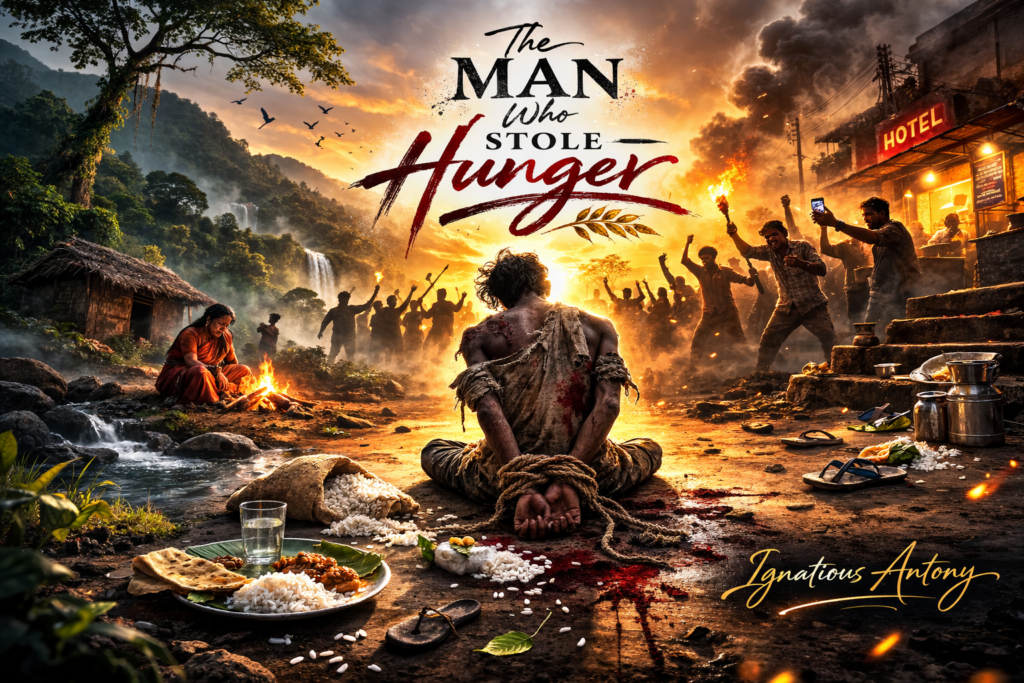
The Man Who Stole Hunger
The forest knew him first.
Before newspapers learned his name,
before microphones shaped his sorrow into headlines,
before debates sharpened their clever sentences,
The forest knew him.
It knew the sound of his footsteps
soft as falling leaves.
It knew the silence he carried,
a silence not empty
but filled with old hunger.
Morning mist wrapped him
like a forgotten son.
Bamboo bent slightly when he passed,
as if greeting one of its own.
He belonged to the hills
the way rain belongs to clouds,
without ownership,
without proof.
And hunger walked beside him
like a shadow that never grew tired.
Hunger is an ancient language.
It has no alphabet.
No grammar.
No caste.
It speaks in trembling fingers,
in eyes that search dust for grains,
in the slow burning inside the stomach
that eats dignity first
before it eats the body.
Hunger does not steal.
It only asks to live one more day.
But cities do not understand
languages older than money.
That afternoon
The world was busy being normal.
Hotel kitchens clanged with abundance.
Oil sang in iron pans.
Rice boiled in careless plenty.
Laughter rose from plates too full to notice absence.
Somewhere nearby,
a man carried hunger like a wound.
A small packet of food,
so light in weight,
so heavy in consequence.
History has always feared
The hungry more than the violent.
Because hunger reminds society
of its unfinished promises.
They saw him.
Not as a man.
Not as a son.
Not as a tired body asking mercy.
They saw the accusation first.
The word thief
leapt faster than compassion.
Hands gathered.
Voices thickened.
Judgment arrived
without waiting for the truth.
And suddenly
The crowd became one creature,
many faces,
one blindness.
When responsibility is divided among many,
Cruelty becomes easy.
They tied him.
Rope around wrists
as if hunger could run away.
Dust rose beneath struggling feet.
Fear moved through the air
like a trapped bird.
Someone laughed.
Someone shouted.
Someone recorded.
The camera did not tremble.
In another age
People hid their violence in darkness.
Now cruelty demands witnesses.
Screens glowed brighter
than conscience.
Technology learned to capture images
before humanity learned to capture compassion.
He looked around.
Perhaps he searched
for one face
that remembered kindness.
Perhaps he thought
Someone would say,
“Enough.”
But crowds rarely hear individuals.
Noise eats mercy.
The forest was far away now.
Trees could not step forward.
Birds could not testify.
Only the sky watched, vast, helpless, silent.
And rice scattered onto the earth,
white grains shining in dust
like small unanswered prayers.
Pain is slow.
It does not arrive as death.
It arrives as disbelief.
How can hands meant for work
become weapons?
How can voices be shaped for speech
become stones?
His body bent under blows,
but something else broke first,
the fragile agreement
between society and humanity.
Civilisation fails not when laws collapse,
But when compassion becomes optional.
Later,
Sirens came.
Uniforms came.
Procedures came.
Statements came.
But mercy
came too late.
The road carried him away
while evening folded itself quietly over the hills
Somewhere,
a mother waited without knowing
that waiting itself had ended.
The hearth remained cold.
Rice remained uncooked.
Night entered the house gently,
afraid to speak.
The news said:
“A man lynched.”
“A tribal youth.”
“A case registered.”
Words lined up neatly
like files in an office cupboard.
But language is poor
at carrying grief.
No headline can describe
How hunger sounds
When it stops breathing.
Days passed.
Outrage rose
like monsoon rain,
loud, sudden, temporary.
Debates argued morality.
Panels searched causes.
Statistics explained suffering.
And slowly,
Life returned to routine.
Hotels are filled again.
Plates overflowed again.
People forgot again.
But the hills remembered.
The wind is moving through the hills
still carries a question.
Not loud.
Not angry.
Just persistent.
Who was the thief?
The man who took food
to quiet dying hunger?
Or the world
That took dignity
from the hungry?
Some nights,
if you listen carefully,
you can hear footsteps in the forest.
Not ghosts.
Not accusations.
Only memory walking.
He walks without anger.
Without revenge.
Because hunger does not hate.
It only waits.
It waits in railway stations,
in construction sites,
In invisible homes at the edge of maps.
It waits inside societies
that believe progress alone is kindness.
And somewhere,
a grain of rice falls from a plate
onto the floor.
Someone brushes it away casually.
But the earth remembers.
The earth always remembers
who valued food
and who valued pride.
A civilisation is measured
not by how it feeds the powerful,
but by how gently it feeds the hungry.
The forest still calls his name.
Mist still rises every morning
as if searching for a missing figure.
And hunger,
ancient and patient,
walks beside humanity still,
asking softly,
not for justice,
not for revenge,
only for bread
without humiliation.
Only for life
without permission.
And somewhere in the quiet hills,
The man who stole hunger
finally sleeps
while the world remains awake,
trying slowly,
painfully,
to understand what it has done.