
The Idol That Was Not Won
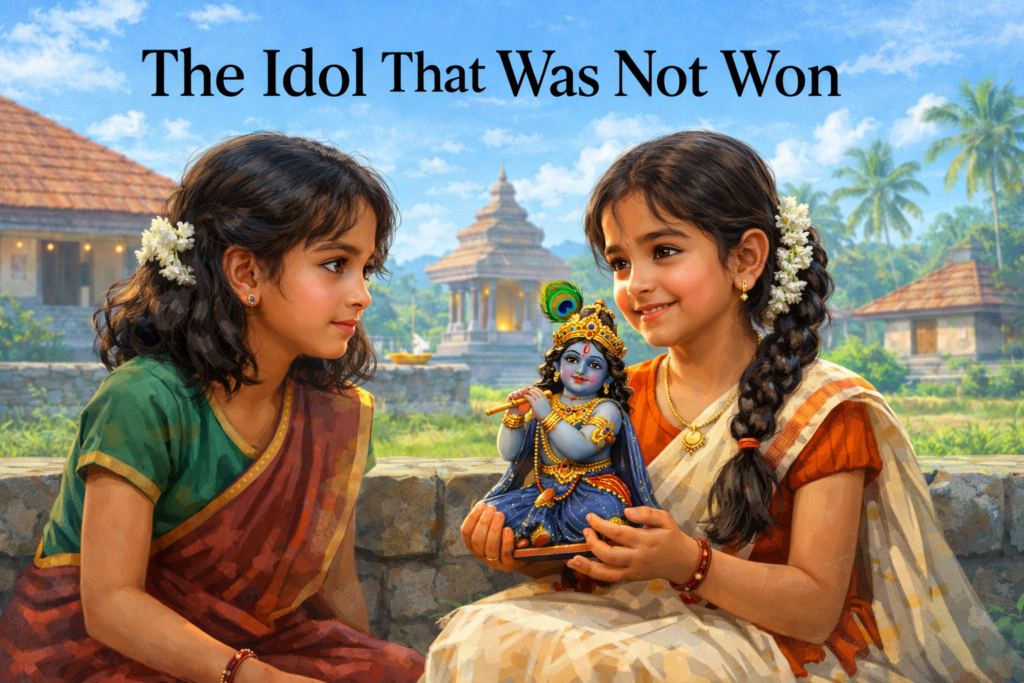
The Idol That Was Not Won
Some stories are not about what happens, but about what trembles beneath what happens, the delicate, dangerous space where love and rivalry grow from the same root. This is one such story.
In a village wrapped in coconut shadows and evening light, where the scent of damp earth rose softly after sunset, two girls met each day by a low compound wall.
Aathira and Devika.
They had grown into each other’s lives so completely that no one remembered when their friendship had begun. They shared everything, half-ripe mangoes, whispered secrets, festival dreams, and the quiet assurance that the other would always be there. If one laughed, the other followed. If one fell silent, the other waited.
And yet, like a thin crack in clear glass, something unseen had begun to form.
On the evening before the temple festival, Devika came running to the wall, her face glowing, her breath uneven with excitement.
“Look what I got,” she said, almost breathless.
In her hands rested a small clay Krishna idol.
It was exquisite.
The paint was smooth, the colors deep and luminous, the tiny eyes alive with an almost unsettling grace. Gold shimmered faintly along the crown, catching the last light of evening.
Aathira leaned closer.
For a moment, she forgot to speak.
“It’s from town,” Devika said, softer now, her voice filled with a kind of reverence. “My uncle brought it.”
Aathira nodded slowly.
At home, she too had an idol to decorate for the festival. But hers, hers was ordinary. Its paint uneven, its features blunt, its presence… quiet.
A silence stretched between them, not empty, but full.
“Love,” it seemed, does not prevent comparison; it only makes it sharper.
“Mine will look better once I finish decorating it,” Aathira said suddenly, her tone light, but not entirely.
Devika looked at her, surprised, then smiled. “Let us see.”
There was no challenge in her voice.
But Aathira heard one anyway.
“What if we ask everyone tomorrow?” she said quickly. “Whichever idol people say is more beautiful… wins.”
Devika’s smile faltered, just for a moment.
“And if someone wins?” she asked.
Aathira hesitated, just long enough for the truth to form.
“If yours is better, I will give you my silver anklet.”
Devika’s eyes widened.
“And if yours is better?” she asked quietly.
Aathira looked at the idol again, at its impossible perfection, at the way Devika held it, not as an object, but as something cherished.
“Then you give me that,” she said.
The words settled between them.
Devika’s fingers tightened around the idol. For a moment, it seemed she might refuse. But then she nodded, slowly, almost reluctantly.
“I will.”
And just like that, something sacred between them shifted.
That night, the village softened into quiet, but Aathira’s mind did not.
She sat before her own idol, trying to make it beautiful. She painted, wiped, repainted. Her fingers moved faster, rougher. Nothing worked. Nothing came close.
Her frustration grew, not loud, but deep, coiling within her.
“There are moments,” her thoughts seemed to echo, when effort begins to feel like humiliation in the presence of something effortless.
She stopped.
Her eyes burned.
And then, slowly, something else took shape, not a plan, not even a decision, but a possibility she did not turn away from.
Later, when the house had fallen silent, she stepped out.
The night held its breath.
Devika’s house stood still, a faint lamp glowing inside.
Aathira knew exactly where the idol would be.
Her feet carried her forward.
Inside, everything felt intimate, too intimate. The air was warm, the silence personal. She could hear her own heartbeat.
She found it.
Placed carefully near the prayer shelf.
She stood there, looking at it.
For a long moment, she did nothing.
Then her hand moved.
Not to take it.
But to change it.
Her fingers dipped into a small bowl of oil nearby. They trembled, slightly, but not enough to stop.
She touched the idol.
The paint blurred.
Just a little.
Just enough.
Her breath caught.
She stepped back.
The idol was no longer perfect.
Neither was she.
“Wrongdoing,” the silence seemed to murmur, rarely feels like a fall, it feels like a step taken too quietly to notice.
The next day, the village gathered in color and sound. Children displayed their idols, voices bright with pride.
When it was time, people looked, compared, nodded.
Aathira’s idol was chosen.
A murmur of approval passed through the crowd.
She had won.
But the word meant nothing.
Devika stood still.
Not crying. Not protesting.
Just… still.
She stepped forward, holding the idol. For a moment, her fingers lingered on it, as if they did not quite know how to let go.
Then she placed it in Aathira’s hands.
That moment stretched.
Something fragile broke.
“Guilt,” Aathira felt it fully now, is not the fear of being seen, it is the unbearable clarity of seeing oneself.
All day, it followed her.
In the laughter, in the music, in every glance, she felt it. The way Devika had smiled less. The way her voice had quieted.
The idol in her hands no longer felt like a prize.
It felt like evidence.
That night, she could not hold it any longer.
When her mother spoke to her, the truth spilled out, not carefully, not bravely, but urgently.
She confessed everything.
Her voice shook. Her breath broke.
But she did not stop.
Silence followed.
Deep, still, unyielding.
She was sent away from the celebration, left alone with herself.
And in that solitude, something softened.
The sharpness within her eased, not into comfort, but into understanding.
“Confession,” she realized, does not erase what was done, but it restores the one who dared to hide from it.
Across the courtyard, Devika appeared at her window.
Their eyes met.
No competition now.
No distance.
Only something tender, wounded, and still alive.
“I am sorry,” Aathira said, her voice barely holding.
Devika nodded, tears slipping freely now. “I know.”
And in that quiet exchange, something returned, not untouched, not as it was, but real.
The next morning, the idol was given back.
Not as part of a wager.
But as an act of love.
Some rivalries end in victory, others in loss, but the ones that matter most end in recognition.
For love does not disappear in the presence of rivalry; it is tested, strained, and, if it survives, it becomes something deeper than innocence.
.