
The Evening We Lost a Song
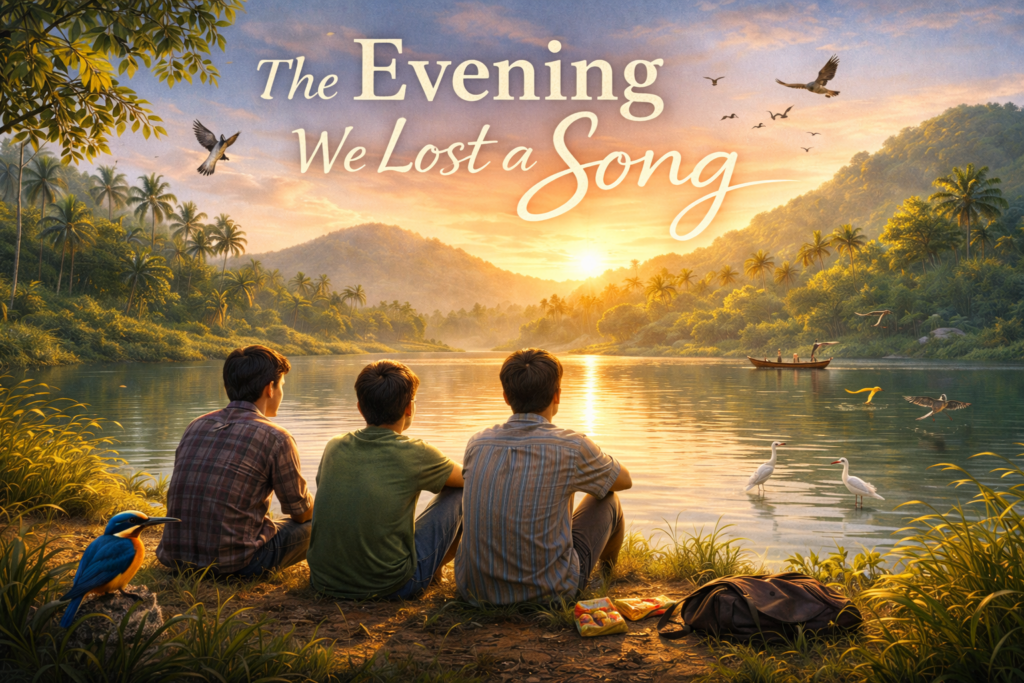
The Evening We Lost a Song
We were not just a group of classmates.
We were, in a quiet way, a group of escape artists.
Every evening, after college, when the last bell rang and the noise of classrooms faded into the usual rush of buses, assignments, and expectations, we would walk away, not towards the town, but in the opposite direction.
Towards the lake.
It lay beyond the last row of houses, near a small valley where a hill rose gently, covered in thick green trees and scattered rocks that had silently watched many years pass. A narrow mud path led us there, winding past paddy fields, grazing goats, and the occasional tea shop where old men argued about politics as if they were running the state themselves.
“Come fast… sunset will start,” Biju would always say, walking ahead.
Sabu would carry a small packet of banana chips. I would carry nothing, only my tired mind.
We never spoke much on that walk.
Because something inside us was slowly becoming quiet.
The lake was not big. But it was alive.
In the evenings, it became a mirror, holding the sky, the trees, and sometimes even our thoughts. The breeze came gently across the water, touching our faces as if it knew we needed it.
We would sit on the slightly sloping bank, our feet brushing against soft grass, watching the day slowly dissolve.
That place was not just a place. It was where we left behind everything we did not want to carry.
That evening, like many others, we came there again.
But that day felt different.
There was a softness in the air… a kind of waiting.
“Today he will sing,” Biju said quietly. We all knew who he meant.
The night singer. The one who never came on time.
The one who made us wait.
While we waited, the evening began its slow performance.
First came the cuckoo.
From somewhere deep inside the hill, hidden among mango and jackfruit trees, it called, long, soft, and slightly lazy, as if stretching its voice after a long sleep.
“Koel,” Sabu whispered.
Its call rose gently, fell, and rose again, like a question that did not need an answer.
It called nearly ten times… and then stopped suddenly.
As if it had said everything it wanted.
Then, slicing through the soft silence, two black kites flew overhead.
Their wings cut through the sky with quiet strength, and their sharp cries echoed like warnings carried by the wind.
“They sound like they are arguing,” I said.
“No,” Biju smiled, “they are announcing… evening has started.”
Then came the oriole. We could not see it.
But we could feel it.
Its voice was deep and full, like a trained singer who knew exactly where to place each note. It did not hurry. It did not waste a single sound.
We often wondered, as their songs filled the evening air… how do these little beings learn such music without ever sitting before a guru?
Each note felt like it had been carefully polished before being released.
We leaned forward without realising.
“That one sings with dignity,” Sabu said softly.
We nodded. We wanted it to continue.
But the sky had other plans.
From far away, we saw them.
A dark moving cloud.
“What is that?” I asked.
“Crows,” Biju said.
Within moments, they arrived. And with them came chaos.
They filled the trees. Branches shook. Voices rose.
Loud. Rough. Endless.
Cawing that had no rhythm, no beauty, only urgency.
“For them, everything is a protest,” Sabu muttered.
We laughed. But slowly, the laughter faded.
Because their noise swallowed everything else.
Then, as if responding to the madness above, the frogs below began.
From the reeds along the lake, from the wet edges where water met mud, their deep, rumbling voices rose.
Croak… croak… croak…
Slow. Heavy. Persistent.
“Government quarters,” Biju joked. “All of them living free and singing without permission.”
For nearly half an hour, the lake became a strange orchestra.
Crows shouting. Frogs rumbling. Wind moving. Leaves whispering.
All sounds mixed together until they became one.
Somewhere in between, a sleepy bird called once… then again.
Its voice was soft and slightly broken, like someone speaking while half asleep.
A water hen answered with a sudden sharp cry.
A reed bird added a thin, trembling note.
And then…Slowly…Silence returned.
Only the crickets remained.
Their soft, steady sound came from the grass near us, like a quiet background music that never stops.
We shifted impatiently.
“Why is he not coming?” Sabu complained.
“We have been waiting so long,” I added.
“He thinks he is a superstar,” Biju said with a smile.
Our patience was slowly turning into irritation.
Then the moon rose.
Slowly. Silently.
And stopped above the grove like a watchful eye.
And at that very moment.
He arrived.
“There!” Sabu whispered suddenly.
We looked up.
On a small mango tree branch, a tiny bird had appeared.
Then it flew to a thorn bush nearby, turned slightly, flicked its tail, and sat still.
“That’s him,” Biju said softly.
The star.
The one we had been waiting for.
He ignored us. Completely.
As if we did not exist.
We waited. One minute. Two. Three.
Nothing.
“Arrogant fellow,” Sabu whispered.
But none of us moved.
Because we knew, He would begin.
The breeze touched the trees.
Leaves trembled. Crickets grew louder.
And then, He sang.
The first note was like a drop falling into still water.
Then another. Then a quick, playful trill.
And suddenly, everything changed.
His voice was not just sound.
It was feeling. It rose like joy. Fell like longing.
Danced like light on water. Paused like a held breath.
Each note carried something we could not explain.
Something we could only feel.
“Some songs are not heard by the ears… they are understood by the heart.”
“True beauty does not try to impress… it simply exists, and everything else becomes silent.”
Even the crickets softened.
The wind slowed. The lake listened.
We forgot ourselves. Forgot time. Forgot everything.
Then, something moved.
From the edge of the grove, a man appeared.
It was Sasiyettan, the caretaker of the nearby farmhouse.
He walked slowly, carefully, bending low, holding a small basket in his hand.
“Why is he coming here?” I whispered.
“Shh…” Biju said.
We watched.
He moved between the trees without making a sound.
We had seen him before. Always quiet. Always watching.
Now he was different. Careful. Silent. Focused.
In his hand, a small basket.
“Why is he here?” I whispered.
No one answered.
He moved slowly between the trees.
Each step placed with care. Each movement controlled.
The bird sang on. Free. Unaware.
Closer. Closer. And then, A sudden movement.
A sharp silence.
The song stopped.
It did not fade. It broke.
“There!” someone shouted.
Sasiyettan came out.
Smiling. In his hand, the bird.
Its tiny body was trapped between his fingers.
Its wings folded. Its voice gone. Its head hanging slightly.
For a moment, we could not breathe.
“Why?” I asked.
My voice did not sound like mine.
“Why did you catch him?”
Sasiyettan laughed. “As if it was nothing.”
“For a cage,” he said.
That word stayed in the air. Heavy. Ugly. Final.
The lake felt empty. The breeze felt wrong.
The moon looked distant.
A lonely bird cried somewhere far away.
The frogs fell silent.
Even the crickets seemed unsure.
Something had been taken. Not just the bird.
Something more.
“Man does not always destroy out of anger… sometimes he destroys simply because he can.”
“The world does not lose beauty in one moment… it loses it slowly, through small acts of indifference.”
Sasiyettan placed the bird inside the basket.
Closed it. And walked away.
Light. Carefree. As if he had gained something.
We stood there. Unable to move. Unable to speak.
That place… our place… no longer felt the same.
After a long time, we walked back. Silently.
Even Sabu did not speak. Even Biju had no words.
Behind us, the lake remained.
The hill remained.
The trees remained.
But the song,
Was gone.
“And sometimes, what is lost is not just a voice… but the part of us that knew how to listen.”