
Pygmalion and Galatea: Love Turned to Life
Pygmalion and Galatea: Love Turned to Life
Long ago, in an ancient land that looked out over the deep blue waters of the Mediterranean, there lived a king named Pygmalion. He ruled his people well.
His judgments were fair, his temper calm, and his presence carried a quiet authority that inspired respect rather than fear. The court trusted him, and the kingdom prospered under his care.
True power does not shout; it settles the room.
Yet when the day’s duties were done, when the voices of ministers faded, when messengers departed, and the palace halls grew still, Pygmalion did not seek music, feasts, or company. Instead, he withdrew into silence.
There, away from power and praise, he turned to something far humbler.
Stone.
Stone as Refuge
Sculpting was not his trade, nor his ambition. It was his refuge. Where others found rest in pleasure or conquest, Pygmalion found peace in marble.
While other kings rode out to hunt or planned wars, he stood alone before blocks of stone, letting his hands do what words never could.
His fingers learned patience. His eyes searched for beauty without noise or deception.
Some people rule the world. Others try to understand it.
He had seen too much falseness among people, too many smiles that hid cruelty, too many promises spoken lightly and broken easily. Gradually, and without bitterness, he decided that marriage was not for him. He would not bind his life to a world that so often disappointed.
Instead, he carved.
The Birth of Galatea
One day, from a flawless block of white marble, a form began to emerge. Slowly, almost shyly, a woman appeared beneath his hands. Her face held a gentleness that did not ask for admiration.
Her posture was calm, as if she had no need to impress. There was no pride in her expression, no fear either, only a quiet grace.
Pygmalion worked with extraordinary care. Each night, he returned to the statue, correcting details that only he could see.
He softened the curve of her lips, refined the line of her neck, shaped her hands as if they were meant to comfort another living being. Time passed unnoticed. When at last he stepped back and felt there was nothing more to change, he gave her a name.
Galatea.
At first, she was only stone.
When Love Arrives Quietly
But Pygmalion spoke to her as if she could hear. He dressed her in fine silk. He placed fresh flowers at her feet each morning.
In his mind, he imagined her kindness, her wisdom, her quiet strength, the very qualities he found missing in the world around him.
Without realising when it happened, he fell in love.
Love often arrives without asking permission.
Galatea did not move.
She did not answer.
She remained cold, unyielding marble.
Yet his love only deepened.
Love That Weakens the Body
Day by day, it began to consume him. He ate little. Sleep came rarely. His body weakened as his devotion grew stronger. The court noticed the change. Ministers whispered among themselves in low voices.
“The king no longer listens in council.”
“He speaks to a statue.”
“Love has made him unwell.”
What the world calls madness is sometimes faith without witnesses.
Still, Pygmalion believed.
A Prayer Without Bargaining
Every night, he knelt and prayed to Aphrodite, the goddess of love, not with arrogance, but with humility.
“Give her life,” he whispered.
“Or give me the strength to love without hope.”
Some prayers ask for miracles. Others ask for courage.
The Announcement That Stunned the Court
One morning, he stood before the court and spoke with a calm certainty that left no room for doubt.
“I will marry Galatea.”
The hall fell into stunned silence. Ministers stared at one another. Servants lowered their eyes, unsure whether to look or flee. But Pygmalion was king, and his word was law.
Invitations were sent across neighbouring kingdoms. Kings and queens arrived, some curious, some confused, some quietly amused. In the corridors, servants whispered behind pillars.
“The king has lost his mind.”
“How can one marry stone?”
“This will be remembered as madness.”
Belief does not ask for approval.
Pygmalion heard none of it.
He believed.
The Day Belief Became Flesh
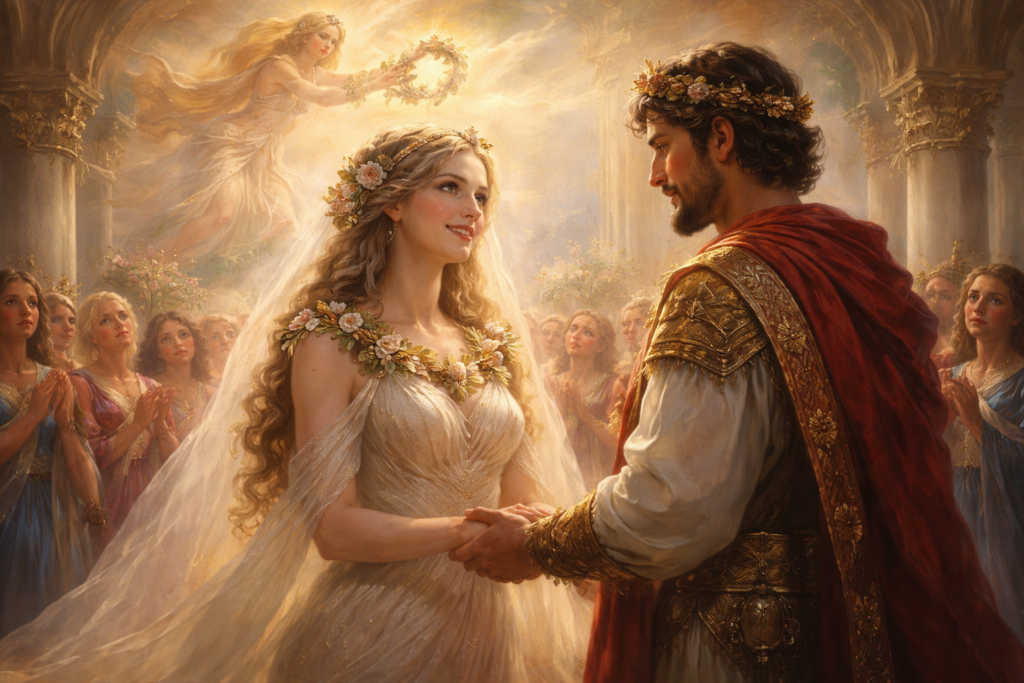
On the day of the wedding, Galatea was dressed in bridal cloth. A garland was placed gently around her neck. The hall was filled with guests. Music played. Every eye watched the king standing before his bride of marble, his face peaceful, his confidence unshaken.
At that moment, quietly, unseen, Aphrodite answered his prayer.
A garland blessed by the goddess fell upon Galatea’s shoulders. The marble warmed beneath it. The stone softened. Breath entered where there had been none.
Galatea opened her eyes.
She smiled.
The hall gasped.
Pygmalion did not cry out. He did not stagger or fall. He simply smiled back, because he had already believed she would live.
They were married that day, not because stone turned into flesh, but because belief had already given it life.
What the Story Leaves Us With
Now, you’ve just heard the story of Pygmalion.
A man who believed so deeply that what he loved could become alive…
And one day, it did.
I want you to remember one thing from that story before we go further:
Nothing changed, Galatea first. What changed first was belief.
Reality often waits for permission from belief.
Let me now tell you why this idea matters in real life.
From Myth to Everyday Life
Let me start with a small, funny story.
Once in London, a group of people decided to start a society called the Pessimists’ Society. All the pessimists in the neighbourhood agreed to meet on Sunday to form the group. It sounded like a great idea, at least to pessimists.
But when Sunday came, nobody turned up.
Why?
Because all of them thought, “It won’t work anyway.”
That’s pessimism for you.
Now, pessimism is very popular. People accept it easily.
What people don’t talk about enough is the opposite force, optimism, or more importantly, positive expectations.
What we expect quietly trains our behaviour.
The School That Proved the Point
I’m not talking about magical thinking. I’m not saying, “Just wish for something, and it will fall into your hands.” Life doesn’t work like that.
But there is strong evidence that what we expect deeply affects what we get.
Let me show you how.
In a school in Texas, USA, a principal wanted better results. So he tried something interesting.
He selected 30 Topmost students from Grade 7 and assigned them to the three Best Teachers of the school.
He told the students:
“You are our top students. The brightest of our school.”
“You have been specially chosen. You are expected to do great things.”
He also told the three Teachers that they had been specially selected to train the school’s best students.
We expect excellent results in the public examinations.
The teachers worked harder. They stayed longer. They prepared better lessons. They gave more projects. They spent extra time helping students individually.
The students believed they were special. So they studied more seriously. They skipped games. They practised more. They pushed themselves.
Parents joined in. Holidays were postponed. Homework was checked. Support increased.
At the end of the year, those students performed exceptionally well, among the best in the state.
The Revelation
A delighted principal congratulated the three teachers for the remarkable results. The teachers modestly credited the students, saying it was a joy to teach such bright and hardworking children.
Then came the surprise. Then the Principal revealed that the students were not exceptional; they had been chosen at random from different classes.
Still stunned, the teachers assumed the success must be because they were the best teachers. The principal smiled and corrected them. He had picked their names randomly, too.
So how did average students, taught by randomly chosen teachers, achieve extraordinary results?
So what really happened?
The teachers expected greatness, so they taught as if greatness were possible.
The students felt trusted, so they worked as if success was expected of them.
The environment supported them.
Just like Pygmalion.
The Message for Us
Now, let me make this very simple and very real for you.
If you keep telling a child,
“You’re careless.”
“You’re clumsy.”
“You always mess things up.”
That child will slowly begin to believe, “This is who I am.”
Every mistake will feel normal.
Every failure will feel expected.
But if you tell that same child,
“You are smart.”
“You can do better.”
“You just need more practice.”
Watch what happens.
The child tries again.
Practices more.
Grows stronger.
Belief changes effort before it changes results.
The same thing happens in teams, classrooms, families, and workplaces.
When leaders expect people to do well, people try not to disappoint them.
When teachers expect students to shine, students try to shine.
When parents expect growth, children grow.
And when we expect failure… well, we usually get that too.
Closing Thought
So here is my message to you today.
Be careful what you expect from others and from yourself.
Expect more.
Expect growth.
Expect effort.
And don’t keep those expectations secret.
Say them out loud.
Let people know you believe in them.
Because expectations are not just thoughts.
They are invisible hands, shaping behaviour.
Just like Pygmalion’s belief shaped stone into life.
And just like those teachers shaped ordinary students into top performers.
The choice is always ours.
You can expect good things and work toward them.
Or expect failure and, one day, say, “I told you so.”
But remember this:
Belief always goes first.
Results follow.