
Prometheus and the Gift of Fire
Stories of Greek Mythology

Stories of Greek Mythology: Prometheus and the Gift of Fire
After the great war between the Titans and the Olympian gods, peace gradually returned to the world. Cronos, the cruel Titan of Time, had been defeated, and Zeus, the god of lightning, now ruled from Mount Olympus. The sky was calm, the rivers flowed freely, and plants covered the land with fresh greenery.
Yet something felt incomplete.
The world was beautiful, but it was quiet and empty.
Among the Titans who survived the war were two brothers who chose to serve Zeus rather than fight him. These brothers were Prometheus and Epimetheus. Though they were twins, they were very different in nature.
Prometheus was thoughtful and careful. He liked to think ahead and consider the future before acting. That is why his name meant forethought. Epimetheus, on the other hand, was cheerful and energetic but often careless. His name meant afterthought because he usually realised his mistakes only after they had already happened.
Thinking ahead helps protect the future; forgetting to think shapes it by accident.
Zeus looked down from Mount Olympus and saw that the world needed living beings, not just plants and rivers. So he called the two brothers to him and said, “It is time to fill the earth with life. Create creatures that can fly in the sky, run on land, and swim in the seas.”
Epimetheus was thrilled. Without wasting a moment, he rushed to his worktable and pottery wheel to begin his work. His mind overflowed with ideas. He shaped animals of every kind. He made tall animals with long necks and gentle eyes, which he called giraffes. He created bright birds with colourful feathers and cheerful voices, naming them parrots. He shaped fish of many sizes, creatures that crawled, leapt, sang, buzzed, and swam.
The earth slowly filled with movement and sound.

Prometheus watched his brother’s work in silence. He admired the beauty of the animals, yet sensed that something important was missing. When Epimetheus finally stopped creating, he suddenly realised his mistake. He had used all his gifts and forgotten to save anything special for one final creation.
That final creation was human beings.
Humans had no sharp claws, no thick fur, no wings, and no great strength. Seeing this, Prometheus felt deep concern. He stepped forward and decided to help. He shaped humans carefully, giving them upright bodies so they could look at the sky and thoughtful faces so they could think and learn. Prometheus grew fond of them because they were curious, gentle, and eager to understand the world.
But humans were weak.
At night, they shivered in the cold. Darkness frightened them. They huddled together in caves, unsure how to protect themselves.
Creation without care leaves life unfinished.
Zeus watched the humans and decided they were not ready for fire. Fire, he believed, was too powerful. It could give warmth and light, but it could also destroy forests and homes. “Fire will only bring danger,” Zeus said. “A warm cloak is enough for humans.” Some gods agreed with him. Others felt uneasy but were too afraid to speak against the king of the gods.
Prometheus, however, could not accept this decision. He believed fire was not just a weapon; it was a tool for growth, learning, and survival.
One evening, as Helios, the god of the sun, returned to Olympus in his blazing chariot, Prometheus waited at the gates. While Helios was busy caring for his glowing horses, Prometheus quietly took a spark from the chariot’s burning wheel. He hid it carefully inside a hollow piece of tree bark and wrapped it in cloth.
Great kindness often moves quietly, even when it changes the world.
Prometheus hurried down the slopes of Mount Olympus and reached the villages of humans. At first, the people were terrified when they saw the tall Titan approaching. But their fear changed to amazement as Prometheus showed them how to arrange dry wood and leaves and light the first fire.
Flames rose into the night. Darkness receded. Faces glowed with warmth. Hands reached towards the fire in wonder. Prometheus taught them how to keep the fire alive and how to use it wisely, for warmth, light, and cooking.
He moved from village to village, sharing the gift of fire wherever he went.

High above, Zeus noticed tiny points of light spreading across the land. Thunder rumbled across the sky. Lightning flashed. Zeus knew immediately what had happened.
He transformed into a mighty eagle and flew across the dark sky. Soon, he spotted Prometheus leaving another village. Zeus landed before him, filled with rage. Prometheus did not try to escape. He bowed his head calmly.
“I knew you would come,” Prometheus said. “But it is too late. Humans now have fire.”
Zeus was furious. He could not take fire away from humans, but he could punish the one who had disobeyed him. He seized Prometheus and carried him high into the mountains.
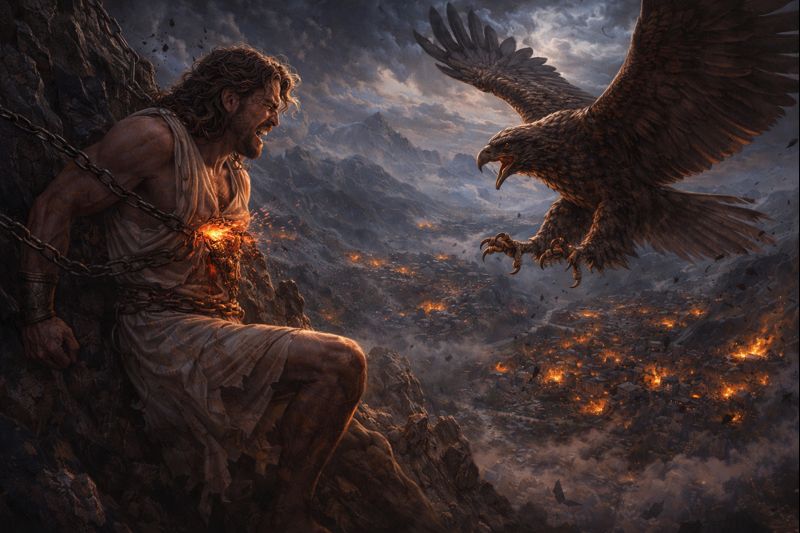
On a lonely rocky peak, Zeus chained Prometheus to a stone with unbreakable chains. Cold winds blew around him, and the sky stretched endlessly above.
Power without mercy turns justice into cruelty.
Each morning, a great eagle arrived. It tore at Prometheus’s side and ate his liver. Prometheus screamed in agony but could not move. Because he was immortal, his body healed by nightfall. And every morning, the eagle returned.
Day after day. Year after year.
Yet Prometheus did not regret his decision.
Far below, he could see thin lines of smoke rising from human villages. Fires still burned, but families were warm. Nights were no longer ruled by fear.
Despite his suffering, Prometheus smiled.
“It was worth it,” he whispered.
True sacrifice is choosing pain for yourself so that others may live with hope and dignity.