Perseus, the Titan, and the Three Blind Sisters
Stories From Greek Mythology

Perseus, the Titan, and the Three Blind Sisters
A Short Introduction to Greek Myths
Greek myths are ancient stories first told in the lands of Greece, long before history was written down.
They speak of gods, heroes, and monsters, but more deeply, they speak of human choices made in moments of fear, anger, love, and courage.
The gods in these tales often behave like powerful forces of nature and emotion, while heroes show what it means to face danger, protect others, and accept responsibility.
These stories have survived for centuries because they continue to offer lessons in patience, wisdom, courage, and the lasting consequences of our actions.
Long before the world felt safe, people whispered of monsters that could empty villages and turn courage into silence.
Among all the horrors said to walk the earth, one name alone could tighten even the bravest heart with fear.
Medusa
Medusa was a Gorgon, a creature both feared and whispered about.
She had wings, sharp claws, and snakes where hair should have been. Yet it was not her fangs or her talons that made her truly dangerous.
One direct look into her eyes could turn any living being into stone. She had once been human, changed by the goddess Athena. She was a monster, and all agreed on one truth, that Medusa was deadly.
Sometimes the most terrifying power is not loud or violent; it is the kind that steals life in a single, silent moment.

King Acrisius and the Prophecy
In the city of Argos, King Acrisius ruled, a man of power and pride, yet also of deep, unspoken fear. Like many kings in Greek myths, he feared prophecy above all else. He believed that prophecies had a way of finding their truth, no matter how fiercely they were resisted.
Acrisius had no son. His only child was his daughter, Danae.
Danae was the light of his life, and the source of his greatest fear.
Her fate was tied to a prophecy, and she would one day become the mother of a hero whose name would echo through legend.
Years earlier, troubled by questions of legacy and fate, Acrisius had travelled to the Oracle of Delphi.
The Oracle of Delphi
The Oracle of Delphi was believed to speak the will of Apollo, the god of prophecy.
Kings and warriors came from distant lands to seek answers about war, children, and destiny.
In Greek myths, the Oracle’s words are never simple predictions; they are seeds planted in time, destined to grow.
The Oracle told Acrisius:
“Your grandson will be great, even greater than you.
From his deeds, a mighty kingdom shall spring anew.
But as he rises, Argos’ king will quail.
For Medusa’s might, none alone can assail.”
From that moment, fear settled into Acrisius’s heart like a permanent guest.
He could not bear the thought that his own grandson would one day bring ruin to Argos.
When fear is allowed to rule the mind, it can turn even love into cruelty.
Danae’s Revelation
One day, Danae came before her father. Her eyes shone with happiness, and her voice trembled, not with fear, but with wonder.
“Father,” she said softly, “I am pregnant.”
Acrisius felt his heart turn cold.
“How is this possible?” he cried. “You are not even married!”
Danae lifted her shoulders in helpless confusion. “I cannot explain it. I dreamed that a shower of gold came through my window and bathed me in light. When I woke, I felt changed. Now I understand, this child is a gift from the gods. There can be no other explanation.”
This shower of gold was Zeus himself, king of the gods, visiting Danae in a form known only to divine power. Zeus was famous for appearing in strange shapes, storms, flames, and light whenever he chose to act in the world of mortals.
Acrisius forced a smile and embraced his daughter. But once she had gone, his strength failed him. He collapsed into a chair, burying his face in his hands.
“I do not know how,” he whispered to himself, “but that child will one day bring Medusa to Argos, and destroy us all.”

The Birth of Perseus
When the child was born, he was named Perseus.
In time, Perseus would become one of the greatest heroes of Greek mythology, known for slaying Medusa and performing deeds of courage. Many stories call him a demigod, for his father was Zeus.
But at birth, Perseus was no hero. He was only a helpless infant, cradled in the arms of a mother who loved him fiercely.
Acrisius remembered the prophecy. He dared not kill the child outright, for harming a god’s offspring was said to bring terrible punishment. Instead, he chose a quieter cruelty.
He locked Danae and the newborn Perseus inside a great wooden chest and ordered his servants to carry it to the sea.
Danae cried out. She begged. She clutched her child to her chest. But Acrisius turned away. The servants pushed the chest into the waves and cast it into the deep.
Inside, the chest rocked violently. Water struck its sides. Darkness wrapped around Danae like a heavy cloth. She held Perseus close, whispering comfort to him, because a mother must sound brave, even when her own heart is breaking.
Responsibility begins with protecting the helpless. When power forgets this, injustice follows.
Zeus Intervenes
High on Mount Olympus, Zeus watched from his cloud-wreathed throne. He saw Acrisius’s fear and his foolishness.
“Foolish man,” Zeus said, shaking his head. “Does he not see how much good this child will do? That is why I blessed Danae with such a son.”
Zeus did not allow the sea to claim them. He sent a guiding wind, steering the chest safely to shore.
Seriphos and a New Beginning
The chest washed ashore on the island of Seriphos.
There, a kindly fisherman named Dictys found Danae and Perseus and took them into his home.
Dictys became Perseus’s first human protector, proof that goodness can live even in ordinary lives.
Perseus grew tall and strong, learning to sail and to work the sea.
But Seriphos was ruled by King Polydectes.
Polydectes soon noticed Danae. Though she was no longer young, her curly hair and clear blue eyes still drew attention. When Polydectes asked her to marry him, Danae had little choice.
Perseus burned with anger, but he was powerless to stop it.
The Banquet and the Trap
At the banquet celebrating the engagement, every noble brought a gift.
Perseus brought none. He was poor.
Polydectes pretended to rage at this insult, though inside he smiled. At last, he had an excuse to rid himself of the young man.
He demanded a gift.
“Far to the north lives the Gorgon Medusa,” he said. “She guards great treasures, including a bracelet said to have been given to her by Poseidon. Bring me that bracelet in repayment for this insult.”
Though stories differ about the exact demand, the purpose was clear: Perseus was being sent away on a task meant to destroy him.
Some people wear honour like a costume. Their words sound polite, but their intentions are sharp.

The Journey Begins
Dictys had taught Perseus to sail well. Now Perseus stood on the shore, preparing a small boat for what felt like a hopeless journey. His hands trembled as he checked the ropes.
He did not want to leave.
But he could not stay. As long as Polydectes ruled, his mother would never be safe.
Then a voice spoke behind him.
“Do not fear the unknown, Perseus. It will define you.”
Athena and Hermes
Before him stood a man and a woman who seemed to shine despite the cloudy sky.
The woman stepped forward, her dark hair framing calm, steel-grey eyes.
“I am Athena,” she said, “goddess of war and wisdom.”
Beside her stood a blond man whose sandals bore wings.
“This is Hermes,” Athena said. “Messenger of the gods.”
Hermes smiled and winked.
They knew of Perseus’s quest and had come to help.
“There is no bracelet,” Athena told him gently. “Your fate is greater than theft. You must slay the Gorgon.”
Wisdom is not only knowing what you desire, but understanding what must be done.
Hermes opened a bag and drew out winged sandals, an invisibility helmet borrowed from Hades, and Athena added a curved sword and a mirror-bright shield, divine tools no mortal could match.
Overwhelmed, Perseus asked where he should go.
“No god knows,” Hermes admitted, then added, “But the Graeae will know.”
With a final blessing, Athena and Hermes vanished like wind.
Perseus set off, flying west.

Atlas
As Perseus crossed the great mountain of Atlas, a deep voice thundered.
“Another hero comes to spite me?”
Atlas, a Titan older than the gods, stood bent beneath the weight of the sky. He agreed to guide Perseus if Perseus would one day bring him Medusa’s head and end his suffering.
Perseus agreed, moved by the Titan’s sorrow.
“Fly south,” Atlas said. “You will find them.”
Even the strongest can suffer. True strength is carrying duty while still feeling its weight.
The Graeae, three blind sisters
It was easy now to find what he sought.
The sun had barely started to sink when Perseus saw the dismal valley, grey land, dry wind, and emptiness.
Swooping down, he saw them:
The Graeae, three old, wizened women.
In Greek mythology, the Graeae (also called the Grey Sisters) are strange sisters who share one eye between them. They guard information, and Perseus must outsmart them to reach Medusa.
They were squabbling, snatching, hissing, arguing, over who should get to “see” with the shared eye.
And then an idea jumped into Perseus’s mind.
He zoomed down fast and grabbed the eye from their clawed fingers.
The three old women screamed and clawed at the air, trying to catch what they could no longer see.
But Perseus hovered above them and shouted:
“If you want your precious eye back, tell me where the gorgon Medusa lives!”
They had no choice.
“Far to the east lies the island of Cisthene,” they cried. “She lives there. Now give us back our eye!”
Perseus flung the eye back down.
Then he spun in the air and headed east, his heart beating with exhilaration.
“I might just be able to do this!” he said to himself as the lands flowed beneath him.

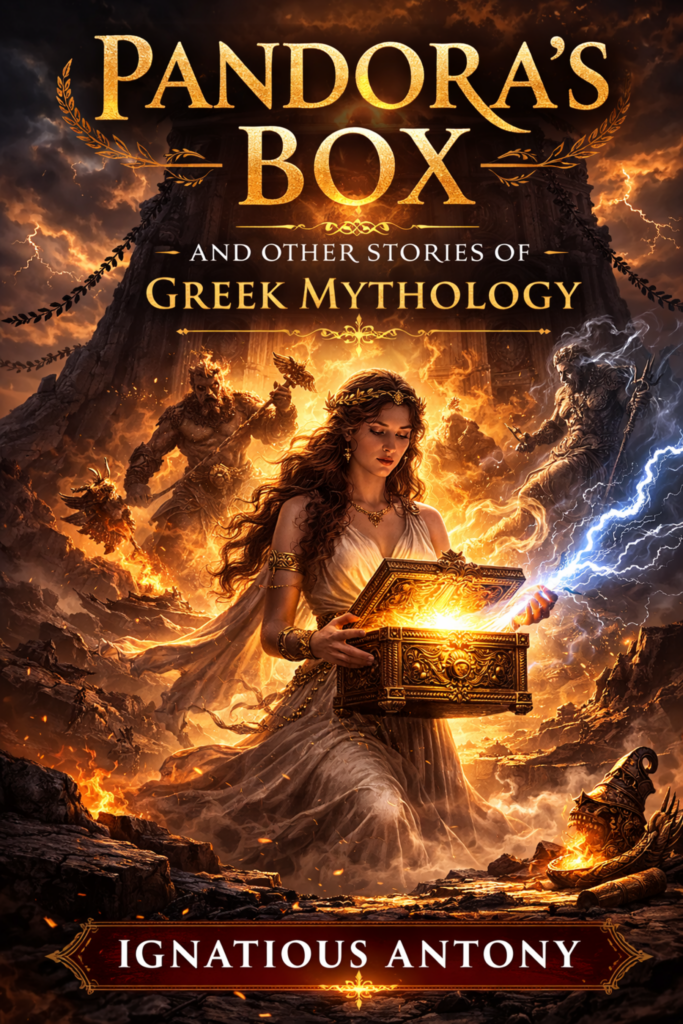
New Book Released!
I’m excited to share that I have published a new book on Greek Mythological Stories. This book brings to life the fascinating tales of ancient Greece—filled with gods, heroes, kings, and unforgettable adventures.
If you enjoy stories about Greek mythology, legendary heroes, and epic tales, I warmly invite you to explore this book.
✨ If you would like to read more stories like this, please take a look at my book.
Thank you for your support, and happy reading!