Perseus and the Gorgon: Stories from Greek Mythology
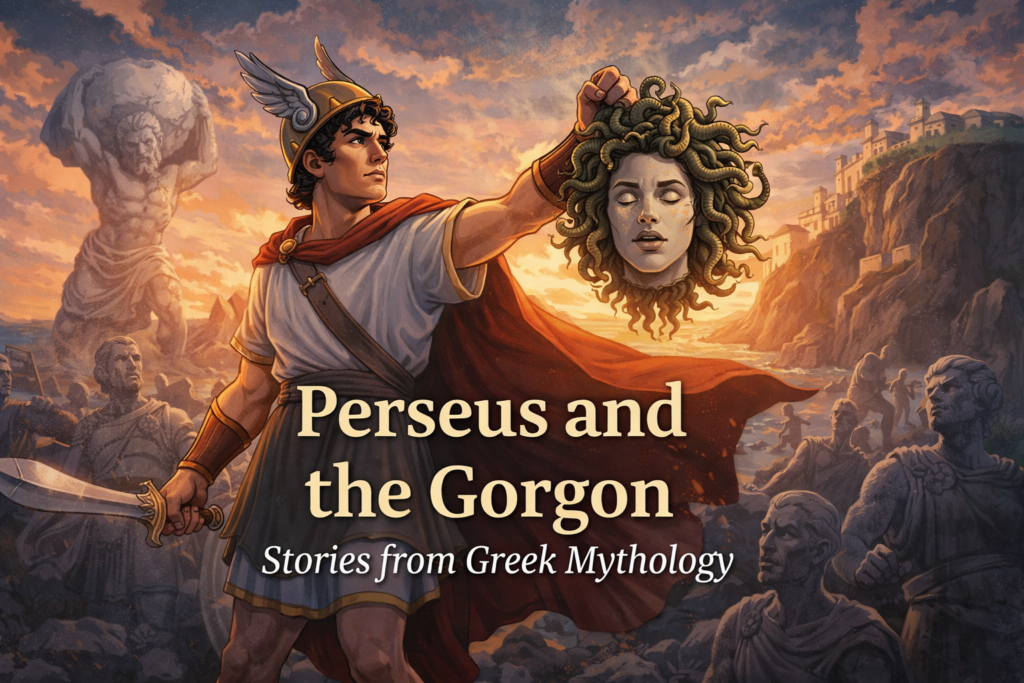
Perseus and the Gorgon: Stories from Greek Mythology
An Introduction to Greek Mythology
Greek myths are ancient stories told by the people of Greece to explain the world around them. They speak of powerful gods, brave heroes, strange creatures, and great adventures. These stories were not just meant to entertain.
They taught people how to live wisely, face fear, respect limits, and understand consequences. Gods showed the power of nature and fate, while heroes showed human courage and weakness.
Even today, these myths help us think about right and wrong, pride and humility, courage and responsibility.
Before Perseus ever flew above the dark sea or faced deadly monsters, his life was already shaped by danger.
Perseus lived on the island of Seriphos with his mother, Danaë. The island’s ruler, King Polydectes, was a selfish and cruel man who wished to marry Danaë against her will.
Perseus stood quietly but firmly in his way, protecting his mother. Unable to remove Perseus by force, the king chose a more cunning plan.
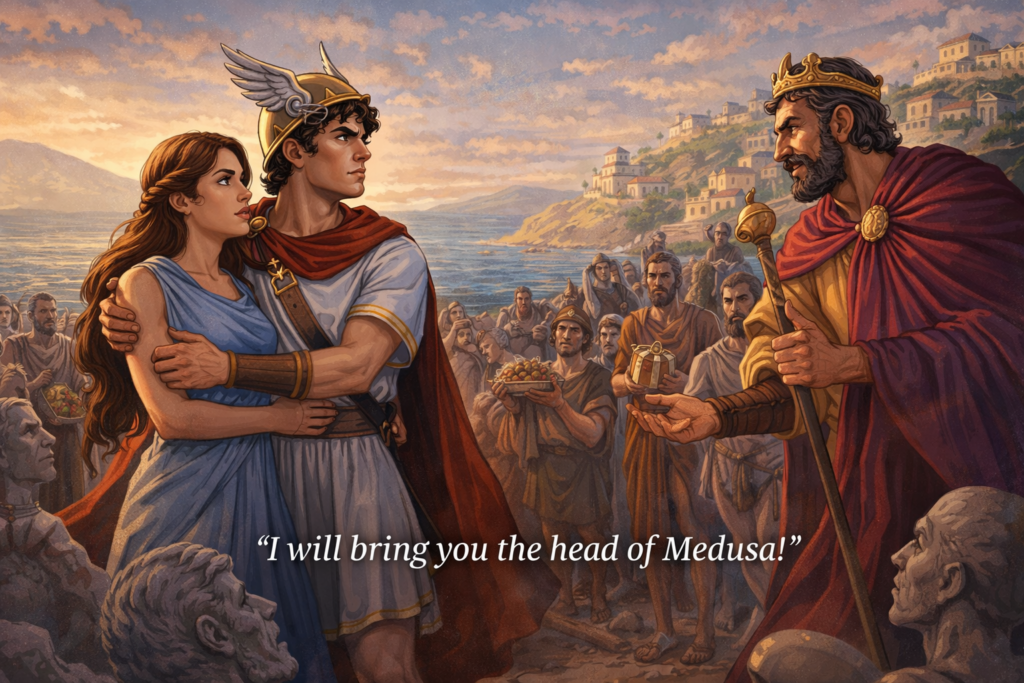
One day, Polydectes demanded that every man bring him a gift. All brought a variety of gifts, except Perseus. As punishment, Polydectes ordered him to bring a heroic gift. Wanting to appear brave and capable, Perseus boldly claimed he could bring back the head of Medusa, the most feared of the Gorgons.
The king accepted this promise at once, certain that Perseus would never return.
Medusa was no ordinary enemy. Her hair was made of living snakes, and her gaze could turn any living being into stone.
Many warriors had gone to her island before, and none had survived. The land around her was said to be filled with statues, once-living men frozen in terror.
Yet Perseus was not abandoned.
The gods Athena, goddess of wisdom, and Hermes, messenger of the gods, watched over him. They guided him and gave him special gifts: a mirror-like shield, a sharp, curved sword, winged sandals to fly, and a helmet that made him invisible. These gifts were not meant to replace courage, but to guide it.
True strength is not wild power, but courage guided by wisdom.
With his mission clear and his heart steady, Perseus began his journey.
The Mediterranean Sea lay far below him like a deep blue rug, dotted with white waves and tiny ships that looked like toys.
One evening, Perseus flew high above the Mediterranean Sea. Below him, the water looked like a vast blue carpet, dotted with tiny white waves and ships so small they seemed like toys.
The islands of Greece rose from the sea like scattered mountains. The sky had already grown dark, and strong winds pushed him forward, as if the world itself knew where he was going and urged him on.
Perseus wore the helmet of invisibility, a powerful gift from the gods. Though unseen by others, he was surprised to notice that he could still see his own arms and legs.
Yet when he looked down at the sea, his reflection was gone. Trusting the gods Athena and Hermes, who had guided and protected him, Perseus took out his curved sword and his shining shield, polished so smoothly that it reflected like a mirror.
But then fear crept into his mind.
“How can I fight Medusa?” he thought. “If I close my eyes, I cannot strike her. But if I open them and meet her gaze, I will turn to stone.”
Sometimes, the greatest danger is not outside us, but inside our thoughts.
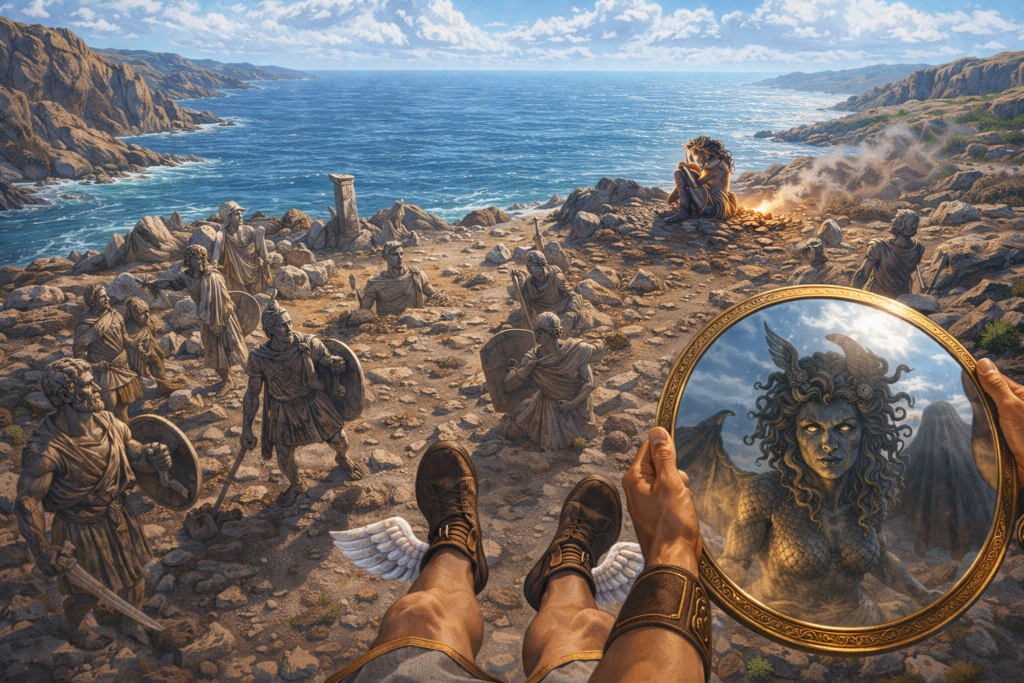
There was no turning back now. Ahead of him lay the dark island of the Gorgons. As he drew closer, Perseus saw something terrifying. The land was filled with stone statues, men frozen in fear. Some held bows of granite, others swords of basalt or shields of marble. Their eyes were wide and empty, their faces twisted in terror. These were once living people who had made one fatal mistake: they had looked into the eyes of Medusa.
Invisible, Perseus flew onward, squinting carefully, ready to shut his eyes at the smallest sign of danger.
Soon, he saw flickering flames ahead.
For a moment, Perseus forgot himself and stared, then quickly shut his eyes. Sitting near a fire was a monstrous creature with scaly skin, wings, and snakes for hair.
This was Medusa, the only mortal Gorgon, whose gaze could turn any living being to stone. She had not noticed Perseus, thanks to his invisibility.
“How can I get close enough to strike?” Perseus wondered desperately.
Then a brilliant idea came to him.
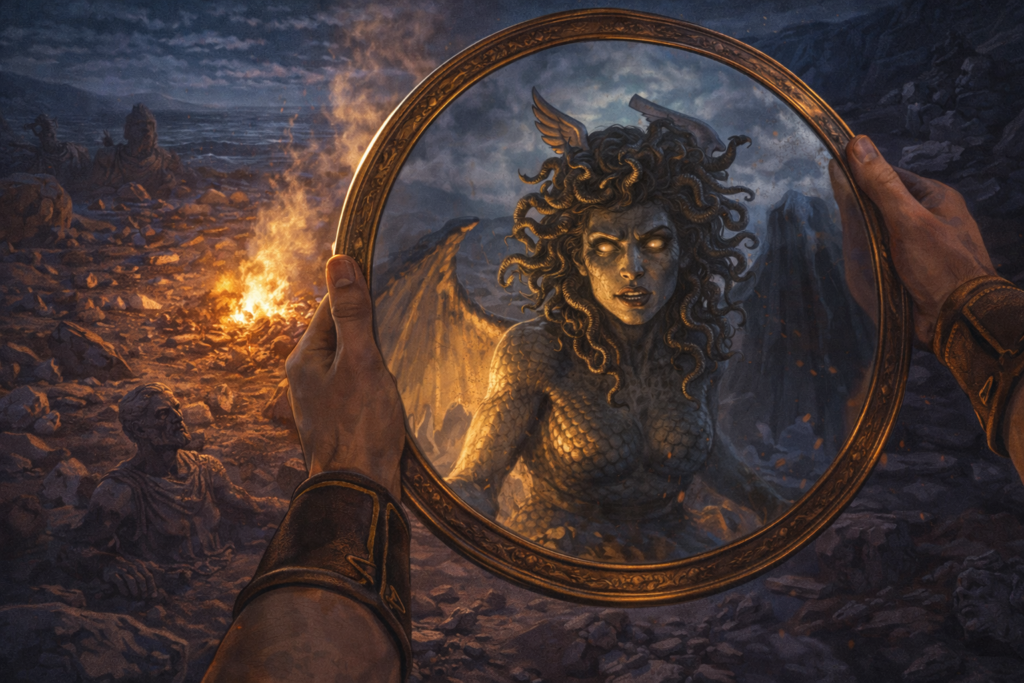
The firelight danced across Medusa’s scales, and Perseus realised he could see her reflection. Slowly, carefully, he lifted his polished shield and looked into it.
Like a bronze mirror, it showed Medusa clearly, yet safely. Her deadly power worked only through direct eye contact.
“Let us see if wisdom can defeat terror,” Perseus whispered.
Flying backwards, unseen, he moved closer.
Medusa suddenly stiffened. She sensed something nearby. Perhaps she heard the soft beat of winged sandals or felt a shift in the air. Her eyes widened, her nostrils flared.
“Where are you, mortal?” she hissed.
“Do not hide. I like to be looked at. I am sure you have beautiful eyes. Let me see them.”
Perseus clenched his teeth. Fear knocked at his heart, but he did not open the door to it.
With one swift, perfect movement, he swung his sword, guided by reflection, not sight. The blade flashed. Medusa’s head fell.
Perseus kept his eyes tightly shut. Carefully, he felt for the fallen head, placed it inside his special bag, and pulled the drawstrings tight. Only then did he breathe again.
Victory achieved through patience is stronger than victory gained through force.
With a cry of triumph, Perseus rose into the night sky.
As dawn painted the sky with soft pink light, Perseus saw something alarming below. A massive sea serpent raced through the water toward a rocky cliff by the shore. On that rock stood a young woman, chained and trembling.
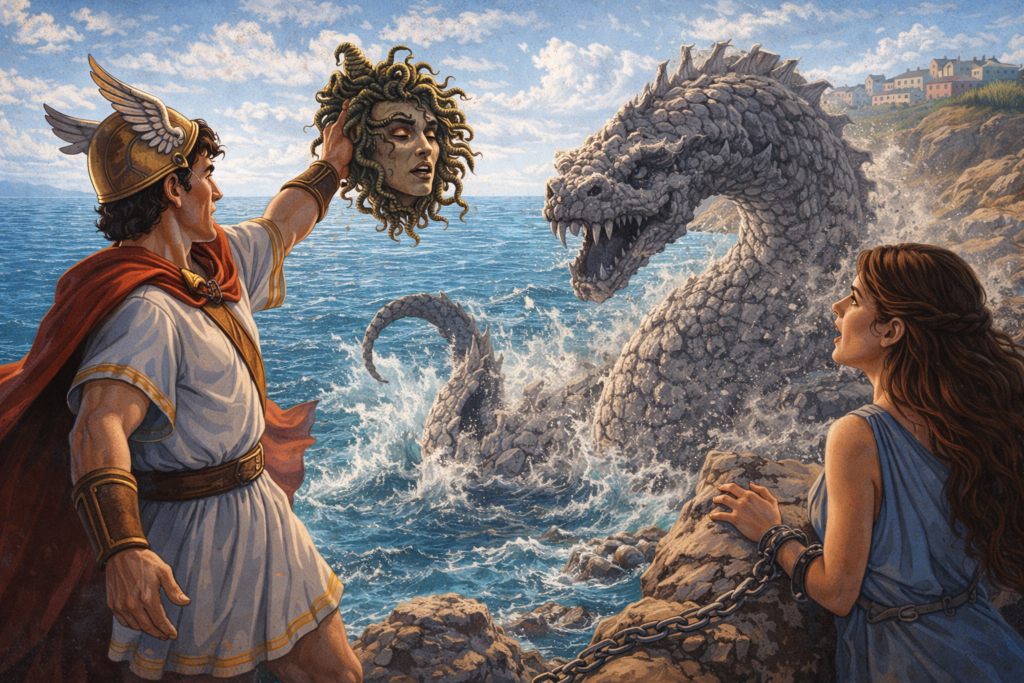
Perseus descended quickly.
“What is happening?” he called. “Who chained you here?”
The girl was pale with fear, but she spoke bravely.
“I am Andromeda, princess of Aethiopia. My mother, Queen Cassiopeia, boasted that I was more beautiful than the sea nymphs. The sea god Poseidon grew angry and sent this monster to destroy our land. The priests said only my sacrifice would save my people.”
Her voice broke as the serpent rose from the sea.
Perseus did not hesitate.
He pulled Medusa’s head from the bag and flew between Andromeda and the beast. One look was enough.
The serpent froze, its skin turning grey, hardening into stone. With a thunderous crash, it fell back into the sea.
True courage is acting before fear has time to speak.
Perseus freed Andromeda and lifted her gently.
“I will keep you safe,” he said. “But first, I must finish what I started.”
They flew westward together.
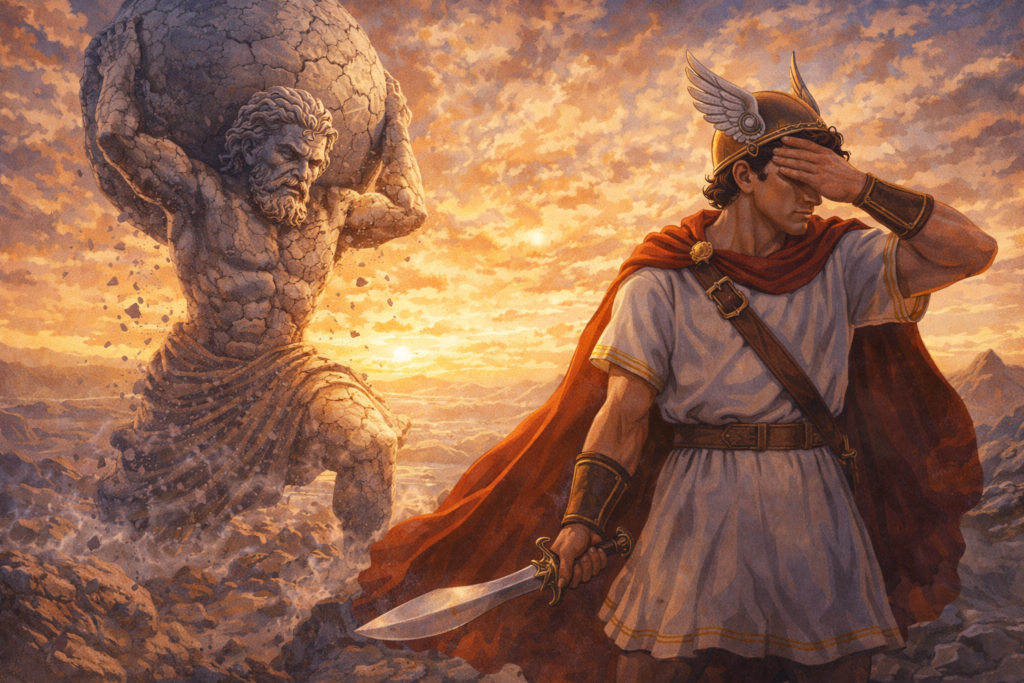
Soon, they reached the land where Atlas, the ancient Titan, stood forever holding up the heavens as punishment. Perseus landed and placed Andromeda gently on the grass.
Atlas looked surprised.
“You have returned, hero. But you bring a mortal woman, not Medusa.”
Perseus showed the bag.
“Medusa’s head is here. Are you certain you wish to be freed, even if it turns you to stone?”
Atlas gazed across the bright world, the sea, forests, and fields. Tears filled his eyes.
“I am sure. But tell me your name.”
When Perseus answered, Atlas nodded slowly.
“Another son of Zeus… but kinder than most.”
Perseus made sure Andromeda covered her eyes. He closed his own. The crackling sound filled the air. When Perseus looked again, Atlas stood as stone, peaceful at last.
Freedom sometimes comes at a great cost, but peace can still be found.
Perseus then returned to Seriphos, where the cruel king Polydectes was about to marry Danaë. Perseus stormed into the palace.
“I have returned!”
When Polydectes mocked him, Perseus whispered to his mother,
“Close your eyes.”
Moments later, the hall fell silent. Polydectes and his followers were stoned.
Justice, though delayed, always finds its moment.
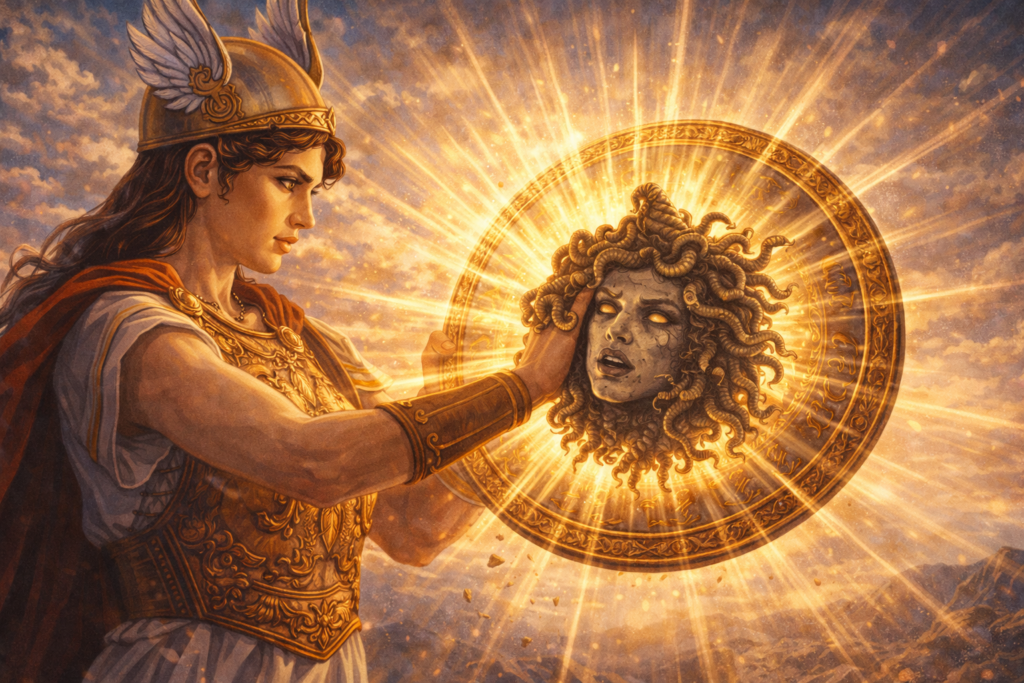
Outside, Athena appeared. She praised Perseus and took Medusa’s head, placing it into her shield, the Aegis of Zeus, so its power could be controlled.
“You no longer need these gifts,” she told him. “You have found your own strength.”
With hope in his heart, Perseus turned to his mother and Andromeda.
“Let us go,” he said, smiling.
“There is a whole world waiting.”
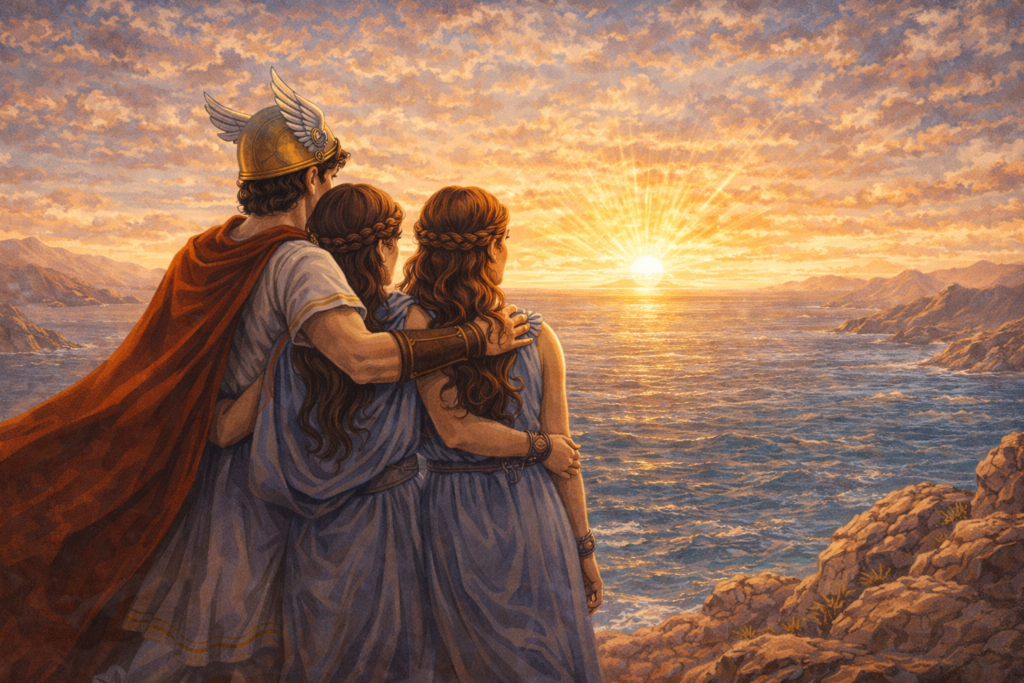
📖 New Book Released!
I’m excited to share that I have published a new book on Greek Mythological Stories. This book brings to life the fascinating tales of ancient Greece, filled with gods, heroes, kings, and unforgettable adventures.
If you enjoy stories about Greek mythology, legendary heroes, and epic tales, I warmly invite you to explore this book.
✨ If you would like to read more stories like this, please take a look at my book.
Thank you for your support and happy reading!