Laomedan – The King Who Broke His Word
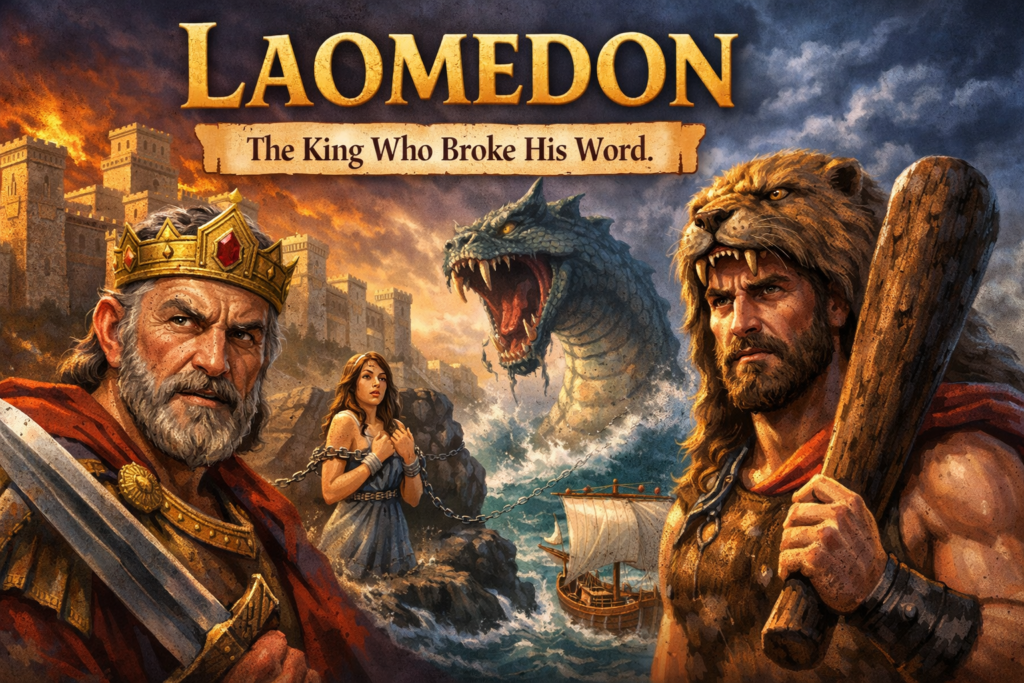
The King Who Broke His Word
Introduction to Greek Myths
Long ago, the people of ancient Greece told stories about powerful gods, brave heroes, and the choices that shaped the world. These stories are called Greek myths. They helped people understand nature, courage, pride, and the consequences of human actions. The gods were mighty but often emotional, and heroes were strong but not perfect. Through their adventures, these myths teach important lessons about wisdom, patience, honesty, and responsibility.
The King Who Broke His Word
Long before the famous Trojan War, before the wise King Priam ruled the great city of Troy, another king sat upon its throne. His name was Laomedon.
Laomedon was powerful and proud. As king, he ruled a rich city beside the shining sea. Ships from many lands came to Troy’s harbour to trade, and the people believed their city would last forever. Yet Laomedon had a dangerous weakness: he did not always keep his promises.
A promise may seem like simple words, but in truth, it is a bond between people. When someone breaks that bond, trust cracks like stone under a hammer.
Laomedon did not think much about this.
The King’s Fear
One day, the king stood on the high hill where his palace overlooked the city. He watched the distant plains and the restless sea.
“What if enemies come?” he wondered.
“What if they attack Troy?”
The thought troubled him. Troy was strong, but its defences were not perfect. If a powerful army arrived, the city could fall.
“I need walls,” Laomedon said to himself. “Walls so great that no enemy could ever break them.”
But building such walls would take many years and many workers. So the king decided to ask the gods for help.
The Two Gods
Among the gods of Olympus were two mighty brothers.
The first was Apollo, the shining god of the sun, music, healing, and prophecy. People prayed to Apollo for wisdom and guidance. His arrows could bring disease or cure it, and his music could calm even the wildest heart.
The second was Poseidon, god of the sea. With his great trident, he ruled the oceans, commanded storms, and shook the earth with earthquakes. Sailors feared and respected him, for the sea obeyed his will.
These two powerful gods came to Troy disguised as ordinary workers.
Laomedon spoke to them proudly.
“If you build mighty walls around my city,” he said, “I will reward you with something magnificent, a pair of divine bulls, sacred animals given to me by the gods themselves. They are strong, fearless, and more valuable than gold.”
Apollo and Poseidon agreed.
Sometimes, even gods enjoy testing the character of humans.
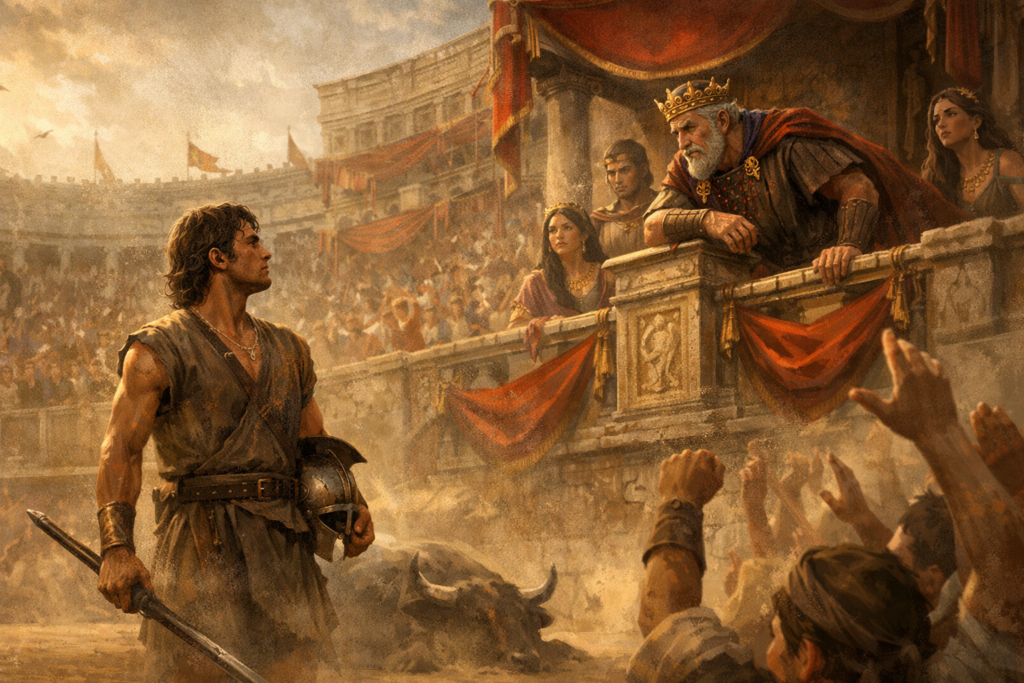
The Walls of Troy
Day after day, the two gods worked.
They lifted stones larger than chariots. They placed them with perfect skill. The walls rose higher and higher until they seemed to touch the clouds.
The people of Troy watched in amazement.
“Look how strong the walls are!” they said.
“No enemy will ever defeat us now.”
Indeed, the walls were magnificent. Towers stood along the edges, gates guarded the roads, and the shining stones seemed almost alive in the sunlight.
When the work was finished, Apollo and Poseidon came before the king.
“Our work is done,” said Apollo calmly.
“It is time for our reward,” added Poseidon.
The Broken Promise
King Laomedon looked at the walls.
They were perfect.
They were strong.
And suddenly a greedy thought entered his mind.
Why should I give away my sacred bulls? he wondered. The gods have already finished the work. What can they do now?
Pride whispered to him that he was clever.
So he laughed.
“Reward?” Laomedon said coldly. “You will receive nothing.”
The two gods stared at him.
Laomedon waved his hand dismissively.
“Be gone from my city!”
For a moment the air felt heavy and silent.
Apollo’s face showed quiet anger. Poseidon’s eyes burned like a rising storm.
Without another word, the two gods left Troy.
Sometimes pride makes a person feel tall, but it blinds them to the danger ahead.
The Sea’s Revenge
Not long after, disaster came.
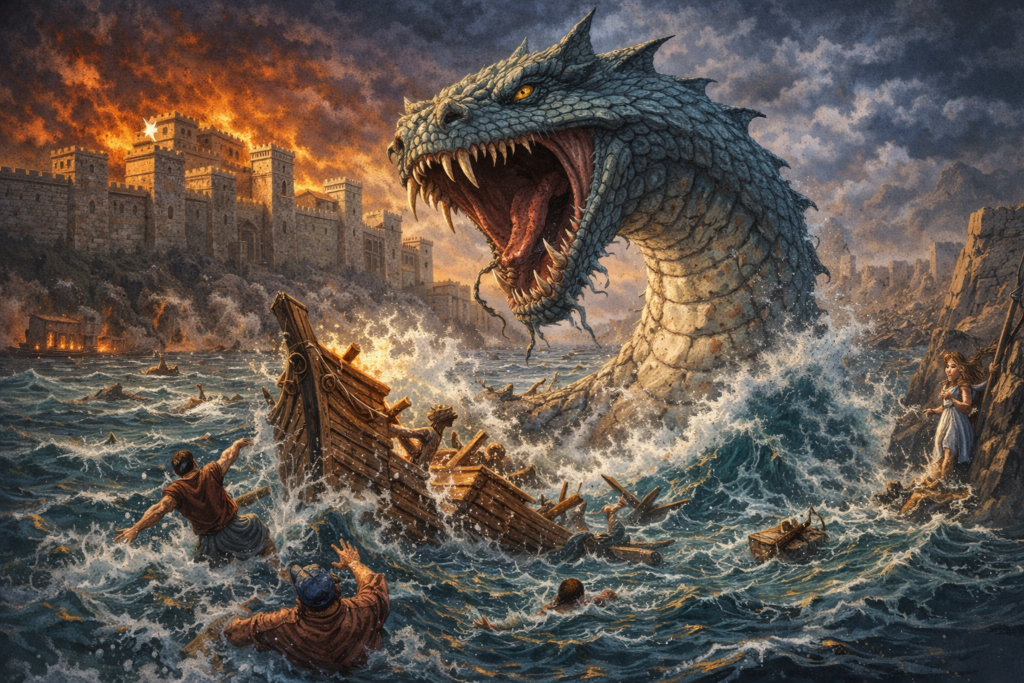
From the dark depths of the sea rose a terrifying creature.
It was a giant sea serpent, larger than any ship. Its head was shaped like a huge triangle, its jaws filled with curved teeth like swords. Its body twisted through the water in enormous coils, and its scales were thick like armour.
The monster attacked the harbour.
Ships were smashed.
Waves crashed over the fields.
Salt water flooded the land, ruining crops. Animals died. Fishermen were too frightened to sail.
Fear spread through the city.
People whispered in the streets.
“This must be punishment from the gods.”
Often when leaders act selfishly, it is ordinary people who suffer the most.
A Terrible Answer
Desperate, King Laomedon went to the priests of the temples.
“What must I do to stop this monster?” he demanded.
The priests prayed and studied the signs of the gods. At last, they spoke.
Their answer filled the room with dread.
“The sea god is angry,” they said.
“The monster will leave only if the king sacrifices his daughter to the sea.”
Laomedon’s heart became heavy.
His daughter Hesione was kind and gentle, loved by the people of Troy.
But fear ruled the king’s mind.
Fear can push people toward cruel decisions, especially when they think only of saving themselves.
At last, Laomedon made his choice.
The Princess on the Rocks
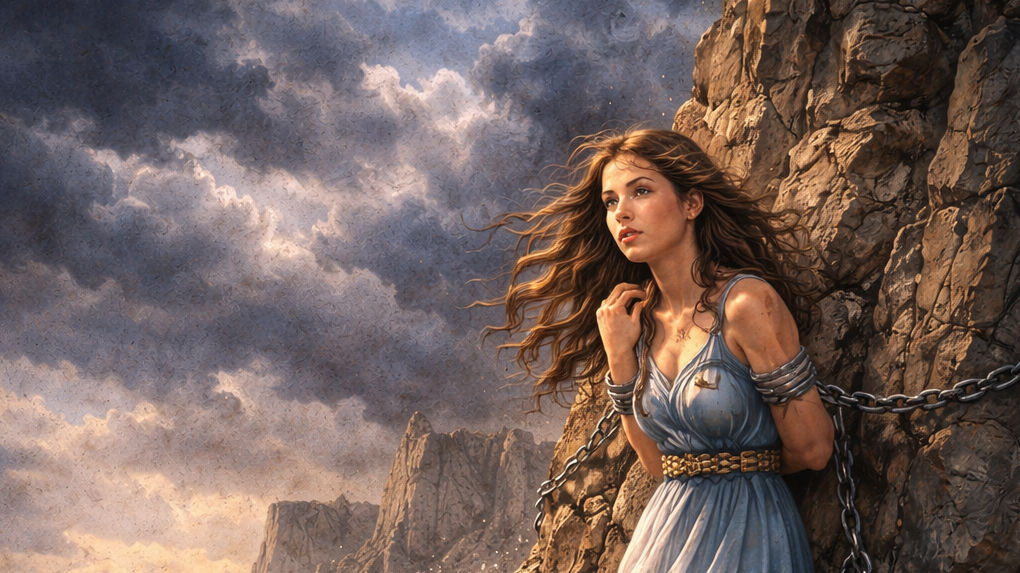
Hesione was taken to the shore.
Chains were fastened around her wrists and ankles. She was tied to the dark rocks beside the roaring sea.
The wind blew through her hair as the waves crashed below.
She tried to be brave, but inside she trembled.
“Father must have a reason,” she thought sadly.
Laomedon could not bear to watch. He turned away and returned to the city in tears.
But fate had other plans for Troy.
A Hero Appears
At that very moment, a ship sailed along the coast.
On board was one of the greatest heroes in all Greek mythology.
His name was Hercules (also called Heracles).
Hercules was the son of Zeus, the king of the gods, and a mortal woman named Alcmene. Because he was half god and half human, his strength was greater than that of any ordinary man. He was famous for completing the Twelve Labours, difficult tasks that no one else could survive.
Beside him stood his loyal friend Telamon, a brave warrior who had fought beside Hercules many times.
As their ship passed the shore, Hercules noticed something strange.
A young woman was chained to the rocks.
“That is no ordinary sight,” he said, narrowing his eyes.
The sailors steered closer, and soon Hercules learned the terrible story.
His face darkened.
“Leave a helpless person to a monster?” he muttered.
Justice sometimes begins with one person refusing to look away.
Hercules Meets the King
Hercules and Telamon went straight to the palace of Troy.
King Laomedon welcomed them with great excitement when he heard who had arrived.
“Great Hercules!” the king cried. “Is it true that you defeated the terrible Nemean Lion, whose skin could not be pierced?”
“It is true,” Hercules replied calmly.
“And the Hydra of Lernaea, the monster with many heads?”
“Yes.”
“And the wild Erymanthian Boar?”
Hercules lifted his heavy wooden club.
“I have faced many monsters.”
Laomedon leaned forward eagerly.
“Then you must defeat the sea serpent that plagues my city!”
Hercules crossed his arms.
“I will fight your monster,” he said slowly. “But I do not fight for nothing.”
The king quickly made a promise.
“If you save Troy, I will reward you with a pair of divine horses, the fastest and most powerful in the world.”
Hercules nodded.
“Then the monster will die.”
Responsibility means keeping your word, especially when the promise becomes difficult.
Waiting for the Monster
Hercules returned to the shore.
The sea looked calm and quiet, but he knew the creature was nearby.
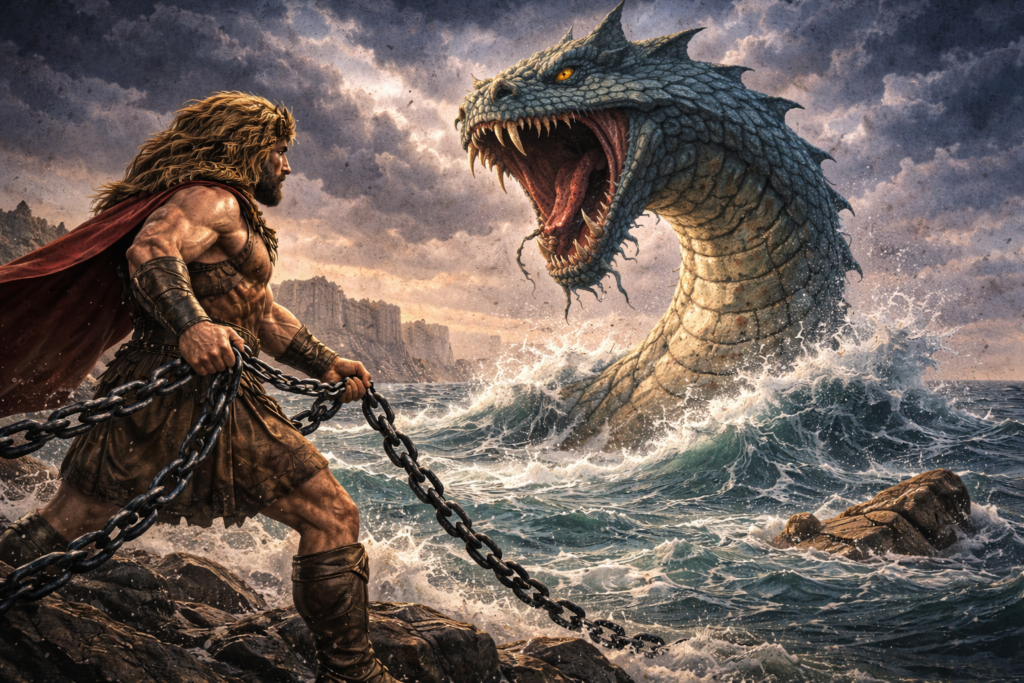
He took a heavy anchor chain from a ship and wrapped it around his arms.
Beside him stood Telamon.
“Are you ready?” Telamon asked.
Hercules watched the waves carefully.
“Patience,” he replied.
Patience is not doing nothing. It is holding steady until the right moment comes.
Suddenly, the water exploded.
The sea serpent rose from the depths, rushing toward the ship with a roar that shook the air.
The Battle in the Sea
“Take the ship to land!” Hercules shouted to Telamon.
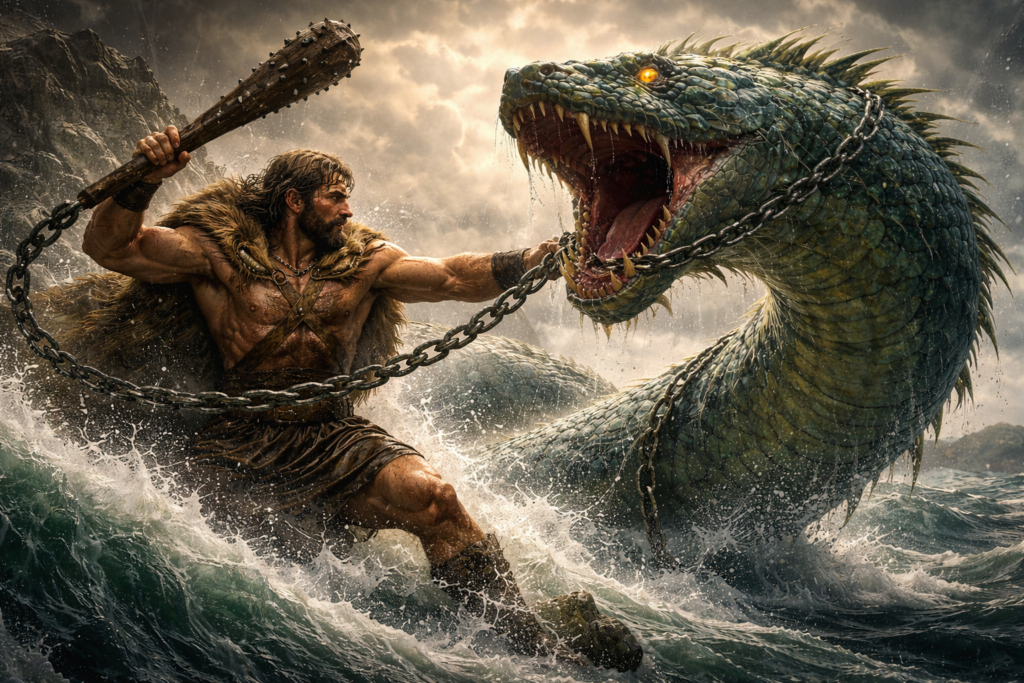
Then he leapt into the crashing waves.
The monster lunged toward him.
With perfect timing, Hercules hurled the anchor chain around the serpent’s neck and pulled it tight.
The creature thrashed wildly.
It dove deep into the sea, trying to drag him under. It smashed against rocks. Its enormous coils twisted around him like living towers.
But Hercules refused to let go.
Courage is not the absence of danger; it is the refusal to surrender to it.
He pulled the chain tighter and tighter until the monster could barely breathe.
Then Hercules drew his sword.
Again and again, he struck the serpent’s thick neck.
Finally, with one last powerful blow,
The head came free.
The sea turned red as the monster’s body sank beneath the waves.
Exhausted but victorious, Hercules swam back to the shore.
Celebration in Troy
The people of Troy cheered when they saw him.
“Hercules has saved us!”
Princess Hesione was freed from her chains. She thanked the hero with tears in her eyes.
That night, the city celebrated with a great feast.
Music filled the palace halls. Torches glowed against the new stone walls.
Yet the story was not finished.
Sometimes the greatest troubles begin after victory, when promises are tested, and pride begins to speak again.
Winning a battle is often easier than mastering one’s own pride.
A Promise Delayed
The next morning, King Laomedon asked Hercules if he wished to take the divine horses immediately.
But Hercules shook his head politely.
“I cannot take them yet,” he explained. “I still serve King Eurystheus, who ordered my twelve labours. Until my oath is finished, I cannot accept such gifts.”
He looked directly at Laomedon.
“Keep the horses safe for me. I will return one day.”
The king nodded.
“They will be waiting.”
Satisfied, Hercules sailed away across the sea.
Years passed.
The sea monster became only a memory.
Troy prospered.
But promises, even old ones, do not disappear.
The Hero Returns
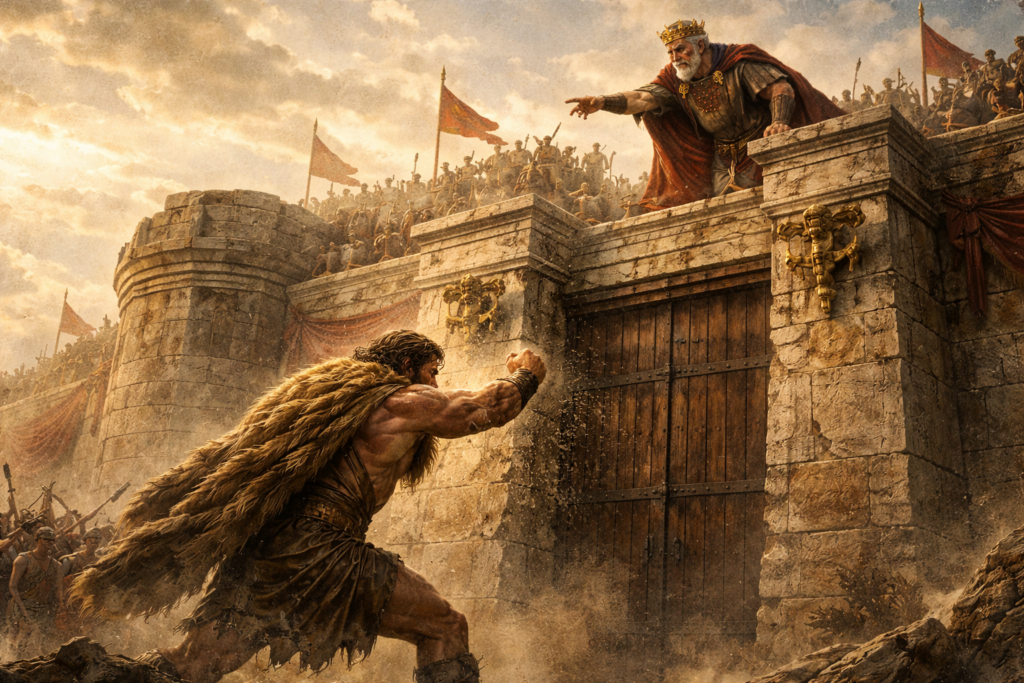
One day, Hercules returned to Troy.
He stood before the mighty walls, the very walls built long ago by Apollo and Poseidon.
He called out to the king.
“Laomedon! I have come for the horses you promised.”
The king climbed to the top of the great gate and looked down at him.
Then he laughed.
“These walls were built by the gods!” he shouted.
“You are strong, Hercules, but not stronger than the gods!”
Hercules’ eyes darkened.
The promise had been broken again.
When trust is broken twice, it is no longer an accident. It becomes a choice.
Hercules struck the walls with his fist so hard that the stones trembled.
“I shall return, liar Laomedon!” he roared.
“And when I return, both my horses and your head will be mine!”
A wise person learns from mistakes.
A foolish one repeats them.
But King Laomedon chose pride once more.
And the consequences were already beginning to gather like storm clouds over Troy.
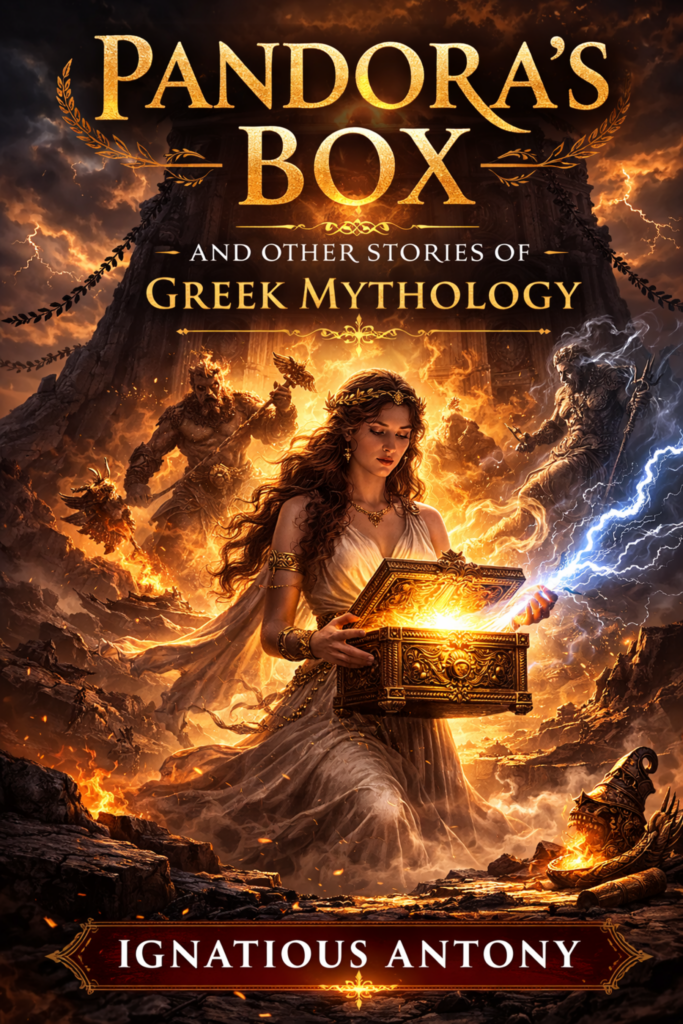
Pandora’s Box and Other Greek Mythological Stories
New Book Released!
I’m excited to share that I have published a new book on Greek Mythological Stories. This book brings to life the fascinating tales of ancient Greece,filled with gods, heroes, kings, and unforgettable adventures.
If you enjoy stories about Greek mythology, legendary heroes, and epic tales, I warmly invite you to explore this book.
✨ If you would like to read more stories like this, please take a look at my book.
Thank you for your support, and happy reading!