
I Lived Through Others
I Lived Through Others
Some lives grow like coconut trees – straight, tall, visible from far away.
Some lives grow like water plants – quiet, floating, moving wherever the current carries them.
Mine was the second kind.
I am Anitha, the daughter of the late Govindan Nair, a small government clerk who believed in neat files and early mornings. We lived in our old tiled house near Kanjikuzhi, where the town slowly gives up its noise and hands itself to evening insects, damp soil, and the smell of rain trapped in red earth.
After my father died, silence became my first companion.
His armchair stayed in the corner long after he was gone. Sometimes, while passing, I would slow my steps, as if he might still be sitting there, clearing his throat before speaking. Then I would remember. Silence would return, heavier than before.
I had a degree in Mathematics. People used to ask,
“Why didn’t you try for a government job?”
I did try. The forms were filled out. Exams were written. Results never came my way.
So I did what came quietly to my hands.
I took tuition for schoolchildren in the evenings – algebra, geometry, sums that frightened them. In the mornings, I did tailoring – simple blouses, school uniforms, and altered saree borders. The sound of the sewing machine became part of the house, steady and patient.
Money came slowly, but it came.
More importantly, days had shape.
Still, when night fell, when the students left, and the machine went silent, the house felt too large for one person. I realised then that numbers filled notebooks, not the heart.
Work can feed the body, but only presence feeds the soul.
One evening, years later, I was sitting on the back steps of the house. The stone was still warm. Mosquitoes traced circles around my ankles. From the neighbour’s kitchen came the sound of coconut oil heating, mustard seeds beginning to dance. The sky hung low, swollen with rain.
That was when Rajeev stepped into the yard.
He lived in the small outbuilding inside our compound. He was a freelance photographer, specialising in weddings, engagements, temple festivals, and church feasts. His income depended on light, crowds, smiles, and clear skies. Rain could erase a week’s earnings in one afternoon.
He stood there, looking upward, his camera bag slipping from his shoulder.
“Clouds again,” he said. “Always clouds when there is work.”
Then his words began to spill, fast and tired.
“People think photography is easy, Anitha. They don’t see the waiting. I stand for hours to catch one real moment. But they want quick photos, cheap albums, fake smiles. And now this rain – two bookings cancelled. EMI is still waiting.”
He laughed, but the sound cracked halfway.
“I feel like throwing this camera into the river and watching it disappear.”
I did not interrupt. I listened.
That night, after he went inside, I noticed something strange.
I was listening even after he stopped speaking.
Some hearts are built not to speak, but to receive.
Days passed. His worries entered my thoughts without asking permission. When he lost work, my chest tightened. When he spoke of light and angles, I began to notice how evening sunlight leaned gently on walls, how faces changed under shade.
One evening, sitting on the veranda steps, he asked quietly,
“Why do you listen like this?”
I searched for a clever answer and found none.
“Because if you keep everything inside,” I said, “it will grow heavier.”
He was silent for a long time.
Then he asked, almost like a child asking for shelter,
“If I fall… will you stay?”
I nodded, though I did not fully understand what I was agreeing to.
Before marriage, he spoke honestly, his eyes fixed on the ground.
“Doctors say I should not think about children now. Maybe not ever.”
I held his hand.
“Children come when they want,” I said. “Love can come earlier.”
We married simply.
It rained that morning – steady and quiet.
After marriage, I learned his language: light, frame of mind, and patience. I repeated his opinions as if they were my own.
“People don’t value good work,” I told my friends seriously.
“They want things cheap, not lasting.”
Love does not argue. It slowly agrees.
Then came Coimbatore.
He went for a large wedding shoot. Fever followed. Infection spread. Hospitals smelled of antiseptic and fear. He still tried to smile.
“Don’t worry,” he whispered once. “I’ll take your photo properly when I come back.”
He never came back.
The night I returned home alone, the house felt hollow, as if someone had scooped the air out of it. I cried loudly, then quietly, then not at all. After the tears dried, something worse remained.
Silence – filled with memory.
Sometimes I heard the click of his camera in my mind. Sometimes I waited for his complaints about the rain. Grief became a room I learned to walk through without bumping into furniture.
Loss does not end love. It removes its voice.
Years later, after evening prayers, I walked home slowly from the temple. Near the junction, Suresh Menon walked beside me. He owned a textile shop near the private bus stand. His voice was calm, like folded cloth.
“Life does not stop because we are tired,” he said gently.
Before marriage, he asked me,
“You don’t have children. Does that pain you?”
I shook my head.
“I have room,” I said. “That seems enough.”
Doctors later told us quietly that children were unlikely. Suresh accepted it without bitterness.
“Maybe,” he said, “we were meant to hold something else.”
Life with him was orderly – accounts, measurements, festivals, customers. I learned fabric names, seasons, and bargaining smiles. Slowly, his thoughts became my thoughts.
Then illness arrived – slow, patient, unstoppable.
On his last night, he held my hand and said,
“You know how to stay. That is a rare gift.”
After he died, I did not cry loudly. My tears fell inward.
Years passed. I agreed with everything anyone said. The world moved, and I moved with it, like driftwood.
Then one evening, Dr. Pradeep stood at my gate with his son, Sachin.
He was staying in the house next door. He asked me to look after his son after school until he returned from his clinic at night.
They had returned from Kannur, where he had worked in a private hospital. He came back to Kottayam after separating from his wife. She had left earlier, angry and unwilling to return.
Sachin ran into the yard, chasing my black cat, laughing freely. The sound startled something awake inside me.
I cooked without thinking. I listened without effort. I repeated his lessons.
“An island is land surrounded by water,” he said.
“Yes,” I repeated. “Land surrounded by water.”
Sometimes borrowed words rebuild an empty mind.
One night, a knock at the gate froze me.
“They are taking him away,” my heart whispered.
It was only his father returning late.
I lay awake, listening to Sachin murmur in sleep, smiling in the dark.
And then I understood something – not suddenly, but gently.
My life was not meant to grow outward.
It was meant to hold.
Like a well that does not travel,
but quenches whoever leans over it.
Outside, rain began to fall again – soft, patient, endless.
I did not curse it.
I listened.
Some lives are not remembered for what they achieved, but for what they sheltered.
And somewhere between the sound of rain on tiles
and a child breathing in sleep,
I finally felt –
not complete,
but rooted.
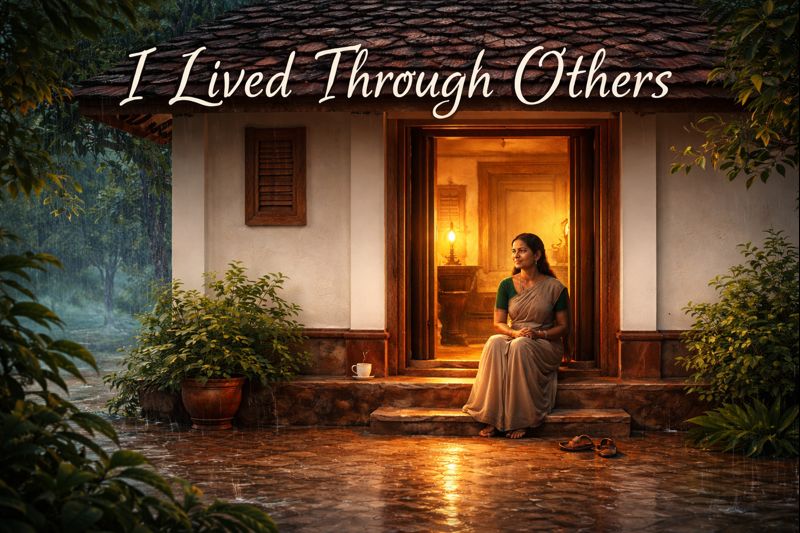
On some evenings, when the rain softens the tiled roof and the world slows down, I sit near the doorway and listen.
The sewing machine is silent now.
The tuition notebooks are stacked away.
A child sleeps in the next room, breathing like a quiet tide.
I do not ask life what it still owes me.
I only keep the door open, the lamp lit, and the floor swept.
If someone passes by, wet and tired, they will find a place to sit.
If no one comes, the rain will still arrive.
And that, I have learned, is enough.