
Hercules’s First Great Lesson: Stories from Greek Mythology
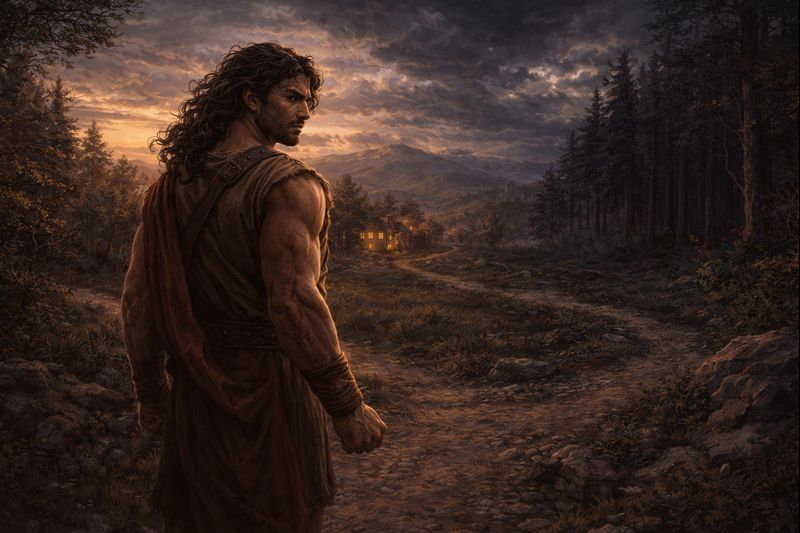
Hercules’s First Great Lesson
Long before Hercules learned to lift stones or break bows, his life had already been touched by the will of the gods.
Zeus, king of Olympus, had once walked among mortals in the city of Thebes. There he met Alcmene, a woman known not for beauty alone, but for her kindness, courage, and quiet strength. From that meeting, a child was born, a child who carried the blood of gods and the breath of humans.
Zeus knew such a child would face danger, for the gods do not look kindly on rivals, even infants. To protect the boy, Zeus arranged for Alcmene’s husband, Amphitryon, to raise the child as his own. Though Amphitryon did not know the full truth, he loved the boy without question, and Alcmene guarded him with a mother’s fierce heart.
The child was named Herakles, “the glory of Hera, a name Zeus chose in hope that it might soften the goddess’s anger.
But fate, once written, does not change easily.
A Boy Unlike Others
Hercules did not grow like other boys.
Since he could walk, people noticed it. When he ran, the earth seemed to feel his steps. When he played, wooden toys cracked in his hands. When he laughed, it echoed louder than it should.
At first, the people of Thebes smiled.
“He will be a great hero one day,” they said.
But Alcmene watched her son with quiet worry.
One morning, she saw Hercules lift a heavy stone that two grown men had failed to move. The boy stared at it, startled, and quickly dropped it.
“I didn’t mean to,” he said, frightened by his own strength.
Alcmene knelt beside him and cupped his face.
“I know, my child,” she said softly. “But strength must learn patience.”
Hercules nodded.
He wanted to be careful.
He truly did.

Raised Like a Mortal
Amphitryon insisted that Hercules be raised like any other boy.
“A strong arm is nothing without a calm mind,” he told him one evening, handing him a wooden practice sword.
“Strength must obey thought.”
“I will try,” Hercules promised.
And he did try.
But trying was not always enough.
When boys mocked him, he pushed back—too hard.
When teachers scolded him, he answered—too fast.
One afternoon, during archery practice, Hercules pulled back his bowstring. The wood groaned loudly.
“Easy,” the trainer warned.
“Not so much strength.”
Before Hercules could loosen his grip, the bow snapped in two.
The courtyard fell silent.
“I didn’t mean to,” Hercules whispered, staring at the broken bow. His hands trembled.
The trainer stepped back carefully.
“Put it down,” he said. “Slowly.”
Alcmene noticed it first. When Herakles was angry, the air around him seemed to tighten.
“Slowly,” she would say, placing her hand on his shoulder.
“Your strength lies in your heart. Keep your heart calm.”
Amphitryon taught him patience.
“Power is like fire,” he warned. “It can warm a home, or burn it down.”
Herakles tried. Truly, he did.
But strength grew faster than wisdom.
The Question Every Child Asks
One evening, when Herakles was about ten, he finally asked the question that had been living in him for years.
“Why am I not like the others?” he asked quietly.
Alcmene froze.
Amphitryon looked away.
After a long silence, his mother knelt before him and took his hands.
“There are things you must know,” she said softly.
“But also things you must keep hidden.”
“You are my son,” Amphitryon added firmly. “Never doubt that.”
Alcmene’s voice trembled.
“But your strength comes from Zeus.”
Herakles stared at them.
“The king of the gods?” he whispered.
“Yes,” Alcmene said. “And because of that, you must be careful. The gods do not always love what they create.”
Herakles frowned.
“If Zeus is my father, why isn’t he here?”
Amphitryon spoke sharply, glancing at the window.
“Do not insult the gods.”
Herakles clenched his fists.
“I don’t care if they are angry. If they come for me, I’ll face them.”
His mother pulled him into an embrace.
“That is exactly why you must learn control.”
A Life Almost at Peace
Years passed.
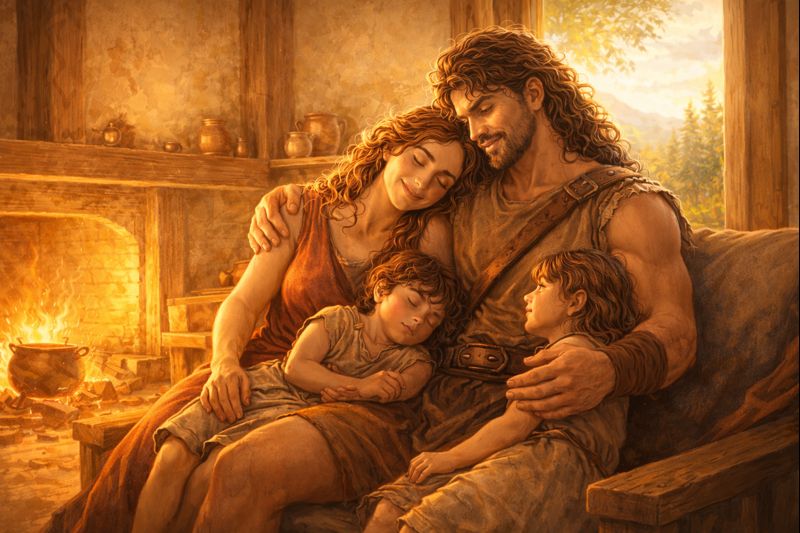
Herakles grew tall and broad, feared by many, admired by some. Although people whispered about him, one person saw beyond his strength.
Her name was Megara.
“You’re gentle,” she said one day, smiling.
“No one believes me when I say that.”
Herakles laughed, embarrassed.
“They don’t see what you see.”
They married.
They built a home with their own hands.
Children filled the house with noise and light.
For the first time, Herakles felt whole.
High on Olympus, Zeus watched with pride.
And Hera watched with something far colder.

Hera’s Silent Decision
Hera did not shout this time.
She did not argue.
She sat alone, staring down at the mortal world.
He has everything, she thought.
A family. Peace. Love.
Her fingers tightened.
If I cannot strike his body, she decided,
I will strike his mind.
She closed her eyes and whispered words that twisted the air itself.
“Go,” she murmured.
“Blind him. Confuse him. Let his strength betray him.”
A shadow slipped from Olympus, silent as breath, like smoke and sank into Herakles’ sleeping mind.
The Night That Broke a Hero
Herakles woke suddenly.
The room felt wrong.
The shadows moved.
His heart raced.
“Megara?” he whispered.
The world twisted before his eyes.
“Monsters!” he shouted, leaping up.
“They’re everywhere!”
To his broken mind, enemies closed in.
To the quiet house, horror unfolded.
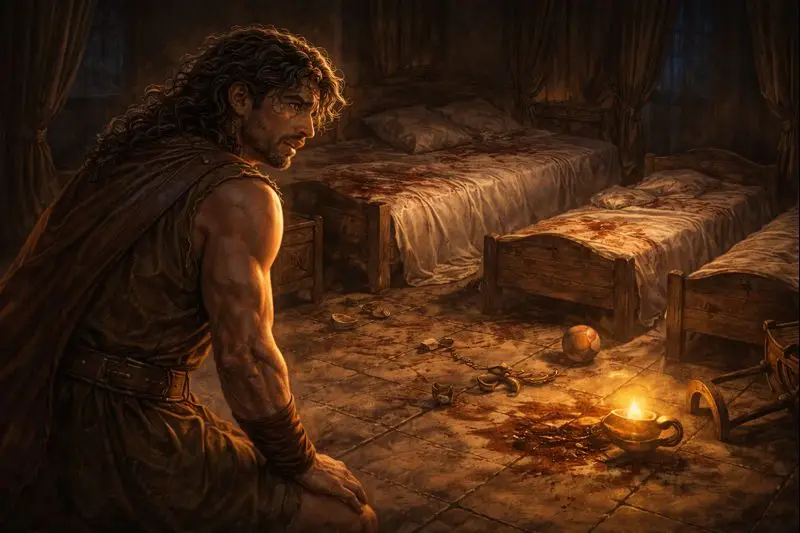
When the darkness lifted, Herakles dropped to his knees.
The truth stood before him.
“No…” he whispered.
“No, no, no…”
His strength had done what no enemy ever could.
Horror struck him. There had been no monsters at all.
His family, his wife Megara and his children lay dead before him,
and the terrible truth broke through his mind.
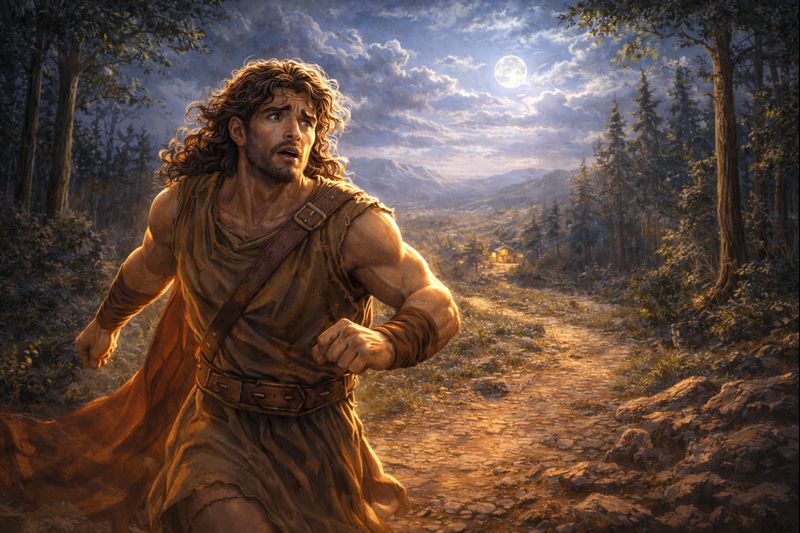
With a cry of pain, he turned and ran into the night.
He screamed into the empty house and fled into the night.
Exile and Guilt
For days, Herakles wandered alone.
“I can’t stay,” he told the wind.
“I can’t trust myself.”
He avoided towns.
He avoided people.
He feared the madness would return.
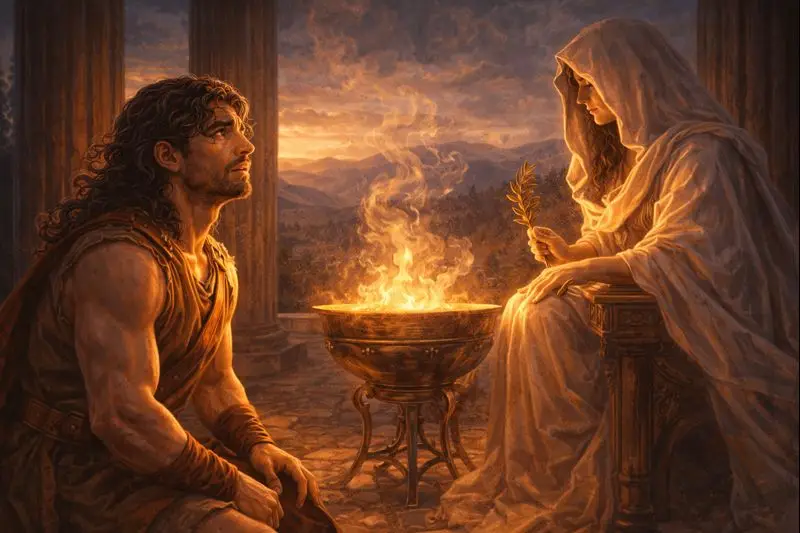
At last, broken and exhausted, he climbed the steps of the Temple of Apollo at Delphi.
Inside, a woman sat in the firelight, her eyes shining strangely.
“I know you,” she hissed.
“Son of Zeus.”
Herakles bowed his head.
“I don’t ask forgiveness,” he said.
“I ask for a way forward.”
The Pythia’s voice echoed like stone grinding on stone.
“Then you must suffer to heal,” she said.
“You must serve to be cleansed.”
“Tell me how,” he whispered.
“Go to Eurystheus, king of Tiryns,” she commanded.
“He will set your tasks.
Through them, your soul may yet be washed clean.”
Herakles rose slowly.
“So be it.”
Sometimes, the path to forgiveness begins with suffering.
A Truth Written in Pain
Power without control becomes destruction.
Strength without wisdom becomes tragedy.
Even heroes must learn this truth, sometimes too late.
As Herakles stepped away from Delphi, he was no longer just a man of strength.
He was a man about to face his greatest trial.
Herakles rose and walked into his fate.
Not as a hero.
Not as a monster.
But as a man learning the cost of strength without wisdom.
And far above, the gods watched.
The story of his labors had begun.