
Hercules, Bull and Mares: Stories From Greek Mythology
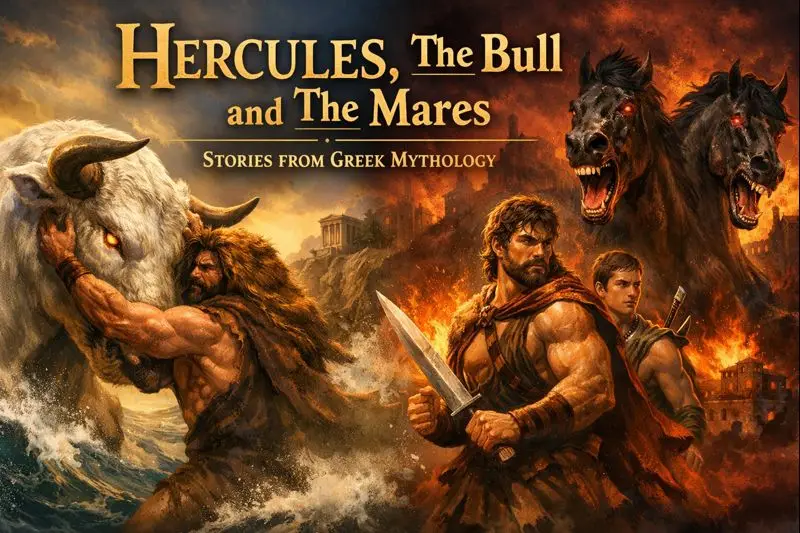
Hercules, Bull of Crete and Mares of Tiridia: Stories from Greek Mythology
Why Greek Myths Still Matter
Long ago, before science explained the world, the people of Greece told stories called myths. These were not just tales of magic and monsters. They were stories about human choices, mistakes, courage, and consequences.
Greek myths spoke of powerful gods who controlled nature and heroes who struggled between right and wrong. The heroes were strong, but they were also emotional, confused, and sometimes afraid, just like us.
These stories were told to help people understand life: how power can corrupt, how promises matter, and how true strength must walk hand in hand with wisdom and responsibility.
The Weight Herakles Carried
Herakles, the greatest hero of Greece, walked the earth with unmatched strength, but his heart was never light.
Though famous for his mighty arms, he lived under the shadow of deep sorrow and regret.
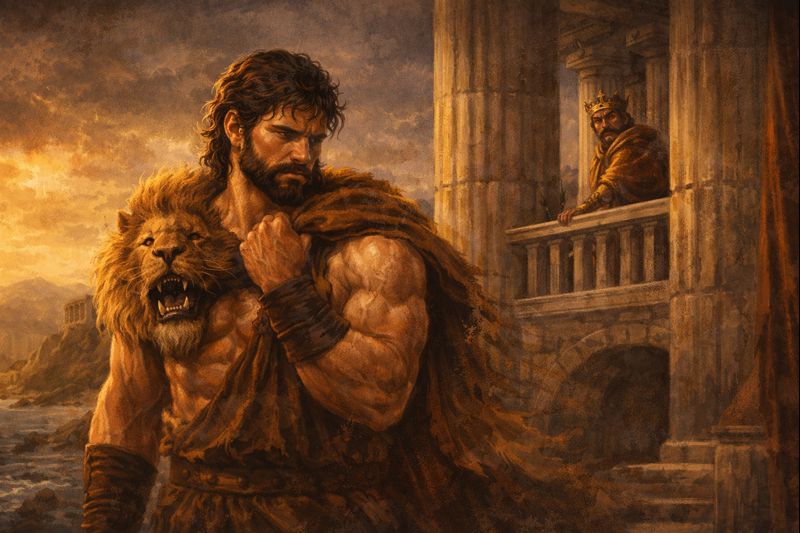
As punishment for terrible deeds committed in madness, he had been ordered to serve King Eurystheus of Tiryns, a weak and jealous ruler who feared Herakles’ strength.
Eurystheus set Herakles impossible tasks, hoping one day they would finally destroy him. These tasks were called the Labours.
Each labour tested not only Herakles’ muscles, but also his patience, judgment, and sense of justice.
The Bull of Crete
Herakles’ next task took him across the sea to the island of Crete. Crete was not a small or weak land. It was rich, busy, and powerful, ruled by King Minos, a king known for making laws and commanding fleets.
Yet when Herakles arrived, he did not see a proud ruler waiting. He saw a man who looked troubled and uneasy, as if a heavy secret sat on his chest.
Minos welcomed Herakles quietly and led him to a high place overlooking the island.
“That bull you hear about,” Minos said at last, his voice low, “was never meant to be my enemy.”
Herakles turned to him. “Tell me,” he said calmly.
Minos sighed. “The bull was a gift from Poseidon, god of the sea. It rose from the waves one morning, white as sea foam, strong as a storm. Poseidon asked only one thing: that I sacrifice the bull in his honour, to show respect and gratitude.”
He paused and then admitted, “But when I saw how perfect it was, I hesitated. I thought, why give up something so beautiful? So I kept it and offered another bull instead. I thought the god would not notice.”
Herakles said nothing, but inside he understood at once.
The gods always notice, he thought.
Minos continued his shame clear now. “Poseidon did not strike me with lightning. Instead, he made the bull mad. Its beauty remained, but its mind turned wild.”
The bull now raced across Crete like a living disaster. It smashed stone walls as if they were toys.
It tore up olive trees that families had cared for over generations. Farmers fled their fields. Children hid behind doors whenever they heard heavy hooves shaking the ground.
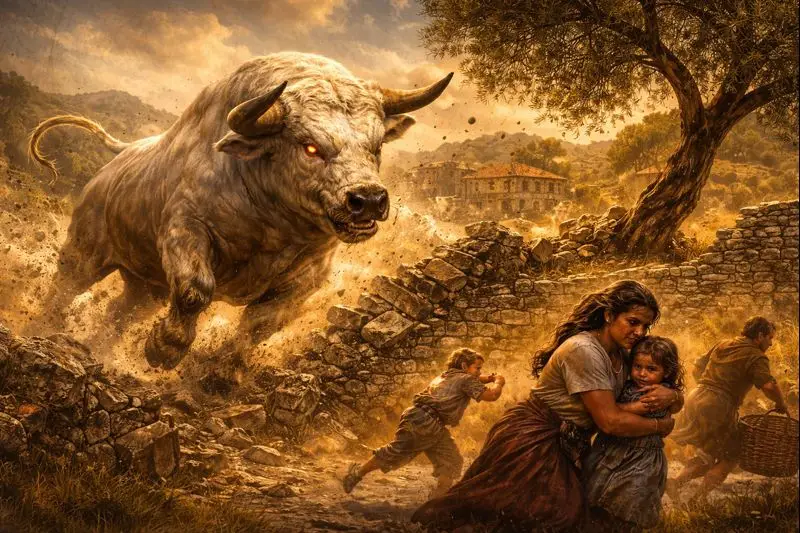
Villages lived in fear, never knowing when the bull would appear again.
“I created this suffering,” Minos said softly. “And I cannot stop it.”
Herakles listened carefully. He did not blame the king aloud, but he knew the lesson clearly:
When a promise is broken, especially a sacred one, the cost is never small.
Without boasting or delay, Herakles set out to find the bull. He followed broken paths, crushed trees, and frightened voices pointing the way. At last, near the rocky coast where the sea roared endlessly, he saw it.
The bull stood tall and powerful, its white coat glowing in the sunlight, its breath rising like mist. For a moment, Herakles felt something unexpected, not fear, but respect. The creature was not evil by choice. It was driven mad by a broken promise.
“This did not have to happen,” Herakles murmured.
When the bull charged, the ground shook. Dust rose. The air filled with the sound of thunderous hooves. Herakles planted his feet and waited. At the right moment, he leapt forward, seized the bull by its great horns, and held on with all his strength.
The struggle was fierce. Muscles strained. Breath burned. The sea wind howled around them.
At last, slowly, the bull weakened. Herakles forced it down and held it firm, not with anger, but with control.
He bound the bull and brought it to the temple of Poseidon, where proper prayers were spoken at last and the sacrifice was made with respect. The ground seemed calmer afterward, as if balance had returned to the island.
Yet Herakles felt no joy.
As he stood alone by the sea, he thought, doing what is right does not always feel good.
But wisdom is choosing what is right even when the heart feels heavy.
Crete was safe again. The task was complete. But the lesson remained, for kings, for heroes, and for all who heard the story.
Promises matter, especially when others depend on them.
Power without responsibility creates suffering.
True strength is not only in muscles, but in honesty and restraint.

A King Who Envied Freedom
Back in Tiryns, Herakles found Eurystheus reclining on a balcony overlooking the sea.
“A fine view,” the king said lazily, without turning. “You’ve seen many lands, haven’t you? I envy you.”
Herakles said nothing.
“As king,” Eurystheus continued, “I must stay here. But you, ah, you travel the world.”
Herakles clenched his jaw. Some men mistake comfort for greatness, he thought.
Then came the next command.
“Go north,” Eurystheus said, smiling thinly. “To Thrace. Steal the mares of King Diomedes. They say those horses eat men. Take care… or don’t.”
The Road to Thrace
As Herakles walked north, the land opened before him, wide plains, shining rivers, and forests glowing with green light.
The sun broke through clouds, painting the world gold.
“This is a punishment,” he told himself firmly. “I do not deserve joy.”
Yet the beauty forced its way into his heart.
“But the world is still beautiful,” he whispered. “And maybe that beauty is meant to be protected.”
The City of Fear
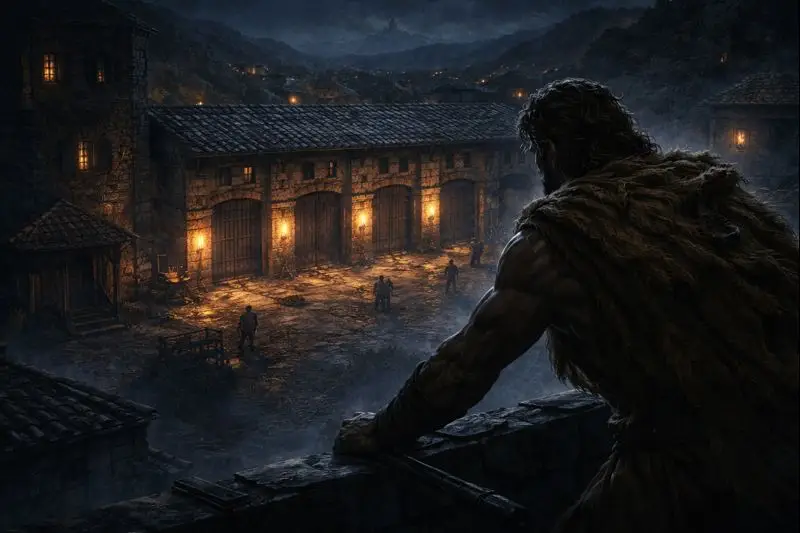
At dusk, Herakles reached Tiridia, the city where Diomedes was the King. Herakles wrapped his lion-skin cloak tighter and entered quietly.
“I’m a horse merchant,” he told the locals. “I hear the king has fine horses.”
People exchanged uneasy glances.
“You’ll find the stables there,” one man muttered. “But tread carefully.”
Herakles soon noticed something strange. The city jail stood directly beside the royal stables.
“That makes no sense,” he murmured. “Prisoners next to horses?”
Slipping into a narrow alley, he climbed the stable wall and peered inside.
A wide courtyard lay below. Four massive stable doors were reinforced with beams and chains.
“These aren’t stables,” Herakles whispered. “They’re cages.”
Suddenly, bang!
A prison door burst open.
Two guards dragged a chained man into the yard.
“Why here?” the prisoner begged. “Why bring me to the stables?”
“For freedom,” one guard sneered.
Then a tall man entered, wearing a golden circlet and carrying a richly decorated sword.
This was King Diomedes, ruler of Thrace, a warrior king who believed strength gave him ownership over everything, even life itself.
A Cruel Bargain
“Demetrios of Tiridia,” Diomedes announced. “You stole from me.”
“I was hungry, my king, ”
“Silence,” Diomedes snapped. “The law demands your hand. But I am merciful.”
The guards loosened the chains.
“If you can harness Deinos,” Diomedes continued calmly, “you may leave free.”
Demetrios stared in disbelief. “Thank you, my king!”
Herakles’ stomach tightened. Mercy that hides cruelty is the worst kind, he thought.
The Horror Revealed
The guards led out Deinos, the most feared of all the mares.
She was enormous, taller than any horse Demetrios had ever seen. Her muscles shifted under her skin like coiled ropes, and her eyes burned with a wild, hungry light that did not blink or soften.
This was not the look of an animal that feared humans. It was the look of an animal that waited for them.
Demetrios swallowed hard. His hands shook as the guards placed the shining harness into his grip.
“Easy now,” one guard muttered, stepping back quickly.
“Be quick,” said the other. “The king is watching.”
High above, hidden on the stable roof, Herakles leaned forward. His jaw tightened. Something in the mare’s stillness felt wrong. Too calm. Too ready.
Demetrios lifted the harness. The leather gleamed under the torchlight.
The moment it touched the stone floor,
Deinos screamed.
It was not a horse’s cry. It was sharp and terrible, like metal tearing. In one violent motion, she reared up, her hooves flashing in the air, and smashed them down onto Demetrios’ chest. He fell without even a chance to cry out.
Before the guards could move, the mare lunged.
What followed happened too fast and too horribly. Hooves struck. Teeth tore.
The yard filled with screams, then silence. Within moments, nothing remained of Demetrios but dark stains on the stone.
Herakles turned his face away, his stomach twisting. He had faced monsters, giants, and beasts, but this was different.
This was cruelty made into sport.
Below, Diomedes laughed.
His laughter echoed against the stone walls.
“One must understand horses,” Diomedes said lightly, as if explaining a small trick. “Once Deinos has eaten, she becomes calm. Gentle, even. For a day or so. Hunger is the problem.”
One guard cried out, “My king, please, don’t stand so close!”
Diomedes waved him away and stroked the mare’s neck with pride.
“That is why I use these magic harnesses. They keep the hunger… managed.”
High above, Herakles’ hands clenched into fists.
No, he thought grimly. Hunger is not the problem. Cruelty is. And cruelty grows when power goes unchallenged.
Justice Unleashed
Not long after, the iron gate groaned open again.
Another prisoner was dragged into the yard.
Younger this time.
Thinner.
Barely old enough to shave. His eyes darted around in terror as he saw the stains on the ground.
Herakles felt his chest tighten.
Enough.
He waited.
He listened.
Then he heard footsteps he recognized, the slow, confident stride of Diomedes returning to the yard.
As the king stepped fully inside, Herakles acted.
With a sudden, powerful pull, he yanked the ropes tied to the magic harnesses.
The yard exploded with sound.
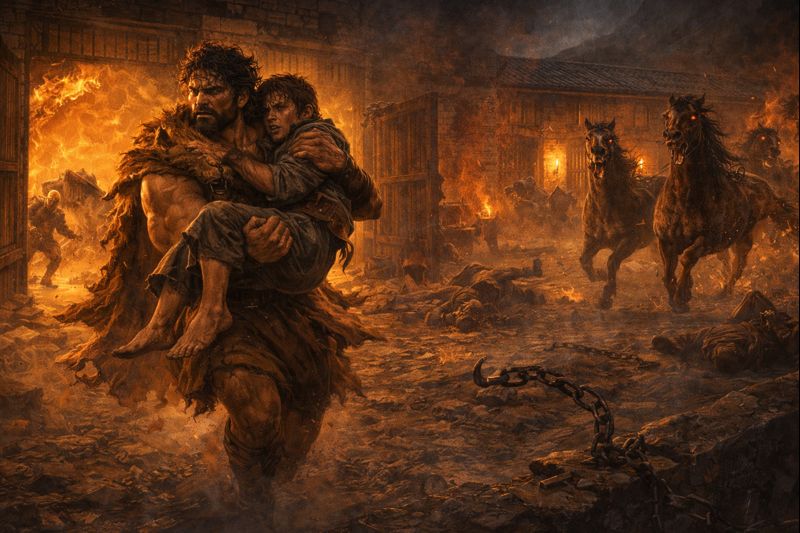
The mares screamed, high, furious cries that shook the air. Chains snapped loose. Wooden bars crashed to the ground. Doors flew open.
Chaos erupted.
Guards shouted. One fell. Another ran straight into a rearing horse.
Herakles leapt from the roof.
He landed hard, sprinted forward, and lifted the prisoner with one arm as easily as if he were a child.
Hooves struck the ground inches behind them. Hot breath rushed past his leg.
A mare lunged.
Herakles spun and kicked with all his strength.
Bone cracked.
The mare shrieked and staggered back.
With one final leap, Herakles vaulted onto the wall, the prisoner still in his arms. They landed safely on the other side.
From above, they watched.
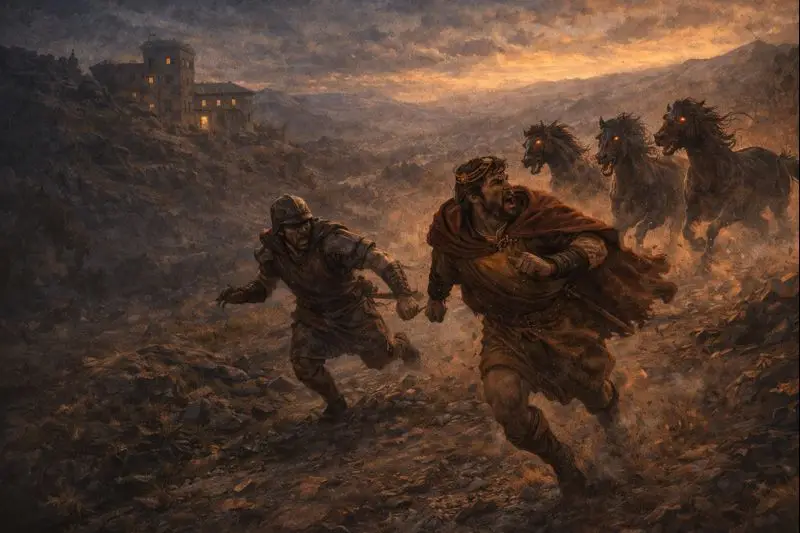
Diomedes shouted orders. The last guard screamed.
Neither escaped.
The mares were faster.
Then, silence.
The night seemed to hold its breath.
A New Ally
The rescued prisoner slid from Herakles’ arms, shaking, gasping for air. He looked up slowly, as if afraid this too might be a dream that would vanish.
“I… I don’t know who you are,” he said hoarsely. “But I know one thing. I should be dead.”
Herakles placed a steady hand on his shoulder. “You are alive. That matters.”
The young man swallowed. “My name is Philoctetes. I hunt deer. The king said all the animals in Thrace belonged to him.”
Herakles nodded. “Kings who believe they own everything usually forget they do not own justice.”
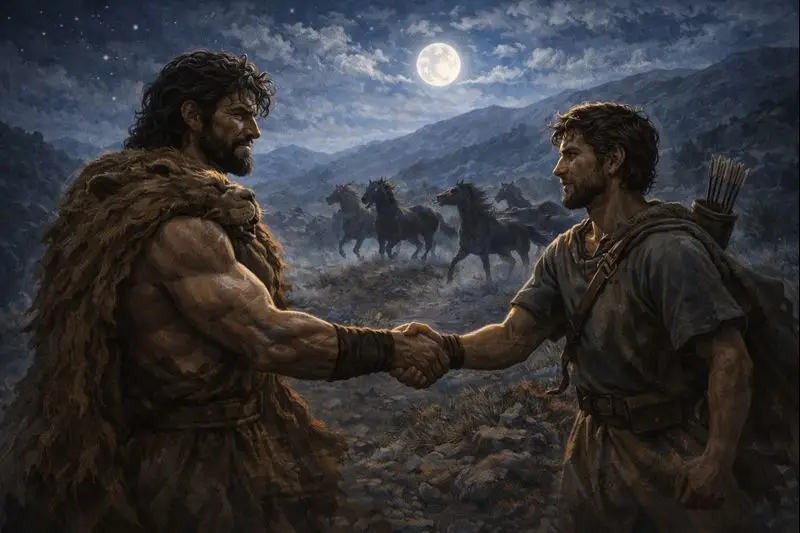
He extended his hand. “I am Herakles.”
Philoctetes took it firmly. “If you need help, now or someday, I will answer. A life saved is a debt I will never forget.”
Herakles smiled, just a little. “Then help me now. We must gather the mares.”
Philoctetes nodded without hesitation.
“You won’t do this alone.”
Cruelty often hides behind excuses
Power becomes dangerous when no one questions it
True justice begins when someone finally says: enough
Final Reflection
That night, Thrace learned a lesson its king never did:
Power without mercy destroys itself.
Strength without wisdom becomes a monster.
Herakles did not act from rage, but from responsibility.
And that is why, in Greek myth, he is remembered not just as the strongest man who ever lived, but as one who learned what true strength truly means.