
Athene and Poseidon: Stories of Greek Mythology
Stories of Greek Mythology: Athene and Poseidon
The world had grown full and lively. Thanks to the work of Prometheus and Epimetheus, the land, sea, and sky were now crowded with creatures of every kind. Birds filled the air with song, fish flashed through rivers and seas, and animals roamed forests and plains. Life followed a beautiful rhythm: wolves hunted deer, deer grazed on grass, and when all living things died, their bodies returned to the earth and helped new life grow.
Even humans, Prometheus’ most beloved creation, were flourishing.
At first, humans lived close to the foothills of Mount Olympus, where the gods could watch over them easily. They built small villages, learned to farm, raised animals, and lived. But as families grew and children were born, the land became crowded. Soon, humans began to move away, searching for new places to call home.
One group, led by a thoughtful man named Cecrops, travelled south. They passed Mount Parnassus and reached a wide, fertile peninsula near the sea. There, Cecrops noticed a great flat-topped hill rising above the land.
“This place is strong,” Cecrops said, shielding his eyes. “From here, we can see danger coming from every side.”
They named the hill the Acropolis, meaning high city, and built their settlement there. At night, they brought their sheep and cattle up the hill, safe from the wolves that prowled the lowlands. The people were content, and soon other villages sought to join them.
But Cecrops stood firm.
“We were here first,” he declared. “This land belongs to my people.”
Without realising it, Cecrops had become the first king in human history.
Leadership often begins before a person knows they are leading.
Zeus Calls a Council
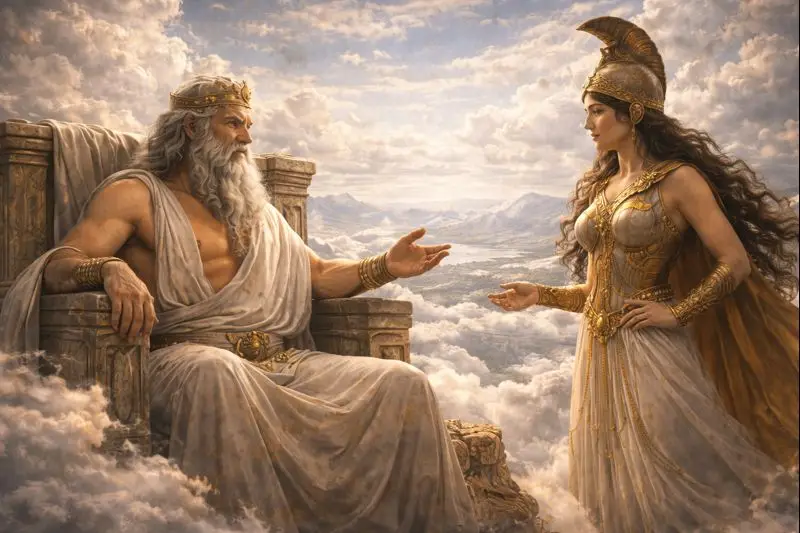
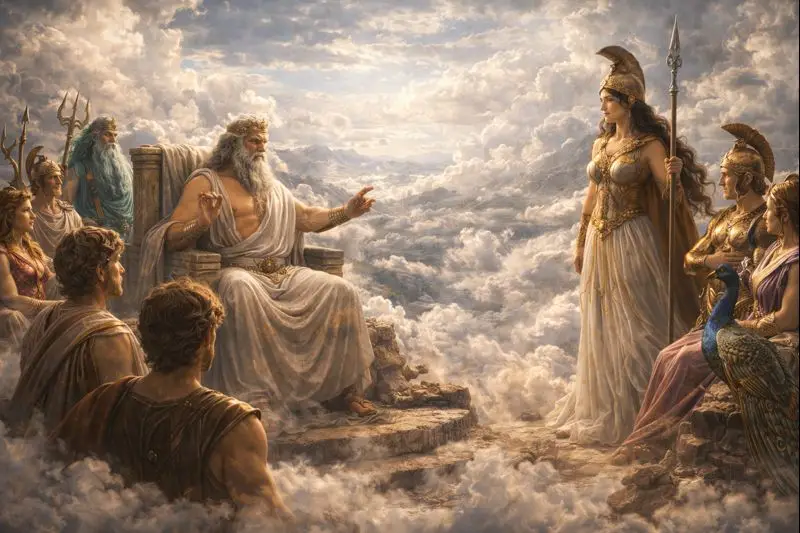
High above, on cloud-wrapped Mount Olympus, Zeus watched these events with interest. He called the gods together.
“Humans are no longer simple creatures,” Zeus said. “They are learning to build, to rule, and to dream. We must guide them, but we must also remind them who truly rules this world.”
The gods murmured in agreement.
“I propose this,” Zeus continued. “Each new city shall have a patron god or goddess. We will not rule directly, but we will guide, advise, and protect.”
Athene, goddess of wisdom, stepped forward. Her grey eyes were calm and thoughtful.
“Father,” she said, “wisdom is what humans need most. I offer myself as the patron of this new city.”
Before Zeus could answer, the ground trembled. Poseidon, god of the sea, struck the marble floor with his trident.
“What do you know of rule, niece?” he scoffed. “That city lies near the sea. Ships, storms, trade, and travel will shape its future. I should guide them.”
The two gods glared at one another.
Zeus smiled slightly.
“Let Cecrops decide,” he said. “A king must learn to choose wisely.”
True wisdom grows when choices carry consequences.
The Gods Visit the Acropolis
Athene and Poseidon flew down from Olympus like flashes of thought. Soon they reached the peninsula and saw the Acropolis rising proudly above fields, paths, and houses. Smoke curled from hearth fires, and the sea shimmered beyond.
“Cecrops has worked well,” Poseidon said, nodding in approval.
They spotted the king standing at the edge of the hill, gazing toward the sea.
When Cecrops turned and saw the gods, fear seized him. He fell to one knee, shielding his eyes.
“Do not be afraid,” Poseidon said kindly. “We have come to guide you.”
Athene lifted Cecrops gently to his feet.
“You are Cecrops, leader of these people?”
“I am,” he replied, trembling. “And you must be gods of Olympus. What brings you here?”
Poseidon’s Gift
Poseidon stepped forward proudly.
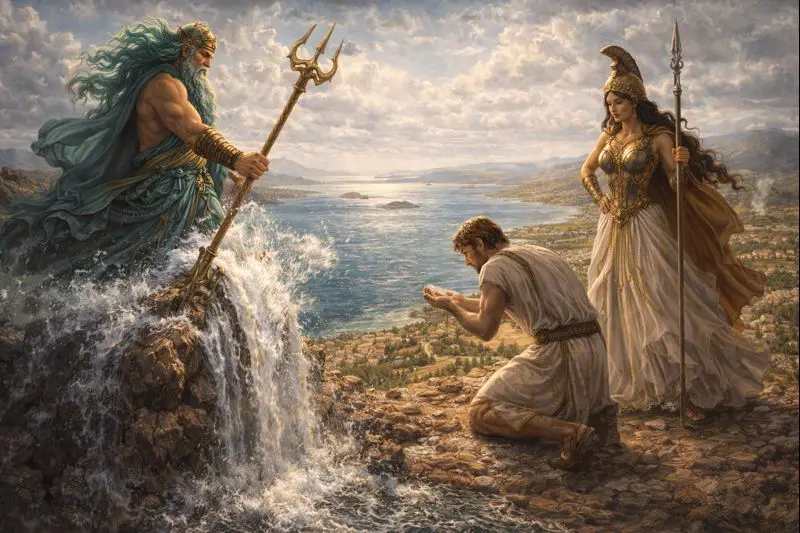
“You and your people have done well,” he said. “I am Poseidon, god of the wine-dark sea. Choose me as your patron, and I will open the world to you. Beyond the horizon lie islands, lands, and wonders you cannot yet imagine.”
He raised his trident and drove it into the rock.
With a roar, a fountain burst forth, water pouring down the cliff toward the sea.
Cecrops knelt and tasted it, then quickly spat it out.
“It is salty,” he said nervously. “We cannot drink it.”
Poseidon frowned.
Athene laughed softly.
“My dear uncle,” she said, “salt water is powerful, but not always useful.”
Athene’s Gift
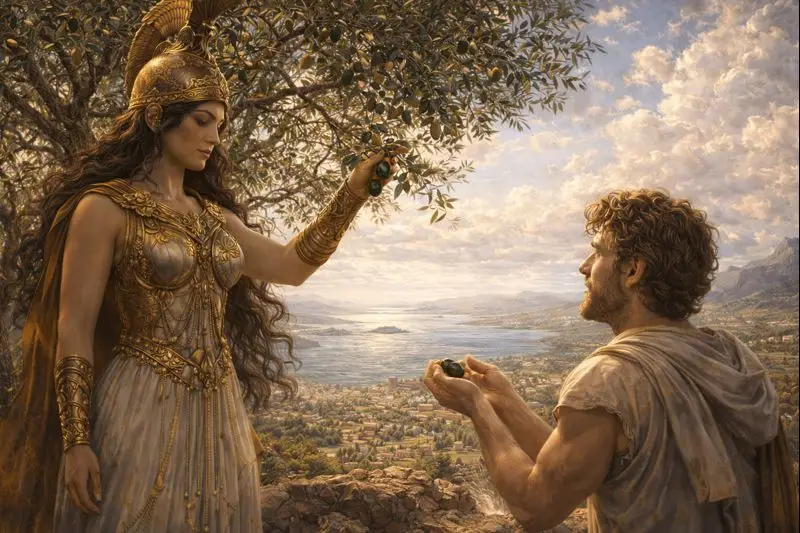
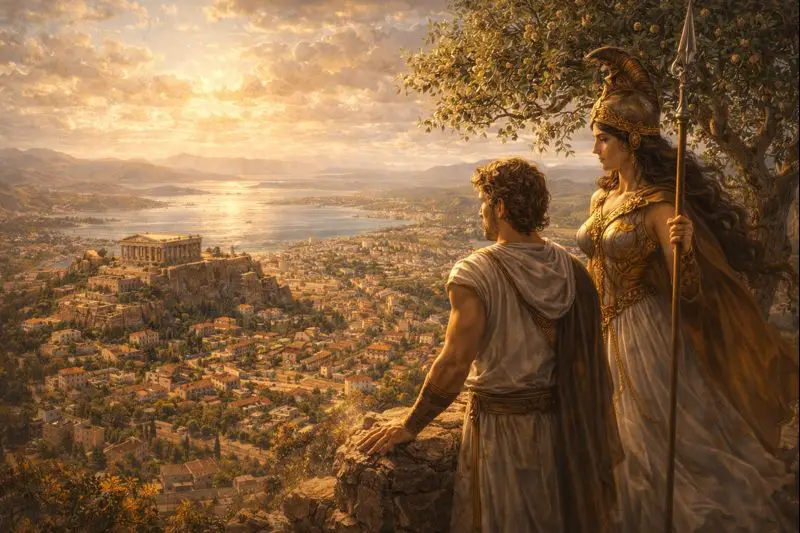
Athene stepped forward and cut a lock of her dark hair. She planted it gently in the soil.
Before their eyes, a small shoot appeared. It grew taller and taller until it became a strong olive tree laden with fruit.
Cecrops Chooses
Cecrops stared at the olive pit in his palm. He looked across the land, the hills, the plains, the sea. In his mind, he saw a great city filled with voices, learning, debate, and life.
At last, he straightened.
“Great gods,” he said, “I choose Athene as our patron. Her gift gives us a future where we can shape ourselves.”
Then he turned to Poseidon.
“But we will honour you always. The sea will remain sacred to your name.”
Poseidon studied the mortal, then smiled.
“You have chosen wisely.”
He stepped into the salt spring and vanished.
True strength knows how to accept a choice made with respect.
Athene picked an olive and placed it in Cecrops’ hand.
“My gift is wisdom,” she said. “Not answers, but the ability to choose. The olive feeds the body, lights the home, heals wounds, and brings trade. Like wisdom, it has many uses.”
Wisdom does not give easy paths, it gives the strength to walk difficult ones.
The Birth of Athens
Athene turned to Cecrops.
“And what shall this city be called?”
Cecrops smiled.
“There is only one name worthy of it. Let it be called Athens.”
And so Athens was born, a city of wisdom, learning, and choice