
At Jew Street, Kochi, Hope Took a Detour
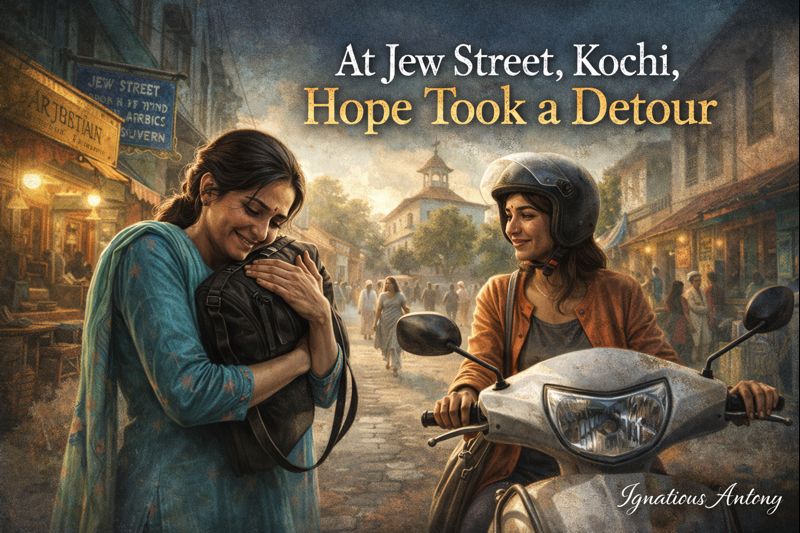
At Jew Street, Kochi
My daughter had come home after many years.
She had brought her little son, my grandson, with her, because she wanted him to see Kerala, not through pictures or stories, but with his own eyes. She wanted him to know where she came from. The rivers. The temples. The churches. The backwaters. The way evenings smell of rain and fried banana chips.
They arrived during the school holidays.
One morning, after an early breakfast, we decided to visit Fort Kochi. From there, we planned to walk through Jew Town, see the old synagogue, watch the Chinese fishing nets, and end the day near the beach before sunset.
It was meant to be a simple day.
We reached Ernakulam by train and took an auto to Fort Kochi. The streets were busy with tourists, schoolchildren, foreign backpackers, and local vendors calling out prices in loud, musical Malayalam.
My daughter wore a small cross-body bag. Inside it were her purse, phone, some cash, cards, and her passport copy, things she carried carefully, like all mothers do when travelling with a child.
As we walked through Jew Town, she stopped often.
To show her son the antique shops.
To explain why old houses had such thick wooden doors.
To buy him ice cream.
To take photos of painted walls and spice stores.
We walked through Jew Town. Bought him a small shirt and pants from a textile shop. Ate ice cream. Took photos near old walls that looked like they remembered more stories than they could tell.
At one point, near the synagogue, she slipped the bag off her shoulder to adjust her son’s cap. She placed it on a low stone ledge beside a shop, spoke to him gently, laughed at something he said, and then, without noticing, walked on.
None of us noticed.
We walked further. Bought lime soda. Watched the sea for a while. By the time we reached the café where we planned to sit, my daughter suddenly froze.
She reached for her shoulder.
Her face changed.
“Appa…” she said slowly.
“My bag.”
We searched her again. Panic rose quickly.
“My bag is missing,” she said louder now. “My money… my phone… everything is inside.”
For a moment, my grandson sensed the fear and went silent.
I asked gently, “When did you last remember having it?”
She tried to think. “I paid for ice cream… I had it then… after that… I don’t know.”
Then suddenly she remembered.
“Jew Town,” she said. “Near the synagogue. I kept it down for a moment.”
Her voice trembled.
“What if someone took it?” she said. “Appa, what if it’s gone?”
I could hear the fear behind her words, not just about money or documents, but the helplessness of losing control in a place full of strangers.
“Let’s go back,” I said. “Immediately.”
We walked fast. Almost ran.
As we hurried through the narrow streets, my daughter kept blaming herself.
“I should have been careful.”
“I was careless.”
“What will I do if it’s gone?”
I said nothing. Sometimes fear needs space, not advice.
When we reached the spot, the ledge was empty.
Her eyes filled.
For a second, she stood very still, like someone who had lost something much larger than a bag.
Then an elderly shopkeeper nearby spoke.
“You are looking for a small bag, alle?” he asked.
“Yes,” my daughter said quickly. “Did you see it?”
The man pointed inside his shop.
“Someone kept it with me,” he said calmly. “A foreign tourist found it and asked me to keep it safe.”
He went inside and brought out a bag.
My daughter stared at it for a moment, as if afraid to hope.
My daughter’s heart jumped.
But the moment she touched it, she knew.
It wasn’t hers.
Different zip.
Different lining.
Different weight.
Hope collapsed.
The worst part of fear is not losing something.
It is almost finding it, and losing hope again.
Her shoulders sagged. Her eyes searched the street helplessly. For the first time that day, she looked truly lost.
“What now?” she whispered.
We went back to the textile shop where we had bought her son’s clothes. We asked the owner. He shook his head gently.
“No one came here with a bag,” he said.
We retraced every step.
Again.
And again.
Each return felt heavier than the last. Her son sensed something was wrong and held her hand tightly. She kept apologising to him for reasons he could not understand.
At that moment, I saw something painful.
How quickly adults forget that life is not a straight line, that sometimes things fall apart not because we were careless, but because life wanted to remind us of our limits.
Then, unexpectedly, a scooter slowed beside us.
A young woman removed her helmet.
She looked at my daughter carefully and asked,
“Are you Aneeta?”
My daughter froze.
“Yes…” she said slowly.
The girl smiled and reached into her scooter’s storage compartment.
She pulled out the bag.
The right one.
For a second, no one spoke.
The girl handed it over, almost ceremoniously.
“I found it near the textile shop,” she said. “There was a name inside. I kept asking around.”
My daughter opened it with trembling hands.
Everything was there.
Nothing missing.
Relief came like a wave, strong, sudden, overwhelming.
Tears followed. She didn’t stop them this time.
“Thank you,” she said again and again. “You have no idea what this means.”
The girl smiled shyly.
“My name is Anjana,” she said. “I drive for Swiggy.”
They laughed, softly, awkwardly, like people meeting at the end of a storm.
We stood there longer than needed. Talked. Shared small things. Where she lived. How long had she been working? How difficult the roads were during the rain.
Before leaving, Anjana said something simple:
“I didn’t feel right keeping it. Some things are not meant to stay with us.”
That evening, as the sun sank into the sea, my daughter wrapped the bag around her shoulder, not tightly, but respectfully.
Later that night, she said to me,
“For a moment, I learned how quickly control disappears.”
I nodded.
“Yes,” I said. “And today, you also learned how quietly goodness appears.”
Later that evening, as we sat watching the sun sink into the Arabian Sea, she said softly,
“This morning, I thought the trip had gone wrong.”
I smiled.
“Sometimes,” I said, “what scares us brings us closer to people, to places, to ourselves.”
That night, when she told her husband about the day, she said only one line:
“I lost my bag in Kochi.”
Then she paused.
“And I found more than that.”
She still speaks to Anjana.
They exchange messages sometimes.
Not because of the bag.
But because something else was found that day.
Faith.