
After the Matinee Movie
After the Matinee Movie
There are some nights that never leave you.
They do not return often, but when they do, they arrive whole, unchanged, carrying with them the smell of old rooms and unfinished thoughts.
Memory does not knock politely; it enters the way it once lived.
This is one of them.
It was a matinee show in Thrissur.
Not a multiplex.
An old single-screen theatre with red plastic seats worn pale by years of use, a curtain that never quite closed, and the familiar smell of tea, sweat, and wet concrete.
The film itself has not stayed with me. Only its mood has. Someone loved too deeply. Someone hesitated too long.
Only that someone waited when he should have spoken, and someone suffered quietly because of it. Silence mattered more than dialogue.
People clapped loudly at the songs. Someone whistled too long, too eagerly, as if trying to announce youth itself.
I remember pretending not to care. Even then, I felt, without knowing why, that this was not just a film. We often pretend indifference when we do not yet know how to name what is stirring inside us.
I did not know then that something inside me had already begun to shift.
I was too young to recognise what moments were doing to me.
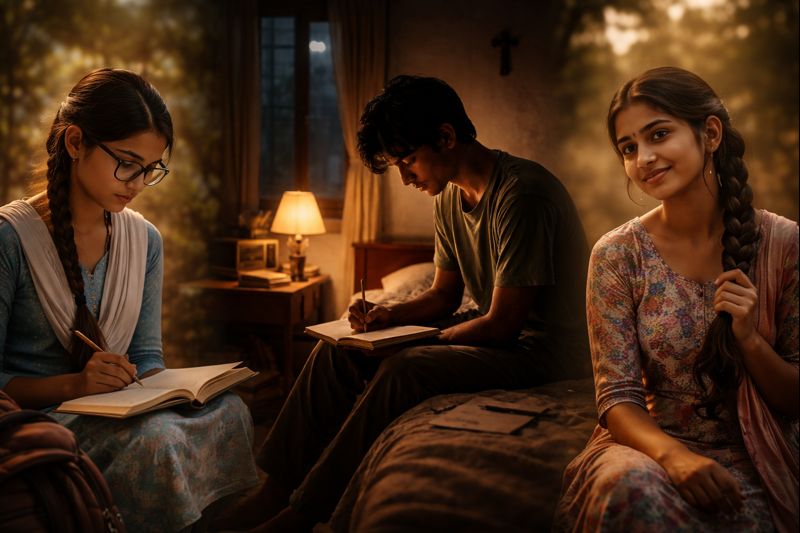
When I returned home, it was a little late. The house was quiet. Amma had fallen asleep early. The fan turned slowly, tired, patient, indifferent. I entered my room, closed the door gently, as though silence itself needed protection, and sat on the edge of the bed without switching on the light.
There was a restlessness in me that had no clear name.
Not sadness.
Not happiness.
Something unsettled, like a question that had learned how to breathe.
Some questions arrive long before language does.
I took out an old notebook, the one I never showed anyone, and began to write. I told myself I was not writing to anyone in particular. But even then, some part of me knew better.
“I love you,” I wrote.
Then, after a pause:
“But you don’t love me. Not really.”
I remember smiling.
It was a careless smile, the kind you wear before you understand that feelings demand payment later.
Youth smiles easily because it does not yet know what memory will charge.
I was sixteen.
At that age, everything feels permanent, especially confusion. I had not loved anyone in the way life would later teach me love. But I knew two girls cared for me. And knowing that felt heavier than joy.
Sheela.
Quiet. Precise. Her thoughts always moved ahead of her words. Physics came to her naturally, as if the world enjoyed explaining itself to her. When she spoke, nothing was wasted. I sensed even then that she was moving toward a life I would not follow, toward questions larger than people, toward answers that required solitude. I knew she would become someone important. Perhaps a scientist. Perhaps something even lonelier.
Some people are born with direction; others are born with longing.
And Reshma.
With her, music arrived before words. She sang without planning to. While waiting for buses. While walking home. While washing her hands. Her voice was untrained but honest. When she sang old film songs, rooms softened. People listened without realising they had stopped what they were doing.
Music does not ask permission; it simply reveals what was already trembling.
They were so different.
And I was not prepared for either.
That afternoon movie had unsettled something in me. The hero suffered beautifully. The heroine loved without defence. And suddenly, sadness looked meaningful. Being unhappy felt deep. Almost necessary. I mistook intensity for truth.
We confuse emotional height with emotional truth until experience teaches us depth.
I wrote again, thinking of Sheela.
“Please don’t say you love me,” I wrote.
“You are too capable. Too intelligent. You will do important work in this world. I will only slow you down. One day you will wonder why you ever met me. You are kind, that is the only reason you haven’t admitted it yet.”
Now, many years later, those words ache differently.
I was wrong.
But more than that, I was afraid.
Afraid of being ordinary beside her clarity.
Afraid of becoming small next to her future.
I disguised fear as concern. I mistook insecurity for sacrifice.
Fear often borrows the language of nobility to avoid naming itself.
My eyes blurred. The words dissolved. The tube light cast shadows heavier than they should have been. I stopped writing.
I leaned back and thought of Reshma.
How she closed her eyes when she sang. How her voice sometimes broke, not from lack of skill, but from excess of feeling. I remembered an evening near a temple courtyard, rain paused halfway, her singing softly while waiting for it to stop. People stood still without knowing why.
She felt reachable.
And that frightened me too.
What feels reachable also feels dangerous, because it asks us to step forward.
I remembered her laughter. Her ease. Her willingness to feel openly, without armour.
My tears dried.
I wrote again.
“I met Sheela yesterday,” I scribbled.
“She spoke about stars and time as if they were neighbours. You would like her. We sat talking late. Tea after tea. I wished you had been there.”
Then my hand stopped.
My head bent forward.
My hair fell onto the page.
And without warning, happiness rose.
Not joy.
Not excitement.
Something quieter.
Like warmth spreading where fear had been.
Sometimes the heart rests not because it has decided, but because it is tired of deciding.
I forgot both of them.
My thoughts scattered, Amma in the kitchen, the road outside, the pencil rolling on the table, the old radio near the window. I began to laugh softly, without knowing why. My shoulders shook. Tears came again, but this time from laughter.
To explain it to myself, my mind searched for something harmless.
“The dog,” I whispered.
“That silly dog.”
I remembered a stray barking at its own reflection in a shop window, retreating in embarrassment. Reshma had laughed until she cried that evening, singing between breaths. The memory felt safe. Manageable.
The mind reaches for simplicity when emotion becomes too large to hold.
I closed the notebook.
“No,” I told myself, with the false firmness of youth,
“Maybe I love Reshma.”
I tore the pages.
What followed felt like calm.
But it was not clarity.
It was relief, from thinking, from choosing, from understanding.
Relief is not resolution; it is only silence after noise.
I lay on the bed and stared at the ceiling. Everything felt good, not complete, but promising. I believed then that happiness was a beginning, that life would soon explain itself.
Summer would come. We would visit relatives. Evenings would stretch. Reshma would sing somewhere. Sheela would leave for college, perhaps far away. Life would move forward, quietly and efficiently, without waiting for me to decide who I was.
The breeze entered through the window, carrying the smell of damp leaves. A branch tapped softly against the grille, as if reminding me that time was already knocking.
I sat up, overwhelmed by something I could not name.
Above my bed hung a small cross.
I looked at it and whispered, not asking, not pleading, only admitting:
“Daivame… Daivame… Daivame…”
Faith, at that age, is not belief, it is surrender without vocabulary.
Now, many years later, I understand that night differently.
It was not love.
It was not a choice.
It was the first time life stood before me and asked a question I did not yet know how to answer.
At sixteen, I believed clarity would arrive on its own. I believed time would explain things gently. I believed that if something mattered, it would wait. I did not know then that life does not pause for unfinished hearts.
Time does not teach patiently; it teaches by moving on.
Sheela went on to a world of her own. I heard, years later, that she did very well. I was not surprised. She belonged to her work the way some people belong to silence. We never spoke again. There was no ending, only distance that grew quietly and became permanent.
Reshma sang for a few more years. Not on stages. Just in rooms, at weddings, on long bus rides. Then even that stopped. Life asked something else of her. When I think of her now, I cannot remember when I last heard her voice. That frightens me more than loss.
Some losses do not announce themselves; they simply fade until absence becomes ordinary.
What stays with me is not what I chose, but how lightly I believed choice worked.
That afternoon, tearing those pages felt decisive. Brave, even.
Now I see it for what it was.
I tore the pages because I was afraid to keep them.
Afraid that if I read them again, I would have to admit how deeply I felt, how unready I was, how much more time I needed than youth allows.
We destroy evidence when we are not ready to testify to ourselves.
I thought feelings were something you either acted upon or discarded. I did not know they wait. I did not know they return, not as desire, but as understanding.
Some nights, when the house is quiet and the fan turns slowly, I remember that room, the smell of paper, the half-dark, the foolish smile of a boy who thought intensity was wisdom.
I do not miss Sheela or Reshma the way one misses people.
I miss the version of myself who could still feel without caution.
Who had not yet learned to protect his heart by shrinking it.
Age does not take feeling away; it teaches it to walk carefully.
That night was not a beginning.
It was not an ending either.
It was a crossing I did not recognise.
And now, when memory brings it back, whole, unannounced, I do not wish I had chosen differently.
I only wish I had understood what was being given to me.
Because some moments are not meant to be kept.
They are meant to leave a mark.
And this one did.
Quietly.
Permanently.