
Aegeus & Theseus: Stories from Greek Mythology

Aegeus & Theseus: Stories from Greek Mythology
Introduction to Greek Mythology
Greek myths are ancient stories from Greece about gods, heroes, monsters, and kings. People told them to explain life, why courage matters, why choices have consequences, and why even powerful people struggle with fear, love, and duty. The gods in these stories are not perfect; they are strong, emotional, and sometimes unfair, so heroes must learn wisdom and responsibility. These myths still matter because they gently teach lessons in patience, justice, restraint, and bravery through unforgettable adventures.
The king who had “more than one thing” troubling him
Aegeus, king of Athens, was happy but for one thing.
“Well, more than one thing,” he admitted to himself wryly.
“I’m a king, so there are always things to do, things which upset my happiness, but the job is about serving my people, not being happy.”
He said that to himself often, especially on days when Athens felt heavy on his shoulders, laws to fix, hungry families to help, soldiers to pay, merchants to calm, and nobles to keep from arguing like children.
This month, Aegeus was not in Athens. He was in Troezen, a seaside kingdom where the air smelled of salt and warm sand. He had come to visit King Pittheus because Athens needed strong trade agreements.
For the past month, he had been visiting King Pittheus of Troezen, trying to work out a trade deal between Pittheus and a number of other cities.
Aegeus had sat through meetings where rulers argued over small things, how many ships, how much tax, who would guard which harbour.
Aegeus tried to hide his frustration. He pressed his thumb into the carved arm of his chair and thought, If they would stop shouting for one hour, we could save thousands from hunger.
But Aegeus had not minded, for that meant he could stay in Troezen a little while longer.
Because after the meetings, after the voices, the ink, the bargaining, the tense smiles, Aegeus had one peace.
Every day, after long hours in meetings with the different kings and queens, Aegeus would walk down to the shoreline to see Aethra.
Aethra of the sea, and the ache of duty
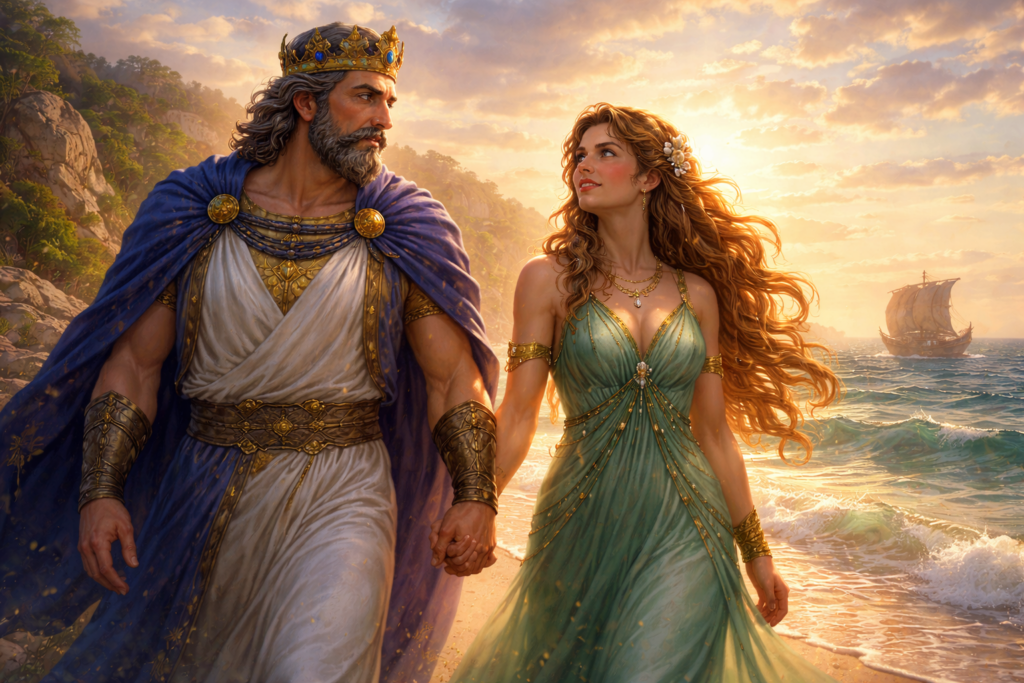
Aethra was a sea nymph, a daughter of the sea god Poseidon, and Aegeus was in love with her.
When she walked, it felt as if the shore itself were breathing. Her eyes were sea-green, and when she smiled, it was as if sunlight touched water.
But this was where sadness truly crept into his life: The trade deal was almost finalised, which meant that Aegeus could return to Athens.
“Indeed, I must return!” he reminded himself daily.
Aethra, however, was bound to the sea of Saronia, over which Troezen looked. That was her domain, which her father Poseidon had commanded her to care for. Both of them were bound by duty, and so soon they must be parted.
Sometimes Aegeus tried to argue with fate inside his head.
Why should a king be chained to a city?
Why should a sea-daughter be chained to a sea?
But the truth was simple: love does not erase responsibility. In myths, that is one of the hardest lessons, because even heroes cannot always get what they want.
A wise heart, Aegeus thought, is not the one that feels nothing… it is the one that still does what is right.
The walk on the beach, and the words that changed everything
The gentle slap of waves on the shore rested Aegeus’ mind as they walked along the beach hand in hand.
“Aegeus,” said Aethra slowly. “I have something to tell you.”
He frowned down at her; she looked nervous.
“What’s wrong?”
“Nothing!” She replied quickly, flashing him a smile that made her sea-green eyes sparkle.
“No, it’s good news, I think.”
Aegeus waited.
Aethra, like the sea, could not be rushed. She did things at her own pace.
“I’m pregnant, Aegeus. It’s a boy, I think.”
For a moment, Aegeus did not breathe. The sea wind touched his face as if the world itself paused to listen.
He opened his mouth to ask how she could possibly know that but then stopped himself. She was a sea-nymph after all.
“That’s wonderful!” He took her in his arms and kissed her.
But when they finally broke apart, they were both frowning.
“You can’t stay,” she said.
He shook his head,
“And you can’t leave.”
Aethra’s eyes looked wet, though she tried to hold her smile.
“Why must duty always stand between two hearts?” she whispered.
Aegeus looked towards the distant line where sea met sky.
“Because if duty dies,” he said softly, “people suffer. Kings cannot run away. And you… you were given a sea to protect.”
Aethra’s voice trembled. “And what about our child?”
Aegeus squeezed her hands. “Our child will not be lost.”
The boulder, the buried sword, and a promise
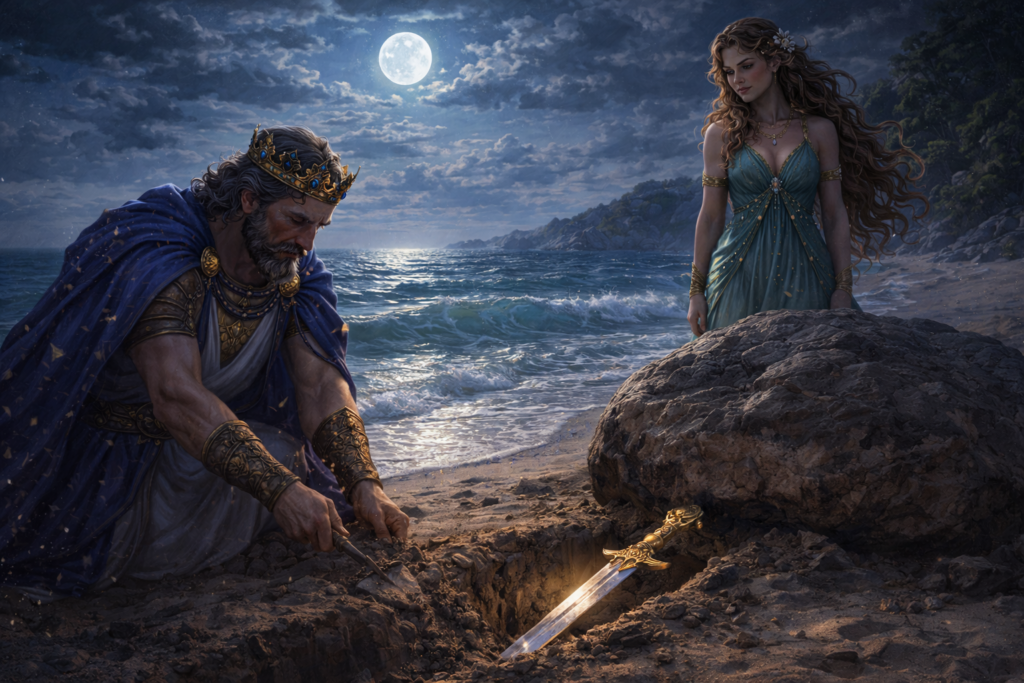
Sighing deeply, they fell back into step. Passing a great boulder at the head of the beach, Aegeus suddenly had an idea.
Straining with the effort, he heaved the boulder out of the way and dug a narrow trench in the dark, sandy earth.
Aethra stared. “Aegeus, what are you doing?”
Aegeus’s arms shook as he dug. “Making a path for our son.”
There he placed his own sword. With a great heave, he replaced the boulder, covering the sword.
“When the child is strong enough to retrieve the sword, you can send him to me.”
Aethra looked up at him and smiled.
“I will.”
Aegeus touched her cheek. “Tell him… tell him I did not forget him.”
Aethra swallowed hard. “And you, when you look at the sea, remember this beach.”
Aegeus nodded. “I will.”
.
Years pass: a boy grows strong…and forgetful
Years passed, and Aegeus finally married, but he never forgot Aethra and that wonderful month by the sea.
He and his wife had children, and they filled him with happiness, but he always wondered about the child he had left behind in Troezen.
Meanwhile, his son Theseus was growing up tall and handsome. He was faster and stronger than all the other boys but was always forgetting things: his spear when hunting or an oar when sailing.
Some boys teased him.
“Strong arms, empty head!” one laughed.
Theseus threw a pebble at the water and grinned. “Maybe. But my empty head still beats you in a race.”
Aethra taught him to swim, and every day in the evening, they would sit by the boulder, Theseus listening to his mother’s voice washing over him like the waves as she told him tales of the sea.
Sometimes Theseus asked, “Mother, why do you always bring me here?”
Aethra would smile. “Because some places hold answers. And answers come only when the heart is ready.”
Often, when he was younger, Theseus would ask about his father, but Aethra would always just smile and say,
“You’ll meet him when you are ready.”
“When will I be ready?” asked Theseus impatiently.
His mother laughed,
“When can you move this boulder?”
Theseus always thought she was joking.
But deep inside, the boulder began to feel like a question sitting on his life.
A lesson quietly growing in him: patience is not weakness; patience is strength that knows how to wait.

Trouble in Athens: Games, a prince, and a death
Meanwhile, Aegeus was facing a crisis in Athens.
Every four years, Athens hosted the Panathenaic Games, an athletic competition nearly as great as those held in Olympia.
The city would fill with cheering crowds, bright banners, and the sound of running feet. People loved the Games because for a short while, worries felt lighter. Even kings smiled.
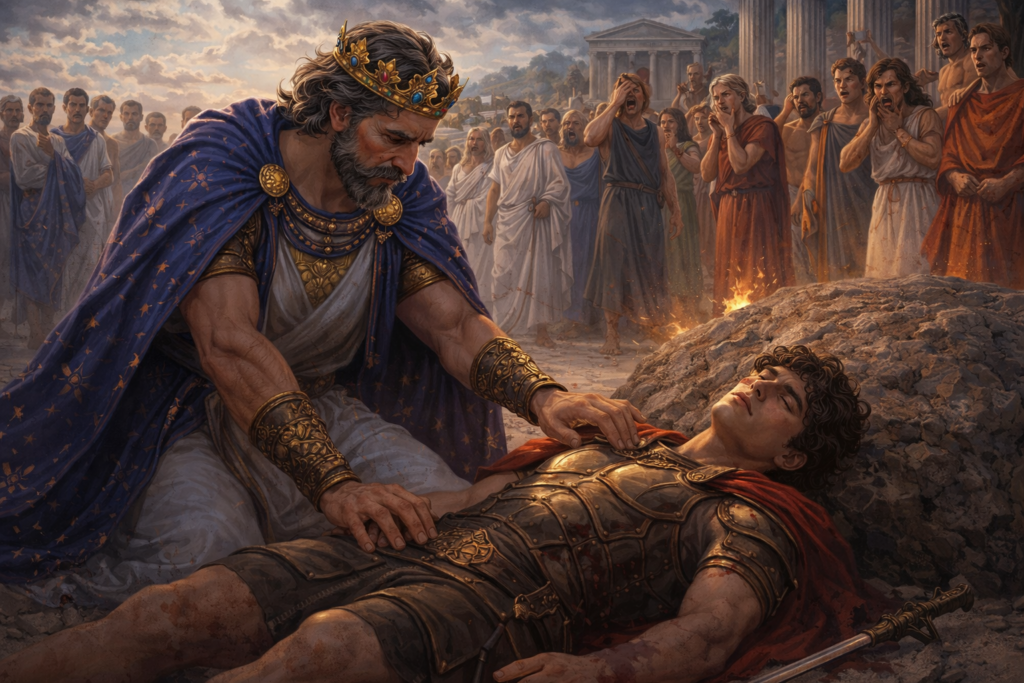
The previous year, however, a young prince from Crete, Androgeus, had come to compete. By whatever means had caused a terrible accident, Androgeus had been killed during the javelin contest.
Aegeus remembered that day like a stone in his chest.
He had walked to the place where Androgeus fell. Athenians stood silent. Cretans cried out.
Aegeus knelt beside the fallen prince and whispered, “This should not have happened.”
He did what a respectful king should do. Aegeus had escorted the prince’s body back to Crete himself, not only as a sign of respect but also because Minos, king of Crete, was the most powerful ruler in Greece at that time.
His navy was easily twice the size of any other city, and his army was feared across the Mediterranean.
Minos refuses to believe, and fear enters like a cold wind
Minos, however, did not believe Aegeus’s story of an accident.
“You knew that he was my heir!” cried the Cretan king.
“This is a plot to destabilise my rule. You think that, with Crete gone, Athens will one day be the most powerful city in Greece, don’t you, Aegeus?”
Aegeus stood in Minos’s great hall, surrounded by guards with spears and bronze helmets. He kept his voice steady, though his heart pounded.
“Minos,” Aegeus said, “I swear on the gods, it was an accident. The Games honour Athena, not hatred.”
But Minos’s eyes were like storm clouds. Some people, once they choose anger, treat truth like an enemy.
Aegeus tried everything he could to convince Minos of the truth, but he was beyond reason.
“I will bring my forces to Athens in one month,” said Minos, now no longer raging but cold as ice.
“When I get there, one of two things will happen: Either we raze Athens to the ground, or you give me nine sons and nine daughters of Athens in payment for Androgeus’ life.”
Aegeus stared at Minos in amazement.
“What could you possibly want eighteen of our young people for?”
Minos smiled a horrible smile.
“That is my business, Athenian. Know this, however: Once they are on my ship, you shall never see them again.”
A chill ran up Aegeus’ spine as he looked into those cold, dark eyes.
He wanted to shout, This is injustice! But he also knew a king must measure danger like a sailor measures waves.
Sometimes the hardest bravery is not fighting, it is choosing the least deadly path when you have no good choices.
A year ago: the painful decision
That had been a year ago, almost to the day.
Aegeus had, with a trembling heart, handed over the nine young men and nine young women to the cruel king.
“Better to lose eighteen than fifty thousand.” He told himself again and again.
But repeating a sentence does not remove pain. Aegeus watched the ship take the youths away, and the sound of parents crying followed him for days.
One mother grabbed his sleeve and sobbed, “My son is all I have!”
Aegeus could not even look her in the eyes. He whispered, “I am sorry. I am so sorry.”
A king can wear a crown and still feel helpless.
The new demand, and the sea that carries sorrow
But now, at the docks, a Cretan ship was docked, its captain awaiting Aegeus’ reply.
Minos, it seems, had not been satisfied by one delivery of Athenian youths. He had sent his messenger to warn Aegeus that, soon, a further delivery of eighteen sons and daughters of Athens would be expected.
Aegeus’s hands clenched.
“What does Minos want with our children?” Cried Aegeus,
But the messenger simply bowed and said,
“It is the will of great King Minos, my lord Aegeus. It is more than my life is worth to question his orders.”
Aegeus’s throat tightened. He could feel the city behind him, markets, homes, temples, and he could feel the sea in front of him, wide, uncaring, endless.
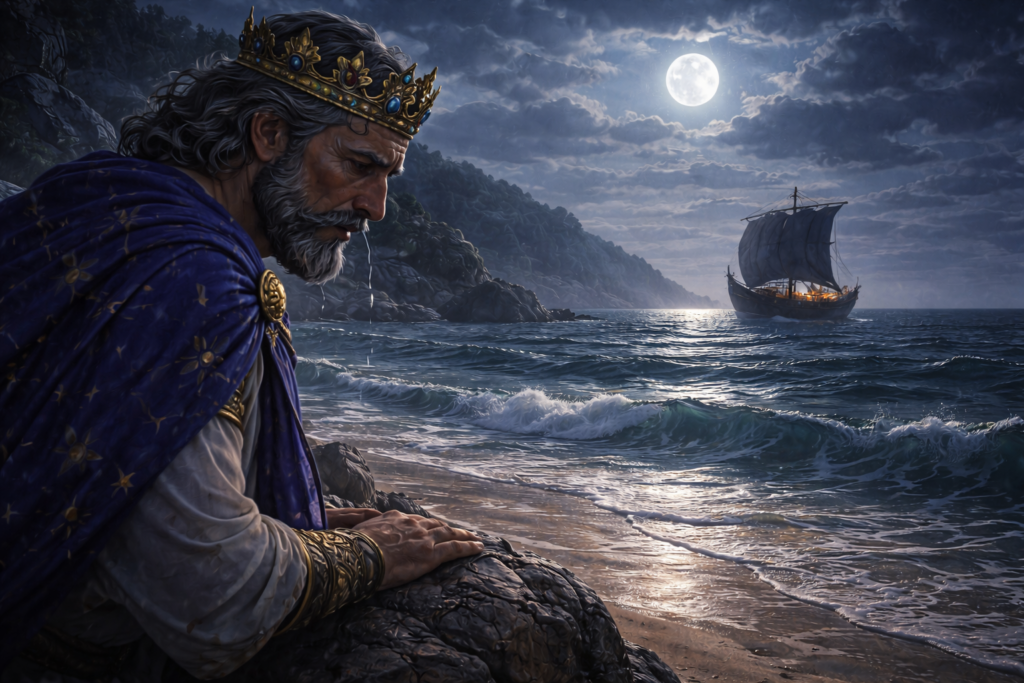
And so, Aegeus stood by the shore of the sea, trying to find calm in the gentle lapping of the water.
But the water only reminded him of his worry, for it was over this sea that the black-sailed ship would come. It was over the sea that eighteen more young lives would be lost.
“Minos will never be satisfied,” Aegeus said to the waves.
“I don’t know what cruel plan he has for our young people, but now that he has us, like a fish on a hook, he shall never let us go.”
Tears flowed down his cheeks, into his beard, and from there into the water.
The current took those tears and carried them across the Saronian Sea…
…and in myth, the sea often acts like a messenger. Not with words, but with feeling.
Across the sea: a mother feels the king’s grief
The current took those tears and carried them across the Saronian Sea to a small bay with a great boulder at its head.
Aethra felt the tears in the water, felt her love’s anguish even from across the wide expanse of sea, and knew that it was time.
Her own heart shook, for she did not want to lose her son.
She watched the shore, and soon Theseus came, striding out of the shallows, broad-shouldered and bearing a great fish he had just speared.
She knew that he was ready.
Sometimes a parent’s heart breaks in two directions at once: one side wants to protect, the other side knows the child must become their own person.
Aethra called out, her voice bright but trembling:
“Theseus!” She called, “Come move this boulder for me!”
Her son dropped the fish on a stone and lay his spear carefully on the sand before leaping up to where she stood, a quizzical look in his green eyes.
“What are you talking about, mother?” He asked.
Aethra swallowed, trying to keep her voice steady.
“Move this boulder.” She repeated simply.
Theseus looked at the stone like it was a joke that had gone on too long.
He shrugged and then put his shoulder on the boulder.
To his surprise, he felt it shift.
He blinked. “Wait… it moved.”
Aethra’s hands pressed together. “Again,” she whispered.
With a heave, he sent it crashing down the slope into the water.
The splash was huge. White foam jumped up like startled birds.
Gasping with wonder, he saw what had lain hidden for so long.
The golden-hilted sword shone in the sunlight, and its scabbard was traced with fish and vines. There was a symbol of a wide-eyed owl on the hilt.
Theseus stared as if the sword was staring back.
“It was your father’s.” Explained Aethra, her voice shaking slightly.
“And now it is yours.”
Theseus shook as he stared first at the sword, then at his mother, and then back again.
“Who is he?”
.
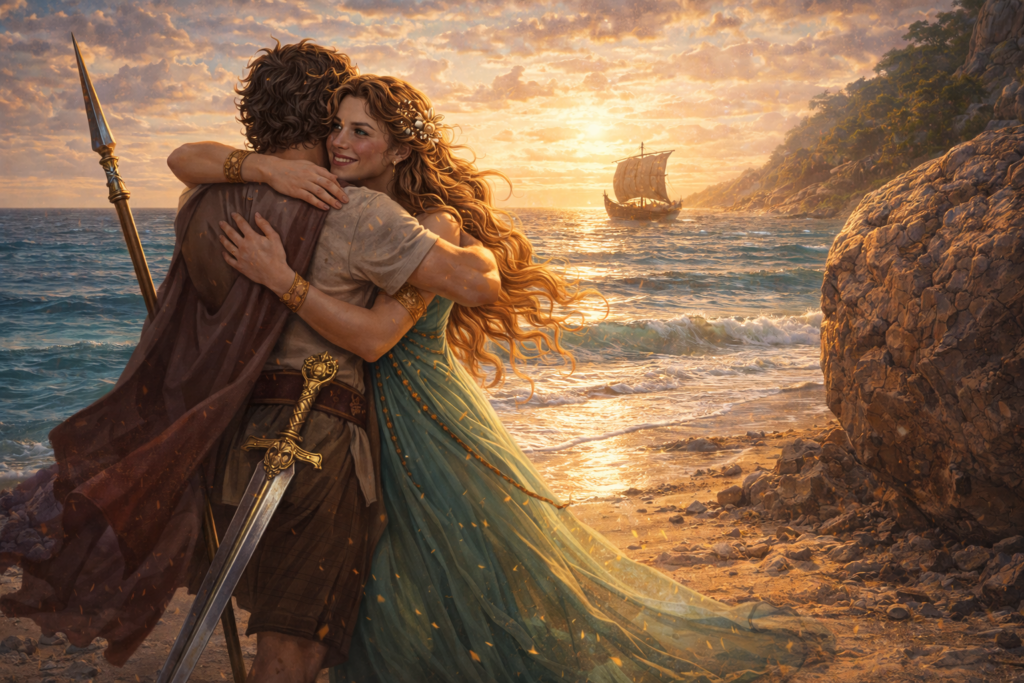
“Aegeus, King of Athens. We met years ago on this very beach and fell in love. But I could not leave, and he could not stay. But he needs you now. I do not know what ails him, but you must go to him, my brave Theseus.”
Theseus’s mind raced.
“The King of Athens… is my father?” he whispered.
Aethra nodded. “Yes.”
Theseus picked up the sword carefully, as if it were not only metal, but destiny.
He looked at his mother. “Why didn’t you tell me sooner?”
Aethra touched his face. “Because strength is not only in your arms. Strength is also in your heart. I had to wait until you were ready to carry the truth.”
That is a gentle lesson: some truths arrive late, not because they are hidden, but because we grow into them.
The farewell: brave words and a funny forgetting
Her son stood up straight, and she saw, perhaps for the first time, just how tall he had become.
He wasn’t her little boy anymore.
“I will go!” He cried.
“I will go now!”
Snatching his spear, he kissed his mother on the cheek and turned to leave.
“Theseus!” She cried, half-laughing, half-crying.
“You’ve forgotten the sword!”
Theseus froze.
Rolling his eyes and smacking himself playfully on the forehead, Theseus jogged back, hefted the beautiful weapon out of the trench, hugged his mother once more, and set off down the beach.
Aethra watched him go, a sad smile on her face.
“You always forget something, don’t you, Theseus.”
Growing up often means walking away from the safest arms you know, so you can do the brave work life asks of you.