
A Centaur, a Sandal, and a Fleece: Stories From Greek Mythology
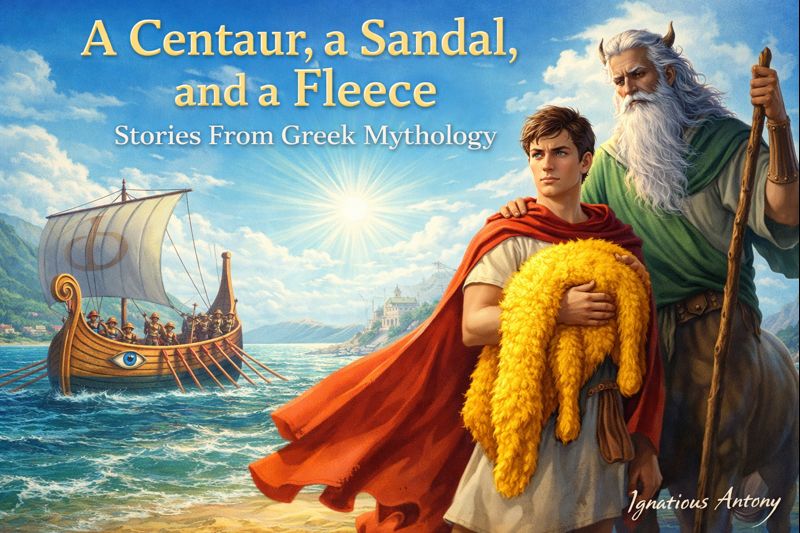
A Centaur, a Sandal, and a Fleece: Stories From Greek Mythology
A short introduction to Greek mythology
Greek myths are ancient stories that people in Greece told long ago to explain the world, human nature, and the powers they believed shaped life.
In these tales, gods are not just invisible forces; they are characters with strong emotions, big pride, and deep influence over fate.
Heroes are humans who face dangers that test their courage, choices, and character. These myths mattered because they helped people talk about justice and power, loyalty and greed, love and betrayal, and the price of doing what is right.
Even today, they teach us that every decision has consequences, and every person is shaped by the choices they make.
A Centaur, a Sandal, and a Fleece
Aeson was the rightful king of Iolcos, a port city in Thessaly, in northern Greece. He was no longer a young king. He had learned that peace can vanish in a single morning, and that danger often arrives by sea.
One bright day, Aeson stood on the balcony of his palace and stared at the water. The sea looked calm, the sky looked harmless, and yet his heart tightened. Far away, dark shapes moved across the blue, warships, many of them, sailing straight toward Iolcos. When Aeson squinted, he saw the sign painted on their sails: two crossed tridents.
Aeson whispered the name like a warning to himself. “Pelias.”
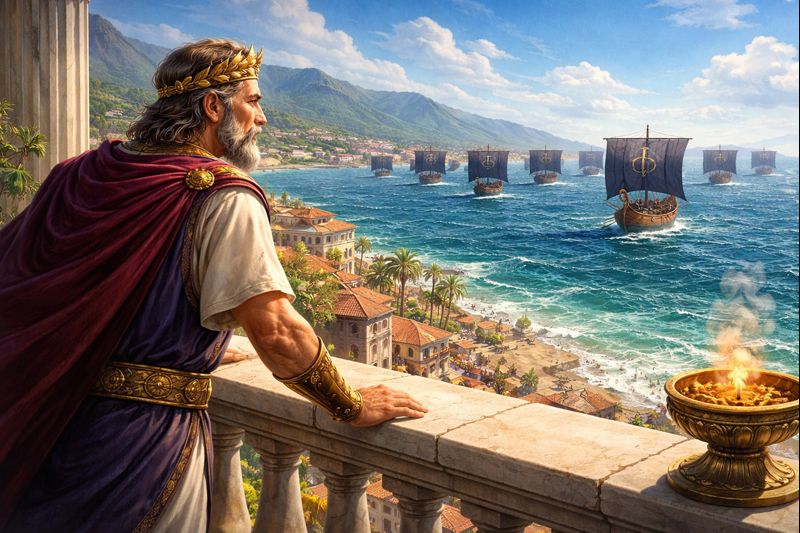
Pelias was Aeson’s powerful enemy, an ambitious man who wanted the throne of Iolcos for himself. In some versions of the myth, Pelias claimed a grand connection to the sea god Poseidon, as if that made his rule “destined.” But Aeson had learned something painful about people who hunger for power: they will use any story, any title, any rumour, anything, to make their ambition look like fate.
Aeson’s soldiers were brave, but Pelias had more ships, more men, and more cruelty than mercy. Aeson knew he could not win a battle today. And so he ran through the palace halls to find his queen, Polymede.
Polymede was not weak. She was a mother, and mothers are strong in a special way. But when she heard the screams from the shore and the clash of weapons beginning outside the walls, fear flashed across her face.
“Our son,” she said, holding her breath. “Jason, what will happen to him?”
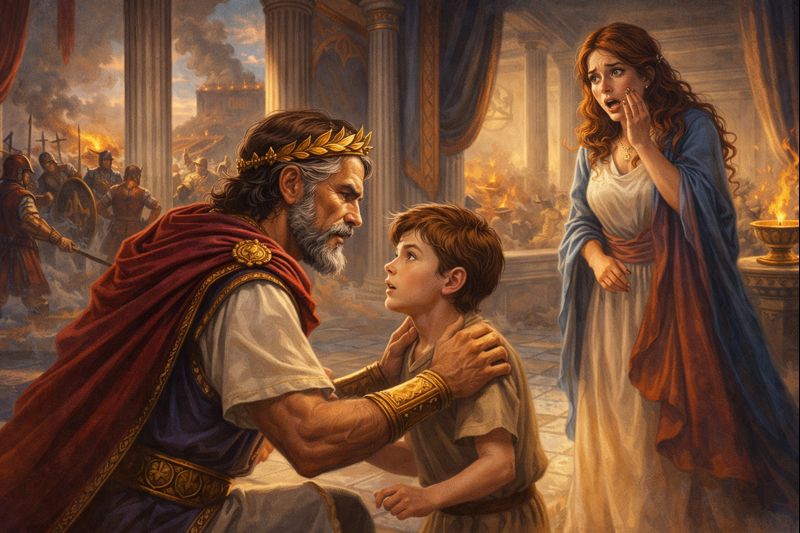
Their child, Jason, was still young, too young to understand thrones and wars, but old enough to feel panic in the air. Aeson bent down, holding Jason’s shoulders, looking into his eyes.
“You must go,” Aeson told Polymede. “Not because we are giving up. But because we are protecting what matters most.”
Polymede’s voice shook. “Where can we go? Where will Pelias not reach?”
Aeson answered, “To Chiron.”
At the name, Polymede stared. “A centaur?” she protested. “A half-horse, half-man creature?”
Her fear made sense. In many stories, centaurs were wild and dangerous. People said they drank too much and fought too fast. But Chiron was not like most centaurs. Chiron was famous across Greek mythology as a wise teacher and healer who trained great heroes. He lived in Thessaly near Mount Pelion, and many young heroes learned skills and self-control under his care.
“Chiron runs a school,” Aeson insisted. “He teaches more than fighting. He teaches character. Jason will be safe there. He will grow strong there, strong enough to return someday.”
Polymede swallowed hard because leaving home feels like tearing a piece of your heart. But the sounds outside were getting closer. She took Jason’s hand and pulled him toward a small back gate.
Jason looked over his shoulder one last time. The palace glowed in the sunlight, as if it didn’t know it was about to be taken. His throat tightened. He wanted to cry, but something inside him, something stubborn and bright, rose up instead.
“One day,” he whispered to himself, “I will come back.”
Pelias takes the throne
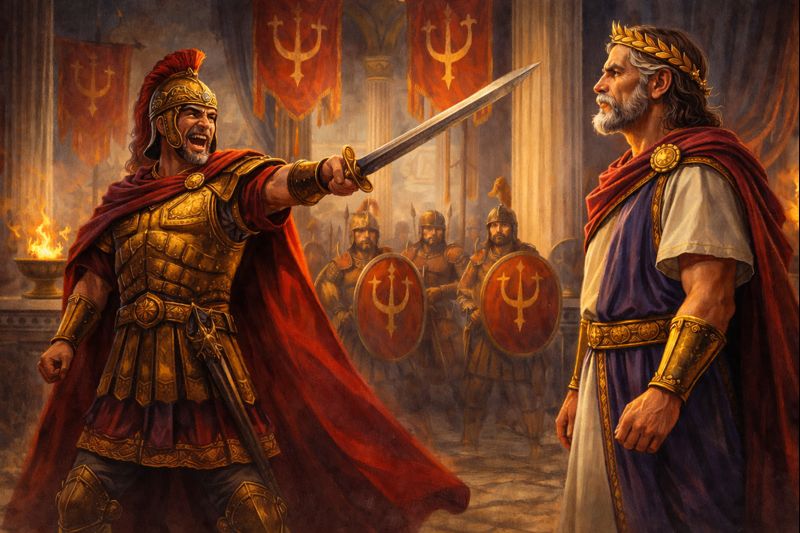
Pelias entered the palace like a man walking into a room he already owned. He threw his shield to a soldier as if servants were everywhere, and he strode straight into the throne room.
Aeson stood unarmed. He tried to keep his face calm, but fear and anger flickered in his eyes.
Pelias pointed his sword toward the king and laughed. “Another city falls before me,” he boasted, speaking loudly so everyone could hear. “The gods favour my empire!”
Aeson lifted his chin. “If the gods favour you,” he said carefully, “then why did you visit the Oracle at Delphi? Why did the Pythia warn you to beware a man with only one sandal?”
In Greek mythology, the Oracle of Delphi was famous. Leaders came there for prophecies, messages believed to come from Apollo through the priestess called the Pythia. And one prophecy tied Pelias’ heart in a knot: he was warned to beware a man wearing one sandal.
Pelias’ smile twitched. For a second, the prophecy touched his pride like a needle.
Then his anger burst out. He struck Aeson and snarled, “Why should I fear a prophecy? I have ships. I have men. I have power!”
But power does not erase fear. It only hides it, until the fear returns stronger.
Sometimes the loudest pride is only fear wearing armour.
Jason’s years with Chiron
Far away in Thessaly, Jason grew up under Chiron’s care. And those years shaped him like a sculptor shaping stone, slowly, firmly, with patience.
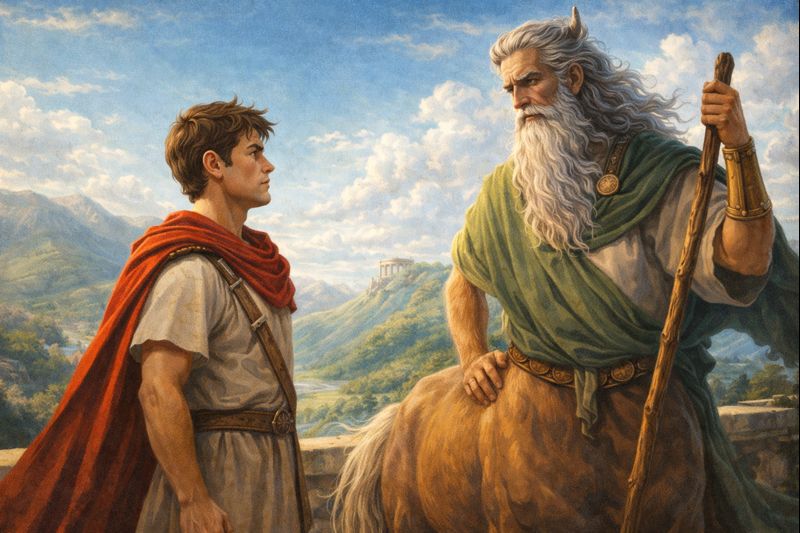
Chiron was a centaur, yes: human from the waist up, horse from the waist down. But his eyes were calm and thoughtful.
He taught Jason to run over rocky hills without giving up. He taught him to wrestle and ride. He taught him to listen to the wind and read the sky. He even taught him about herbs and healing, because a true hero must know how to protect life, not only how to take it.
Jason learned quickly and became proud. Sometimes he wanted to win more than he wanted to learn. Sometimes he spoke too sharply to other students.
One of those students was Peleus, another young hero-in-training who would later become important in Greek myth. Peleus and Jason competed often.
But even when they argued, they were bound by something stronger than rivalry: the shared life of students growing into heroes.
Chiron warned them, “Strength without self-control is like a sword without a handle. It will cut the one who holds it.”
Jason remembered those words, even when he pretended not to.
Wisdom is not only knowing what to do, but it is also knowing when to stop.
The decision to return home
When Jason became a young man, tall and strong, he finally spoke the words he had carried inside him for years.
“I want to go back to Iolcos,” he told Chiron. “I want to face Pelias. I want my father’s throne.”
Chiron did not shout. He did not forbid him. He simply looked at Jason for a long moment, as if reading his heart.
“I cannot stop you,” Chiron said at last. “But I must tell you the truth: the road ahead will test you. Choose your companions wisely. Choose your actions wisely. A hero is measured not only by what he can do, but by what he refuses to do.”
Jason nodded, but inside he felt impatient. I am ready, he told himself. I don’t need warnings.
And still, he felt a small tremble in his stomach.
Because courage does not mean you feel no fear. Courage means you walk forward while fear walks beside you.
The river and the lost sandal
Jason walked the old road back toward Iolcos. Each bend felt strangely familiar, as if the ground itself remembered his childhood escape.
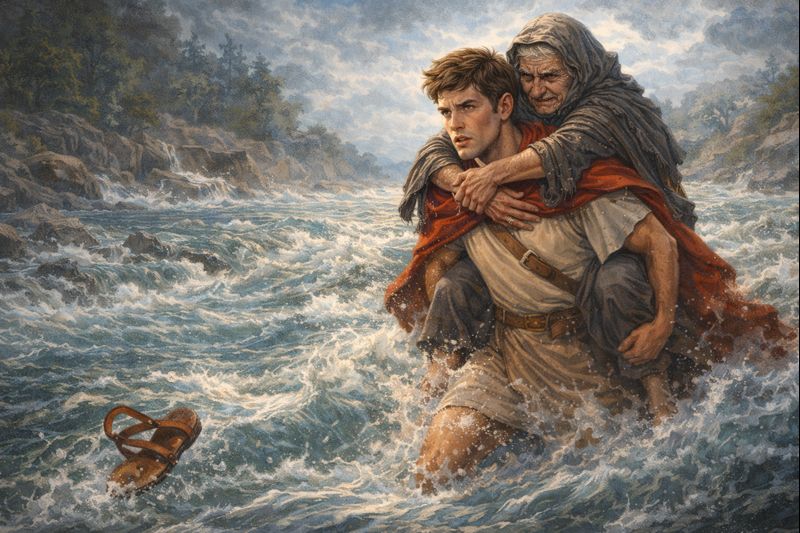
Ahead, he heard rushing water. A river ran fast and high, swollen from recent rain. On the bank sat an old woman, small and tired, with clothes that looked heavy from travel.
She lifted her head and called out, “Young man! Thank the gods you came! I must cross, but I am too old. The current is strong. Will you help me?”
Jason looked at her, then at the river. He wanted to say no. He was focused on his mission. He was thinking of Pelias and the stolen throne. The old woman was a delay.
But something inside him, something Chiron had tried to grow in him, spoke softly: If you can help, you should help.
Jason sighed. “All right,” he said. “Hold on.”
He lifted her onto his back and stepped into the water. Immediately, the river shoved against him like a living thing. He gritted his teeth and pushed forward.
Halfway across, his foot slipped. A sandal strap caught on a stone. With a sharp snap, one sandal tore loose and floated away.
Jason flailed, scratched by the river rocks, and for a moment, he nearly fell. His heart hammered. He fought for balance, then for breath, then for control. Finally, he reached the far side and set the old woman down gently.
He stared at his bare foot, breathing hard. “Are you all right to get home?” he asked, still shaken.
The woman smiled, strangely bright. “Oh yes,” she said. “Thank you. And… I’m sorry about your sandal.”
Jason waved it away, embarrassed. “It’s nothing,” he muttered, though it did not feel like nothing.
He walked on.
Behind him, the old woman straightened her back. Her “tired” look vanished like mist. Her hair shone richer. Her clothes seemed to change, becoming bright and godlike.
Because she was not a normal woman.
She was Hera, queen of the gods, wife of Zeus, protector of marriage, and a powerful goddess who often chose to help or challenge heroes. In this myth, Hera tested Jason’s kindness, and because he helped her, she became interested in his fate.
“You are a good young man, Jason,” Hera murmured. “I will watch what you do next.”
Kindness can look small in the moment, yet it can change the whole direction of a life
One sandal… and a prophecy waking up
At last, Jason reached Iolcos. The city looked familiar and yet wrong, because banners with crossed tridents hung where Aeson’s symbols should have been.
Jason’s bare foot ached on the stone streets, but he kept walking. My birthright is more important, he told himself. Don’t get distracted.
He entered the palace and stepped into the great hall.
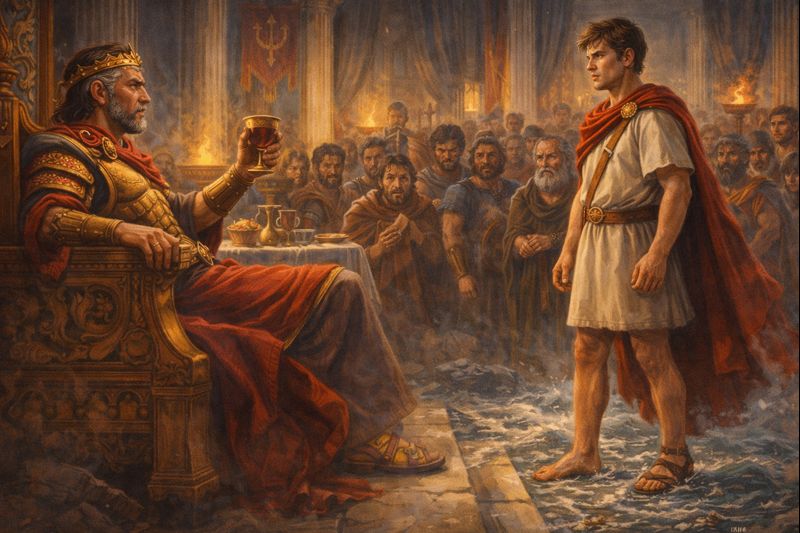
Inside, Pelias sat at a banquet, surrounded by nobles and guards. Music played. Cups of wine glittered. It was the happiness of a man who believed he could not be touched.
Then the hall grew quiet.
Everyone noticed the stranger, young, strong, confident, standing with only one sandal.
Pelias’ eyes flicked downward, and his face tightened.
The prophecy, buried under years of pride, rose up like a shadow.
Beware the man with one sandal.
Jason stepped forward and spoke clearly so the whole hall could hear.
“Pelias,” he said. “You know who I am. I am Jason, son of Aeson, the rightful king of Iolcos. You took this city. I have come to reclaim it.”
Pelias took a slow sip of wine. He forced his voice to stay calm.
“I do not deny you are Aeson’s son,” he said. “But listen, boy, royal blood does not give you power. Power is taken… or given.”
Jason felt heat rise in his chest. His hands curled into fists. He speaks as if stealing is wisdom, Jason thought. As if cruelty is a law.
Pelias stood and drew his sword, pointing it at Jason’s heart, not close enough to stab, but close enough to threaten.
“I have armies,” Pelias said. “I have ships. You have nothing, not even a weapon.”
Then he leaned in, smiling thinly, as if he had just found a clever way to remove a problem without spilling blood.
“But I am generous,” Pelias continued. “I will give you a chance. Bring me the Golden Fleece from Colchis, and I will exchange it for this city.”
At the name, Golden Fleece, murmurs moved through the hall. Everyone had heard the stories: a magical fleece of gold kept far away at the edge of the known world. In the larger myth, it was kept in Colchis by King Aeëtes, and it was a symbol of authority and kingship, exactly the kind of treasure that could make a hero famous… or dead.
Jason’s mind raced.
Is this a trap? He wondered.
But another thought followed quickly: If I refuse, Pelias wins twice; he keeps the throne, and he makes me look weak.
Jason lifted his chin.
“Very well,” he said, his voice sharp with determination. “Everyone here has heard your promise. When I return with the Golden Fleece shining on my shoulders, you will leave Iolcos and never return.”
Pelias gave a mocking bow. “Agreed.”
Jason turned and walked out of the hall, his bare foot striking the stone like a drumbeat.
Outside, the sky felt bigger. The road ahead felt longer.
And somewhere, high above, Hera watched quietly.
Justice often takes time. The brave heart does not rush, but it does not quit either
Pelias’ secret laughter
After Jason left, one of Pelias’ advisors hurried close, shocked.
“My king,” he whispered, “you can’t truly mean to give away Iolcos!”
Pelias burst into laughter.
“Give it away?” he scoffed. “You fool. Colchis is half a world away. And even if that boy reaches it, King Aeëtes will never hand over his greatest treasure. Jason will fail. He will probably die.”
Pelias leaned back, satisfied, as if the future were already decided.
But Greek myths love one truth more than any king does:
People who believe they control fate are often the first to be surprised by it.