
A Bottle of White Silence
What I Learned in a Waiting Room
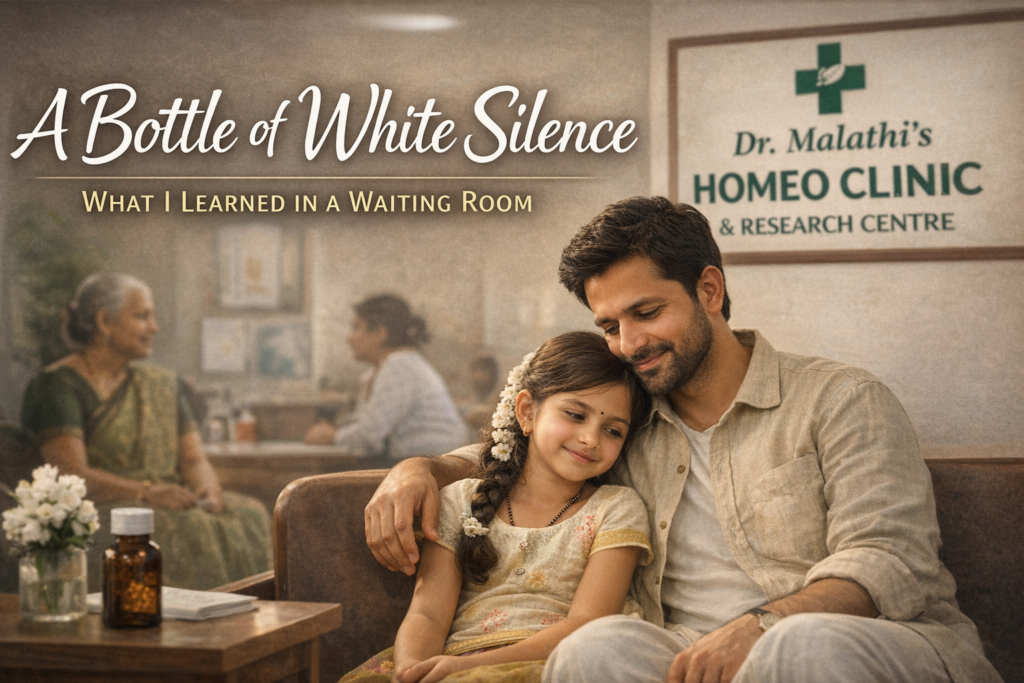
A Bottle of White Silence
What I Learned in a Waiting Room
There are moments in life when nothing breaks…
yet something inside you quietly shifts forever.
This is one such moment.
It happened about thirty-five years ago, in Thiruvananthapuram, near Kulathoor.
In those days, I was a firm believer in homeopathy, not casually, but with a kind of quiet stubbornness. I had convinced myself that “English medicine” was harsh, unnatural, and harmful in the long run. I would often say, with confidence that now feels almost naïve, “Nature knows how to heal. We only need to trust it.”
My wife believed me. My children had no choice.
Even the smallest fever at home meant only one thing, tiny white pills.
That morning, my youngest daughter Aathira was unwell.
She was seven then. Her forehead was warm, her voice softer than usual, and a mild cough came and went like a hesitant visitor.
“Pappa… I don’t want to go to school today,” she said, resting her head on my shoulder.
I touched her forehead gently.
“No, mole… we’ll go to Malathi doctor,” I said.
She nodded, trusting me completely.
We took a KSRTC bus, the old kind, with metal seats, rattling windows, and the faint smell of diesel mixed with coconut oil. She sat close to me, holding my finger.
“Will she give sweet medicine?” she asked.
“Yes,” I smiled. “Very sweet.”
Dr. Malathi’s Homeo Clinic and Research Centre stood a little away from the main road, inside a quiet lane.
It was a simple tiled house, modest and unassuming. A narrow path led through a small garden where hibiscus flowers drooped lazily in the sun. A faded board outside read:
“Dr Malathi Homeo Clinic & Research Centre – Consultation on Tuesdays & Fridays.”
Inside, the air carried a gentle medicinal scent – a mix of spirit, old paper, and something faintly sweet.
A long wooden bench lined the verandah. People were already waiting: farm workers, elderly women, a young mother with a restless child, a schoolboy scratching his arm absentmindedly.
Some had removed their chappals outside. Many held small paper covers carefully, as though holding fragile hope.
I sat with Aathira beside me. She leaned against me.
“Pappa… will it pain?” she asked.
“No, mole… this doctor doesn’t give injections.”
She smiled in relief.
From inside, we could hear Dr. Malathi’s voice, soft, measured, patient.
“Yes… take this three times… morning, afternoon, night.”
“Don’t worry… it will settle.”
On the wall near us hung a framed photograph of a man with calm, kind eyes, her guru, I later learned. Below it stood a wooden table filled with rows of small glass bottles, each holding tiny white globules.
To me, they looked almost magical.
What we believe strongly begins to look like truth,even before it is tested.
“Next… Gopalan Nair!” she called.
We all turned toward the door.
But the man who entered was not who we expected.
He was thin, very thin. His cloth was worn and slightly frayed at the edges. He held an old umbrella, which he placed carefully by the wall. His eyes were sharp, but there was a tiredness in them that spoke of long suffering.
He walked in slowly.
And then, suddenly, he bent forward, almost as if to touch her feet.
“Ayyo! What is this?” Dr. Malathi exclaimed, visibly startled.
“Please… please get up!”
“No, Doctor… let me stay like this,” he said, his voice trembling.
“Today… I am standing because of you.”
I could see everything through the half-open door. Even Aathira lifted her head to watch.
“Please sit,” she said gently. “Tell me… what happened?”
He sat down, but only halfway, as though he was still carrying his pain within him.
“For eight years…” he began slowly,
“I suffered, Doctor. My knees… my back… my whole body… I could not sleep… I could not walk…”
His hands trembled slightly.
“I went everywhere… Medical College… private hospitals… even outside Kerala. Nothing helped.”
She listened quietly.
“Then someone told me about you,” he continued.
“I came here last Tuesday. You gave me those small white tablets…”
He gave a faint, almost embarrassed smile.
“I looked at them and thought… how can something so small cure such a big disease?”
He paused.
“But when I took them… for a week…”
He lifted his head.
“Doctor… it felt like magic.”
“My pain… almost gone. Like someone lifted a heavy load from my body.”
The room fell silent.
“My wife was so happy,” he said softly.
“She could not believe it. She held my hand and asked… ‘Are you really walking?’”
He wiped his eyes.
“That night… we prayed for you.”
“You are not just a doctor… you are a blessing.”
Dr. Malathi’s face softened, a quiet glow spreading across it.
When someone places their faith in you, you begin to believe in your own power.
“It is God’s grace,” she said gently. “I am only an instrument.”
“No, Doctor… it is you,” he insisted.
“I came today to thank you… and to take medicine for the next week.”
She examined him carefully, listening to his chest, checking his pulse, observing his eyes with quiet concentration. Then she went to the shelf, selected a few bottles, and prepared two small vials.
“Take this, two pills in the morning before breakfast,” she said.
“And this, two pills at night before sleep.”
He placed a neatly folded twenty-rupee note on the table.
Then, after walking a few steps toward the door, he paused.
Turned back.
“Doctor… there is one small matter…” he said, hesitating.
She looked up.
“Tell me.”
He avoided her eyes.
“My daughter… she studied well… she passed tenth in first class… but I don’t know how to send her to college…”
His voice softened.
“If… if you could give some recommendation… somewhere…”
Dr. Malathi smiled kindly.
“Bring her details next time,” she said.
“I will write a letter. Let us see what can be done.”
His eyes filled.
He wiped them quickly.
“Teacher… I will never forget this,” he said quietly.
“As long as I live.”
He stood up, not bending this time.
Only standing… with quiet dignity.
“Go carefully,” she said.
He picked up his umbrella, adjusted his spectacles, and walked out,
a little lighter than when he had come in.
A few moments later, something slipped from his pocket.
A small folded paper… and a tiny bottle.
Dr. Malathi picked it up. Opened it.
Inside were a few white tablets. The same ones she had given him during his last visit.
Untouched.
Her face changed. Not suddenly. Slowly.
Like a light dimming.
“He didn’t take them…” she whispered.
For a long moment, no one spoke.
Truth does not shout; it simply stands there, waiting for you to notice.
She looked at the paper… then at the bottles… then at the photograph on the wall.
“Next…” she called. Patients came. One by one.
“Doctor, your medicine cured me!”
“You are like God!”
“Other doctors are not good!”
She listened. But now… her eyes were searching.
I sat there quietly, holding my daughter’s hand.
Something inside me… shifted.
When our turn came, she examined Aathira gently.
“Nothing serious,” she said. “Just a mild fever.”
She gave the medicine.
I took it. But for the first time… my belief was not as strong.
That evening, as we walked back home, Aathira asked,
“Pappa… will I become alright?”
I smiled. “Yes… you will.”
But my mind was somewhere else.
Years have passed since that day.
I still respect healing. I still respect faith.
But I learned something I have never forgotten:
Belief can heal… but blind belief can also deceive, both the one who trusts, and the one who is trusted.
That day, I did not lose faith in medicine,
I lost the comfort of believing without question.