
THE DAY THE WORLD CHANGED
Extraordinary Moments in Human History
EPISODE 01 | DECEMBER 17, 1903
They Said Humans Could Never Fly…
Then Two Bicycle Mechanics Changed History in Just 12 Seconds!
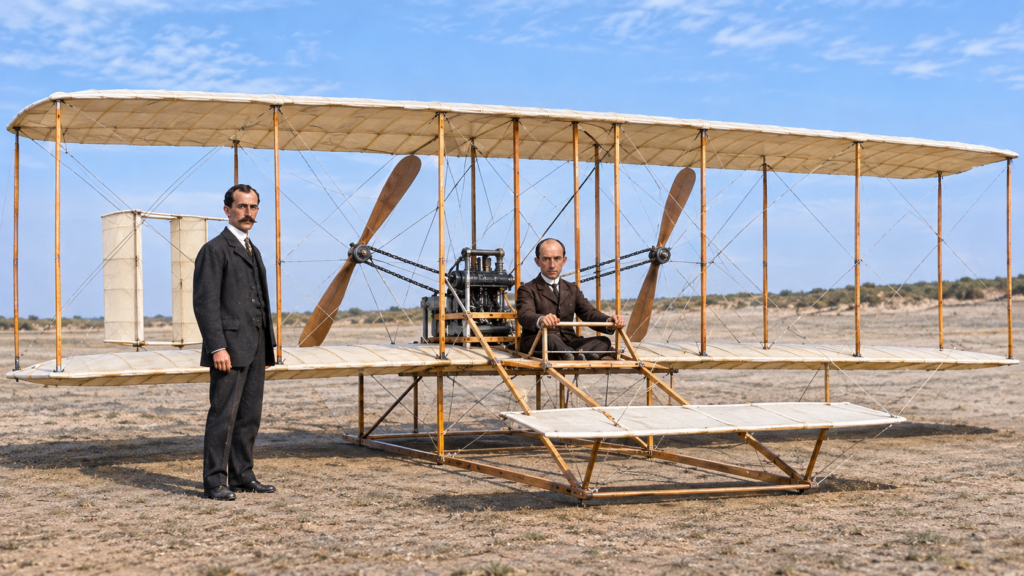
“There are moments in history when the impossible suddenly becomes possible. Moments when one discovery, one invention, or one extraordinary event changes the world forever. This is the story of one such moment.”
The morning that would change the world
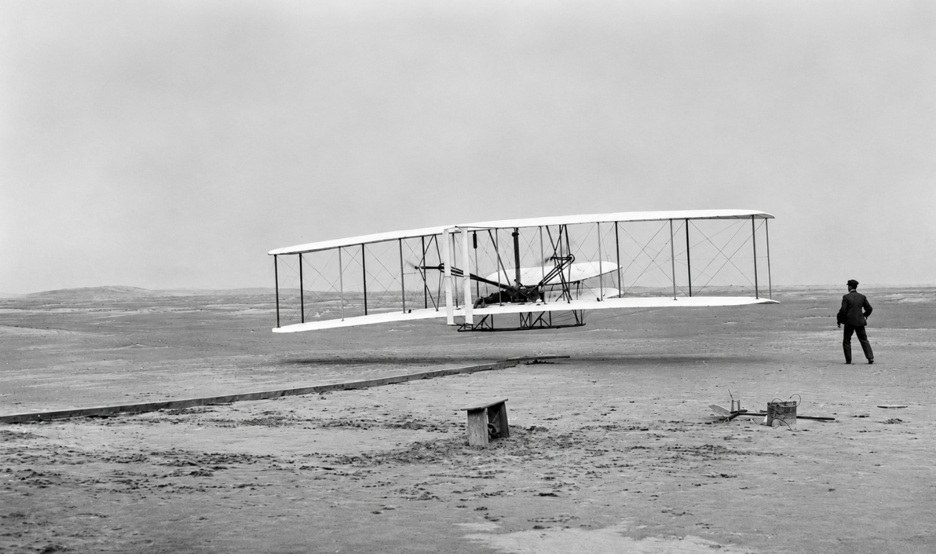
The wind was bitterly cold. Sand blew across the lonely dunes. The Atlantic Ocean roared in the distance. On a deserted stretch of the North Carolina coast, two brothers stood beside a strange-looking machine made of wood, wires, and cloth. It had wings, but it was not a bird. It had an engine, but it was not a motorcar. And it had no wheels like the aeroplanes we see today.
The two men had spent years working on this extraordinary machine. They had invested their savings, struggled through repeated failures, and travelled hundreds of kilometres to test their ideas.
Now the moment of truth had arrived. One brother lay face down on the lower wing. The other stood nearby, ready to help. The engine started. The propellers began to spin. A few men watched silently. Would the machine rise into the air? Or would it crash into the sand like so many flying machines before it?
What happened over the next 12 seconds would change human history forever.
But to understand how extraordinary that moment was, we must go back a few years, to a time when even respected experts doubted whether human beings could build a practical flying machine.
When newspapers laughed at the dream of flying
The two brothers who dreamed of flying
In the early 1900s, people had already seen balloons and gliders. But building a machine that could carry a person through the air using its own engine, while remaining under control, was an enormous challenge. Some famous scientists and engineers had tried. Several attempts had ended in failure.
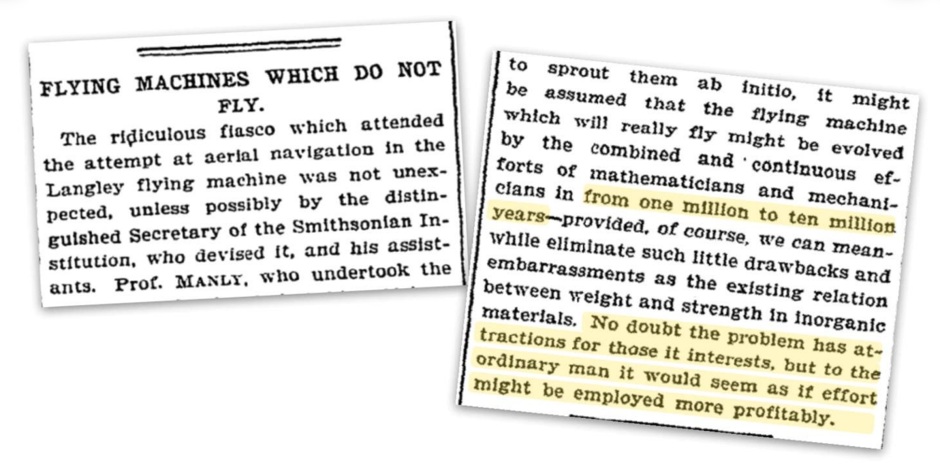
On October 7, 1903, a flying machine developed under the direction of Samuel Pierpont Langley, a respected American scientist and Secretary of the Smithsonian Institution, failed dramatically during a launch from a houseboat. The machine fell into the Potomac River.
Two days later, on October 9, The New York Times published an editorial titled “Flying Machines Which Do Not Fly.” The newspaper suggested that developing a machine capable of real flight might take: “from one million to ten million years”
Imagine that! A major newspaper was suggesting that practical powered flight might be millions of years away.
And here comes the astonishing part.
Just 69 days after that editorial, two bicycle mechanics achieved controlled powered flight.
The newspaper had not specifically ridiculed the Wright brothers. Its criticism was directed at Langley’s unsuccessful machine and the enormous difficulties of powered flight. But the contrast between its prediction and what happened next is one of history’s most remarkable examples of technological progress surprising the experts
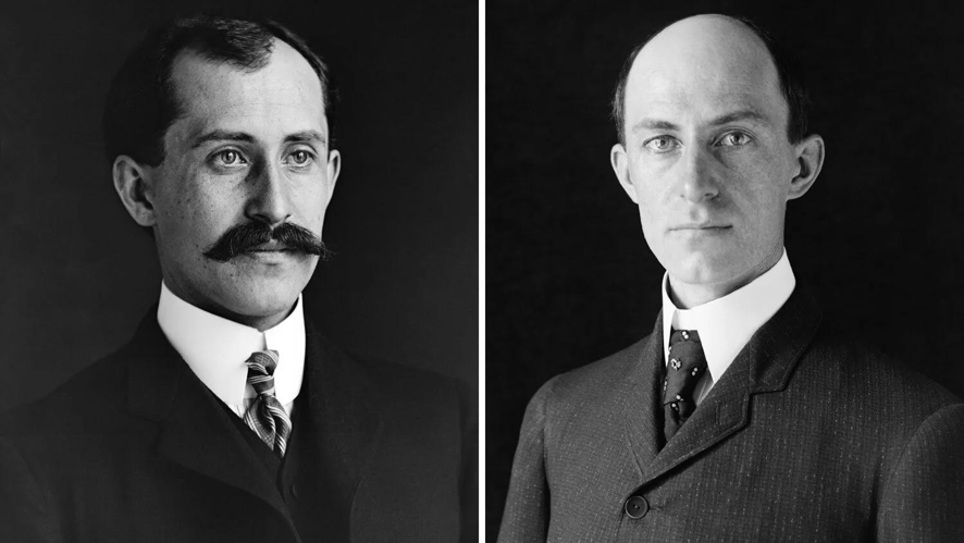
Far away from the famous scientific institutions, two brothers in Dayton, Ohio, were quietly working on the same problem. Their names were Wilbur and Orville Wright. Wilbur was born in 1867 and Orville in 1871.
They had no university degrees in engineering. They ran a bicycle business, repairing and manufacturing bicycles. As adults, the brothers ran a bicycle business in Dayton, Ohio. They were not university-trained aeronautical engineers.
But they had something extremely valuable: curiosity, mechanical skill, and a determination to understand how things worked. Their fascination with flying had begun in childhood, when their father brought home a small toy helicopter powered by a twisted rubber band. The toy flew briefly into the air. For the young brothers, it was a wonderful sight. Years later, they began studying birds, gliders, and the work of earlier aviation pioneers. They gradually realized something important. The biggest problem was not simply getting a machine into the air.
The real challenge was keeping it under control once it was flying.