The Price of Pride: Achilles and Agamemnon
A Great Greek Mythological Story
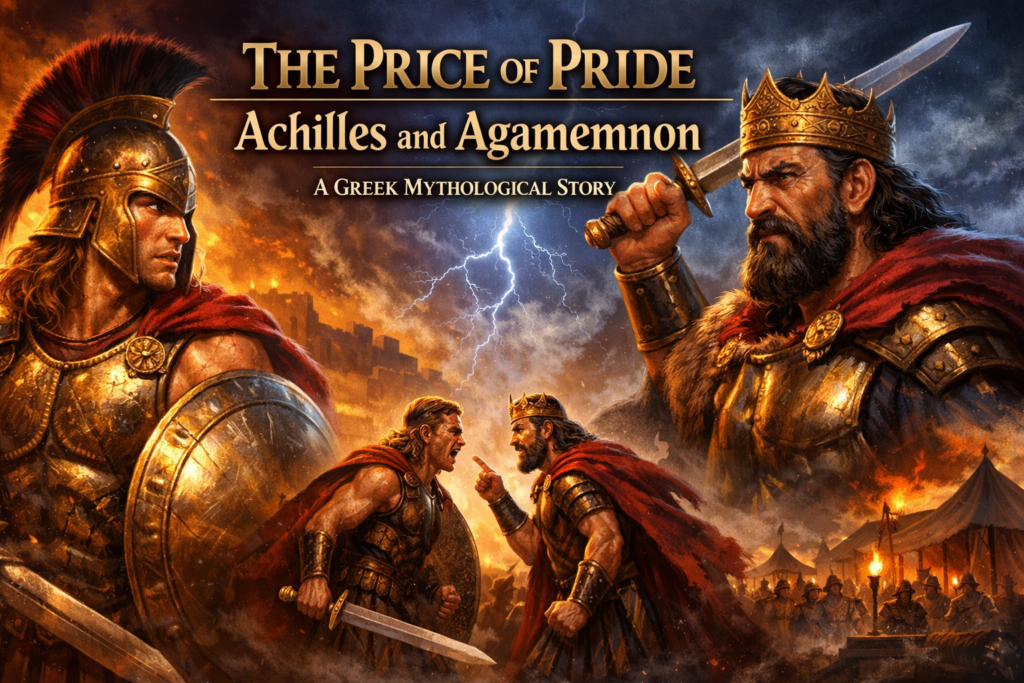
The Price of Pride: Achilles and Agamemnon
Introduction to Greek Mythology
In Greek myths, gods, kings, and heroes do not act like perfect people. They make proud, foolish, brave, and noble choices, and those choices bring consequences. That is why these stories still matter. They are not only about war and wonder. They are also about anger, justice, honour, and the heavy price of refusing to do what is right.
For even the brightest crown casts a shadow, and every choice made in pride leaves an echo in time.
A War Without End
For nine long years, the Greeks had camped before the great city of Troy. Troy, also called Ilium, stood behind mighty walls that seemed to challenge both men and time.
Many towns around it had already been attacked. Ships had come from many Greek kingdoms, and their greatest leaders had joined the war. Yet Troy still stood.
The fighting had become a grim habit, dust by day, watchfires by night, and the sound of grief in between. The Greeks had hoped for a quick victory, but now the war felt like a road with no end.
A hard struggle can test not only a person’s strength, but also his patience.
Some roads do not exhaust the feet first, but the soul.
The Greek Leaders and the Greatest Warriors
Among the Greek leaders was Agamemnon, king of Mycenae, a powerful ruler and commander of the Greek army. He was not the greatest fighter, but he was the high king, and that made him the man who expected others to obey.
Another leader was Achilles, son of Peleus and the sea-nymph Thetis, the strongest and most feared warrior among the Greeks.
Achilles led the Myrmidons, fierce fighters who followed him with complete loyalty. Even among heroes, Achilles shone like a flame.
Yet strength alone does not make peace inside a man, and after nine years of war, even Achilles had begun to feel the bitterness of long battle.
A man may conquer the field before him and still remain a stranger to his own heart.
The greatest Trojan warrior was Hector, the eldest son of King Priam of Troy. He was brave, disciplined, and loved by his people. Men said Hector was the shield of Troy.
Strangely, in all those years of war, Hector and Achilles had not yet met in single combat. Some thought it was a chance. Others whispered that the gods themselves were keeping the two apart, as if the world was not yet ready for that clash.
That thought alone was enough to trouble many hearts. If the greatest Greek and the greatest Trojan had not yet crossed blades, then perhaps the war still held darker days ahead.
The Priest Who Came for His Daughter
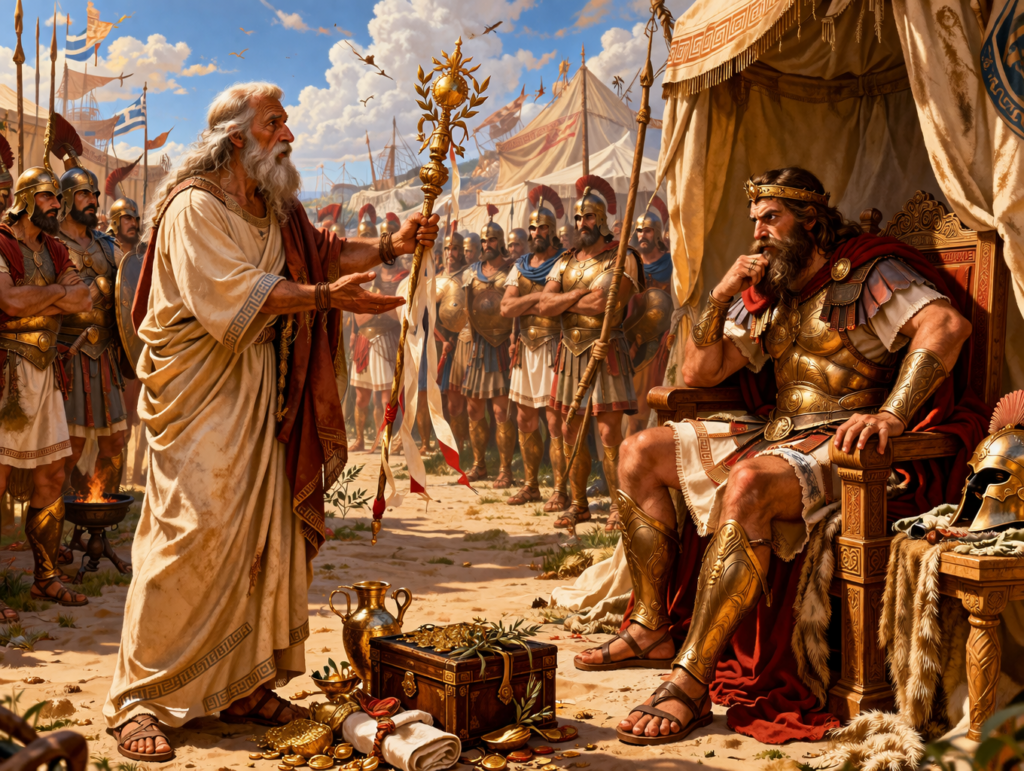
One day, while the Greek camp was still busy with its usual noise, armour being mended, horses being watered, cooks stirring kettles, soldiers arguing over dice, a lone old man approached the camp.
He came without soldiers, without shields, without fear. This was Chryses, a priest of Apollo. Apollo was one of the great Olympian gods, lord of archery, prophecy, healing, and also disease.
He could bless or punish from far away, as swiftly as an arrow flies. Chryses served Apollo faithfully, and people knew him as a sacred man.
He came because his daughter, Chryseis, had been taken captive by the Greeks in one of their raids.
The old priest did not come empty-handed. With him were rich gifts, gold and ransom enough to tempt almost any king. His hands trembled with age, but his voice remained steady as he stood before the Greek leaders and begged for mercy.
“Lords of Greece,” he said, lifting the sacred ribbons of Apollo so all could see them, “may the gods give you victory and safe return to your homes.
But please, give me back my daughter. Take this ransom. Honour Apollo, who sees all.”
Many of the Greeks murmured that his request was fair. Some nodded. Some looked away in discomfort, because even warriors knew it was dangerous to insult a holy man.
But Agamemnon’s face hardened at once.
“No,” he said.
The old priest blinked, as if he had not heard correctly. “My lord, I ask only for my child.”
Agamemnon rose and looked down at him with cold anger. “Do not stand here and test me. I will not give her back. Go while you still can. Your god’s staff and ribbons will not save you from me.”
Agamemnon drove him away in deep humiliation. Agamemnon chose pride over justice.
When power forgets respect, it becomes dangerous not only to others but to itself.
The hand that refuses mercy often prepares its own punishment.
The Prayer and Apollo’s Plague
Chryses turned and walked away from the camp.
No one followed him. No one dared to stop him.
The sea wind moved around him, and the evening light stretched his shadow long over the sand.
At last, when he was far enough from the tents that no one could hear, he raised his hands and prayed to Apollo.
“Hear me, lord of the silver bow,” he cried. “If I have ever honoured you, if I have ever burned fat thighs of bulls and goats upon your altar, then remember me now. Let the Greeks pay for my tears.”
Apollo heard.
That is how Greek myths often move, suddenly, terribly. A prayer rises from a broken heart, and somewhere on Olympus a god listens. Apollo, far-shooting god, was enraged that his priest had been dishonoured.
There are tears so pure that even heaven cannot ignore them.
He came down from the heights with his bow and arrows.
His arrows did not simply pierce flesh. They carried plague. Soon, the Greek camp was full of coughing men, fevered bodies, funeral smoke, and fear. First, animals died, then soldiers, and pyres burned day after day.
When justice is denied on earth, suffering often arrives as its dark messenger.
At first, the Greeks could not understand what was happening.
“Bad water?” one man muttered.
“No, it spread too fast,” said another, wrapping a cloth over his mouth.
“Some curse from Troy?”
“Or from the gods,” whispered an older soldier, staring at the smoke of another funeral fire.
The camp grew quieter with each passing day. Men who had survived swords and spears now feared an unseen enemy. The smell of medicine mixed with the smell of death. Even the proudest warriors began to look at one another with worry.
Nothing humbles men more swiftly than the enemy they cannot see.
Achilles Calls the Assembly
Achilles watched all this with growing anger. He was young, but not foolish. He knew that when suffering came like this, there was usually a reason larger than men could see. At last, on the tenth day of the plague, he called the Greek leaders into assembly.
That was important in itself because even though Agamemnon was the commander, Achilles was powerful enough to rally the army when disaster struck.
Rank may command obedience, but true force gathers men even in chaos.
There, before the assembled Greeks, Achilles stood tall and restless, his face bright with controlled fury.
“We cannot let this go on,” he said. “Men are dying every day. Let us ask a prophet, a priest, or someone who understands the gods. If Apollo is angry, we must learn why.”
Near him sat Odysseus, king of Ithaca, known not for strength like Achilles but for his quick mind and clever speech.
Odysseus was the kind of man who noticed what others missed.
Also, there was Nestor, the old king of Pylos, wise with age and famous for giving careful advice. Nestor had seen more years and more battles than almost anyone there.
Both men mattered because war is never guided by strength alone. Sometimes it needs wisdom. Sometimes it needs caution.
A sword may win the hour, but wisdom decides what survives beyond it.
“As if we did not already have enough trouble,” Odysseus muttered darkly. “Hector and his Trojans can sit safely behind their walls while Apollo destroys us for them.”
“Steady, Odysseus,” said Nestor in his deep, worn voice. “Let us hear the truth before anger leads us into greater harm.”
Calchas Speaks the Truth
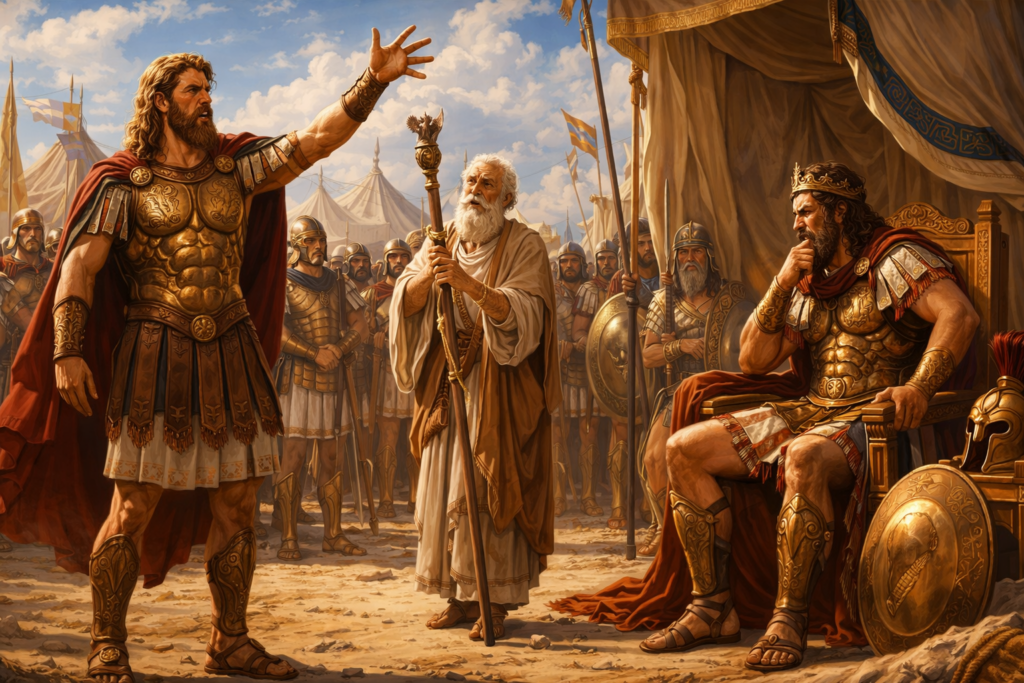
The assembly waited. Then a man stepped forward slowly, clearly afraid.
This was Calchas, the Greeks’ seer. A seer was not exactly a magician. He was a reader of signs, a man believed to understand the will of the gods.
Calchas had guided the Greeks before, and people respected him, but that did not make his task easy. Speaking truth to powerful men has never been safe.
Truth often walks barefoot into halls where pride sits armed.
“My lords,” Calchas said, “I know why Apollo is angry. But if I speak, I may make a mighty man my enemy. Promise that I will be protected.”
At that, some men glanced at Agamemnon.
Achilles gave a short, impatient laugh. “Say what you know, Calchas. If the truth angers someone, let it. I swear no harm will come to you, not even from Agamemnon, if it comes to that.”
Agamemnon’s jaw tightened, but he said nothing.
Calchas drew a long breath. “The plague is from Apollo. The god is angry because his priest, Chryses, was dishonoured. The girl Chryseis must be returned to her father, and no ransom must be taken. Only then will Apollo end the plague.”
A murmur ran through the assembly like wind through dry grass.
All eyes turned to Agamemnon.
Agamemnon’s Pride
For a few moments, he stood silent. He knew Calchas spoke the truth. He also knew all the Greeks were watching. To admit wrong in front of others was hard for him.
Pride finds confession heavier than guilt.
At last, he said, “Very well. I will send the girl back. But I will not be the only man here to lose his prize. If Chryseis is taken from me, I must receive another reward.”
Achilles stared at him. “What are you saying? Men are dying, and this is your answer?”
Agamemnon’s voice grew sharper. “I am the high king. Shall I be the only one left without honour? If I lose my prize, then another man must give me his.”
Honour without fairness becomes greed wearing a crown.
When honour seeks only itself, it ceases to be honour and becomes hunger.
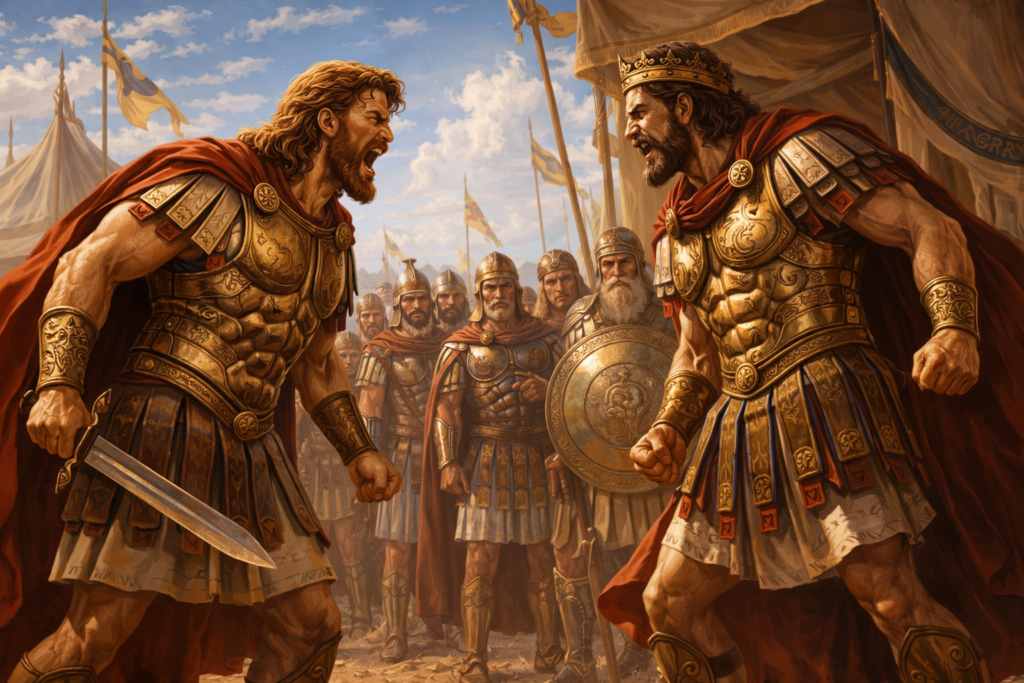
The Quarrel Between Achilles and Agamemnon
The words struck Achilles like a blow.
He had his own war prize, Briseis, a captive woman awarded to him by the army. In the harsh world of the Iliad, such prizes were not only people but signs of honour and rank.
To take a leader’s prize publicly was to shame him before everyone. Achilles understood at once what Agamemnon meant, and his anger burst out.
“Where do you expect to find another prize?” Achilles demanded. “The spoils have already been divided. We cannot take back what has been given. Return Chryseis as the god commands, and when Troy falls, we will repay you three times over.”
But Agamemnon heard no wisdom in that. He heard only resistance.
“Do not try to cheat me with promises of the future,” he said. “If I must lose Chryseis, then I will come and take something better now. Perhaps I will take it from you,from Achilles. Perhaps Briseis will come to my tent instead.”
For one terrible second, the whole assembly froze.
Even Odysseus went still.
Even Nestor stopped breathing.
Some moments are so sharp that all of history seems to hold its breath inside them.
Then Achilles’ face changed.
He looked as if all the fire in him had turned white-hot.
“You shameless man!” he shouted. “How can any good fighter obey you gladly? I did not come here because the Trojans harmed me. I came to help your brother Menelaus and to win honour with the rest. And now you threaten to steal from me,the man who has fought hardest for you?”
His hand went to the hilt of his sword.
That moment matters deeply in Greek mythology because here Achilles stands at the edge between rage and self-control. In the full myth, divine help restrains him from killing Agamemnon on the spot.
Even without dwelling on that wider scene, we can feel the danger. One more foolish word, and the Greek army might have torn itself apart.
The strongest person is not always the one who can strike. Sometimes it is the one who can stop.
The fiercest victory is often the blow a man refuses to give..
At last, Achilles did not attack. But his voice shook with fury.
“Take her then,” he said bitterly. “Take Briseis if you must. But hear me well, Agamemnon. You may be king, but you do not understand what true leadership is. One day, the Greeks will long for Achilles, and you will know what your pride has cost.”
Agamemnon rose to his feet. He had won the moment, but not with dignity.
“You think too highly of yourself,” he snapped. “Yes, I will send Chryseis back. And yes, I will have Briseis brought to me. Then everyone will know that I am greater than you.”
This was not wisdom. It was humiliation turned into policy. A king is meant to protect order, but Agamemnon had chosen to deepen the wound.
A ruler who confuses victory with humiliation has already begun to lose what matters most.
Briseis Taken, Chryseis Returned
Soon orders were given. Odysseus, the clever king, was told to take Chryseis back to her father by ship. Men prepared a sacred offering to Apollo as well, because it was not enough merely to undo the wrong; the god had to be honoured openly. Meanwhile, Agamemnon sent word that Briseis was to be taken from Achilles’ shelter and brought to him.
When the heralds came to Achilles’ hut, they were uneasy. They respected him and feared his anger.
One of them spoke softly. “Lord Achilles, we come unwillingly. The king has sent us.”
Achilles gave a harsh, empty laugh. “I know whose work this is. Do not fear. I blame Agamemnon, not you. Take Briseis.”
Briseis, like Chryseis, had no power in this struggle between mighty men. That, too, is part of the story’s sadness. She was led away while Achilles stood silent, his pride and grief burning together.
Sometimes injustice does not only hurt the people who quarrel. It also falls hardest on those who have no voice at all.
True justice remembers the weak as well as the strong.
The innocent are too often the quiet shore upon which the storms of the mighty break.
The Withdrawal of Achilles
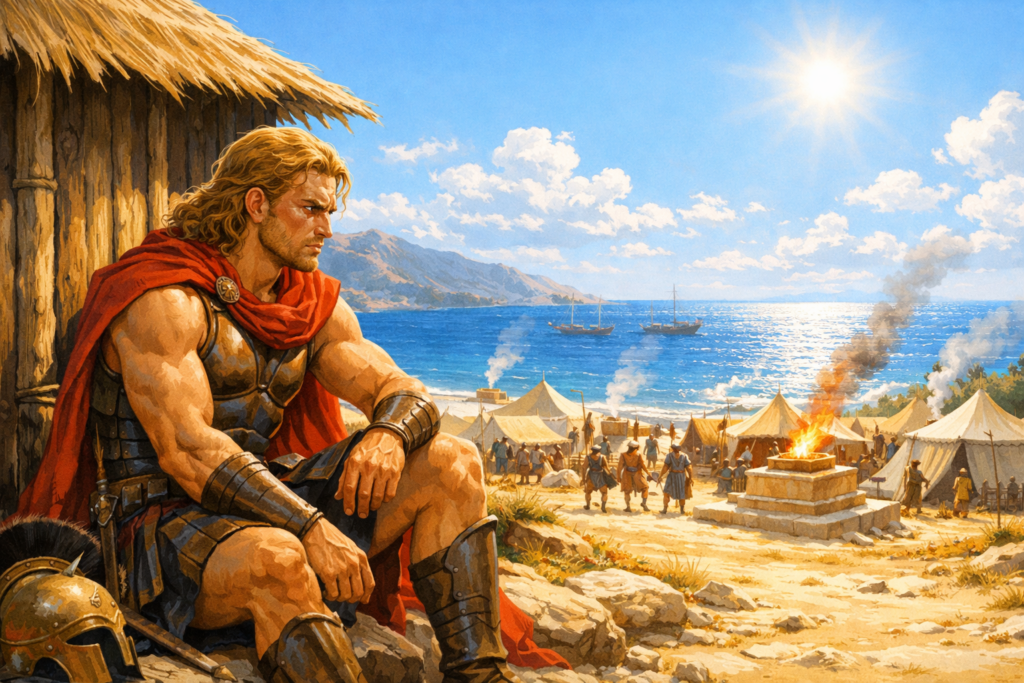
Achilles went apart from the others, away from the noise of the camp and the crash of the waves. He felt dishonoured, robbed, and deeply alone.
He had fought for the Greeks, risked his life for them, and now the high king had publicly insulted him. In his heart, anger hardened into a terrible decision: he would no longer fight for Agamemnon.
When honour is wounded deeply enough, silence itself becomes a form of war.
The End of the Plague, but Not the Conflict
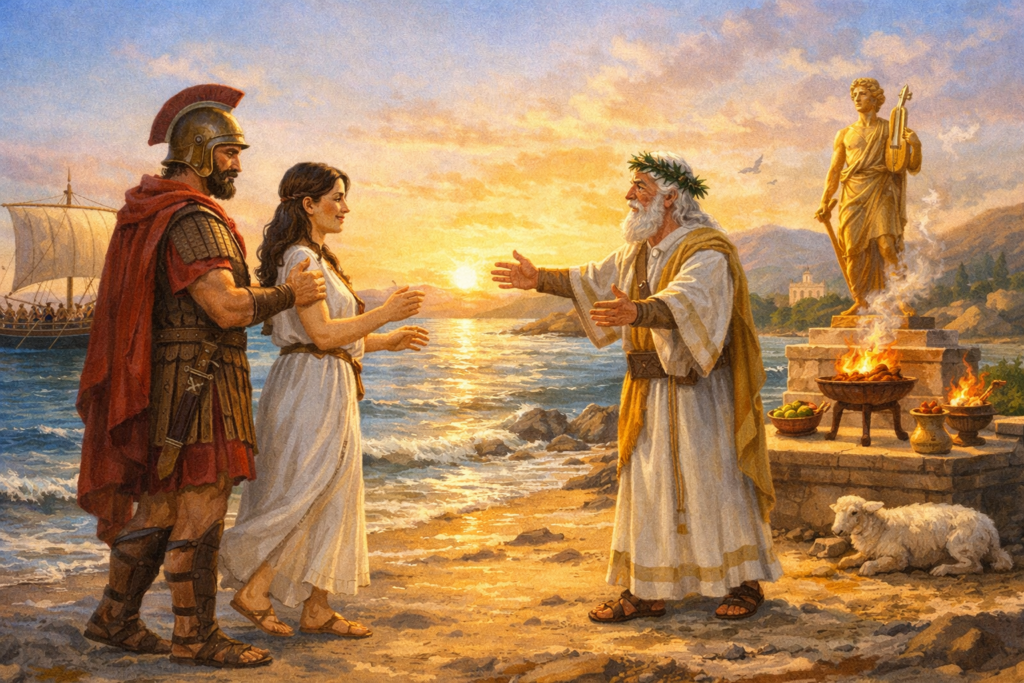
Back at the ships, Odysseus sailed with Chryseis to her father. One can imagine the old priest waiting at the shore, his face lined with fear and hope, hardly daring to believe the ship had truly come.
When father and daughter were finally reunited, the wrong that had begun this disaster was at last being set right. The Greeks offered a sacrifice to Apollo, and the god’s anger slowly passed. The plague ended. The coughs faded. Funeral smoke no longer rose day after day. The camp breathed again.
Some sorrows end like storms, but leave their salt upon everything they touched.
The True Price of Pride
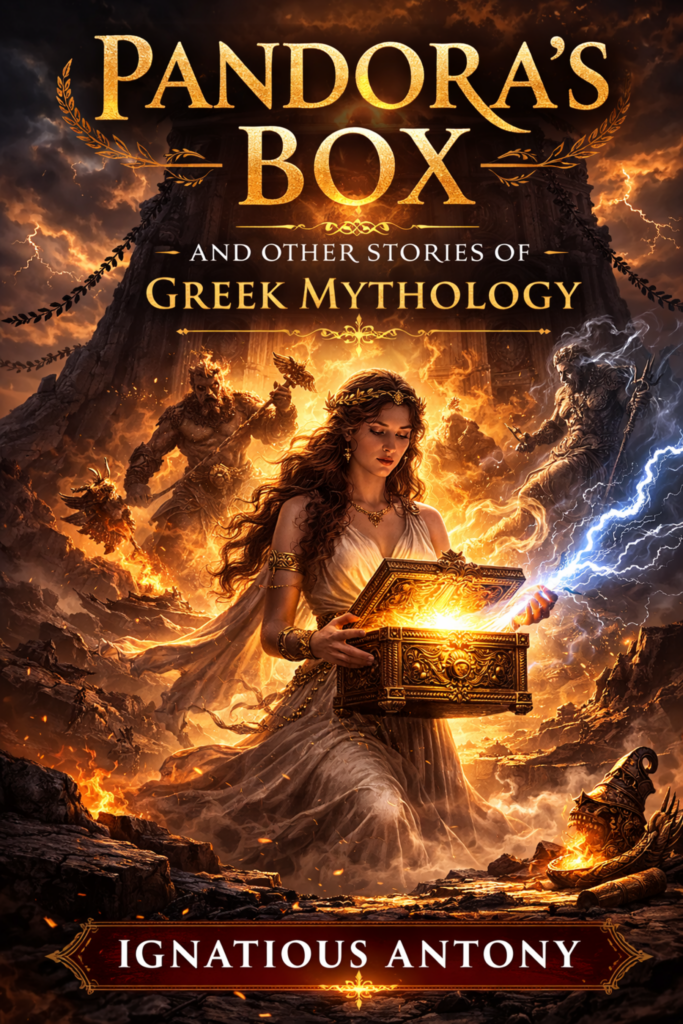
Pandora’s Box and Other Greek Mythological Stories
New Book Released!
I’m excited to share that I have published a new book on Greek Mythological Stories. This book brings to life the fascinating tales of ancient Greece,filled with gods, heroes, kings, and unforgettable adventures.
If you enjoy stories about Greek mythology, legendary heroes, and epic tales, I warmly invite you to explore this book.
✨ If you would like to read more stories like this, please take a look at my book.
Thank you for your support, and happy reading!