
The River Behind the Eyes
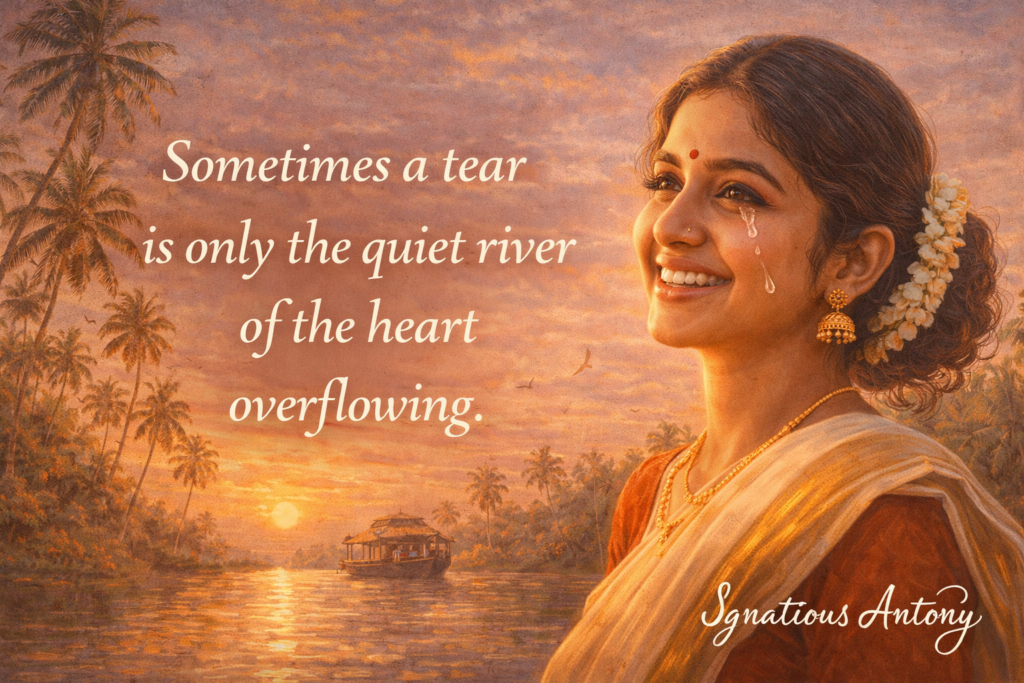
The River Behind the Eyes
There is a river behind the eyes,
hidden deep where silence lives.
No map has ever drawn its path,
No traveller has walked its banks.
It begins somewhere in the heart,
where memories fall like quiet rain,
and feelings gather drop by drop
in a secret valley of the soul.
Sometimes the river flows gently,
like moonlight resting on still water.
A smile appears upon the lips,
while the eyes shine softly with tears.
Sometimes it swells like a monsoon stream,
carrying old sorrows and forgotten dreams.
Words grow weak beside its current,
For the heart speaks best through water.
A mother watching her child return,
an old man hearing a long-lost song,
a lover meeting a distant face again,
In such moments, the river rises quietly.
One shining tear escapes the shore,
rolling down the face like a silver drop.
The world calls it sorrow,
But often it is only love overflowing.
For the river behind the eyes
holds both joy and pain together,
like sunlight dancing on the rain.
And those who understand this river
know a gentle secret of the heart:
Sometimes the deepest happiness
arrives as a tear.
Reflection on “The River Behind the Eyes”
This poem reflects on the mysterious and powerful world of human emotions.
It suggests that deep inside every person there is a hidden river of feelings that flows quietly behind the eyes.
This river is invisible to the world, yet it carries the memories, joys, sorrows, and longings that shape the human heart.
At the beginning of the poem, the river is described as something secret and unseen. No map has drawn its path, and no traveller has walked along its banks. This metaphor shows that emotions cannot be fully explained or measured.
They belong to the inner landscape of the soul, a place where experiences slowly gather like drops of rain.
Memories fall gently into this inner river, and over time, they form a quiet current that moves within us.
Sometimes this river flows peacefully, like moonlight resting on still water. In these moments, emotions are calm and tender.
A person may smile, yet tears appear in the eyes. These tears are not always signs of sadness.
Instead, they can be expressions of gratitude, love, or deep appreciation for life’s beautiful moments.
At other times, the river becomes stronger, like a monsoon stream carrying the weight of past memories.
Old sorrows, forgotten dreams, and powerful emotions rise to the surface.
In such moments, words often fail to describe what the heart feels. The poem suggests that tears become the language of the heart, speaking when ordinary language falls short.
The examples given in the poem, a mother seeing her child return, an old man hearing a long-lost song, or lovers meeting again, show how powerful emotions can suddenly awaken this hidden river.
These moments are filled with love, memory, and longing.
A single tear may escape, not because of sorrow, but because the heart is overflowing.
One of the most beautiful ideas in the poem is that this river carries both joy and pain together.
Human emotions are rarely simple. Happiness and sadness often exist side by side, just as sunlight and rain can appear together in the sky.
Tears, therefore, become symbols of this complex emotional truth.
In the final lines, the poem reveals its deepest message: sometimes the greatest happiness arrives as a tear. When the heart becomes too full of love, gratitude, or beauty, the river behind the eyes finds its way to the world. The tear becomes a quiet sign that the soul has been touched by something profound.
Ultimately, the poem reminds us that tears are not always a sign of weakness. They are often the natural expression of a heart that feels deeply.
Behind every tear there may be a river of memories, love, and life itself, flowing silently within the human soul.