
When the Stone Finally Cracked
When the Stone Finally Cracked
Every town has a story people tell in lowered voices.
In Kuriachira, Thrissur, the story was about a man with the gentlest hands and the hardest heart.
People said two strange things about him.
First, they would say,
“Mathai chettan has the kindest hands in town.”
Then their voices would soften, as if someone were closing a door carefully.
“But his heart… his heart is made of stone.”
As a boy, I never understood why people said that.
Because the man they spoke about loved animals more than most people I had ever seen.
And he built the most unusual garden in all of Thrissur.
A garden filled not with flowers alone,
but with stone animals.
For many years, I thought it was only a strange hobby.
Then, one quiet August evening, I learned the truth.
The statues were not decorations.
They were a confession.
The quiet confession of a man who had once loved too deeply, and then spent the rest of his life pretending he did not.
The Garden of Stone Creatures
Uncle Mathai’s house stood on a small rise along the old Kuriachira road near Thrissur.
The red tiled roof glowed warmly in the afternoon sun. Coconut palms swayed above the yard. A jackfruit tree leaned heavily across the boundary wall.
But what made the place famous was not the house.
It was the garden.
Most gardens in Thrissur grow freely and without much planning.
Banana plants here.
Jasmine bushes there.
Curry leaves in one corner.
But Uncle Mathai’s garden looked different.
It felt almost like a small stone zoo.
Across the lawn stood statues of animals carved from granite and laterite.
A tall giraffe statue stood near the gate, its long neck rising above the hibiscus hedge as if watching the road.
Near the well was a mother elephant carved from dark stone, her trunk gently touching the head of a small baby elephant beside her.
Children loved that one.
Further inside the garden stood a kangaroo, frozen mid-leap.
There were also
stone deer,
stone peacocks,
stone cranes beside a small pond
and even a pair of playful monkeys carved into the trunk of an old mango tree.
Some statues were polished smooth like river stones.
Others still carried the rough marks of chisels.
Uncle Mathai had made many of them himself.
Others were brought from stone yards in Shoranur, Palakkad, and even faraway Mahabalipuram.
People came from all around Thrissur just to see the garden.
On Sundays, you would find families standing outside the gate.
Children pressed their faces against the iron bars.
“Appa, look! A giraffe!”
Sometimes Uncle Mathai would open the gate and let them walk around.
He never charged anyone.
He simply watched quietly as children ran happily among the stone animals.
My father once told me,
“Mathai loves animals because animals never break a man’s heart.”
At twelve years old, I did not understand what he meant.
The Pavilion in the Middle
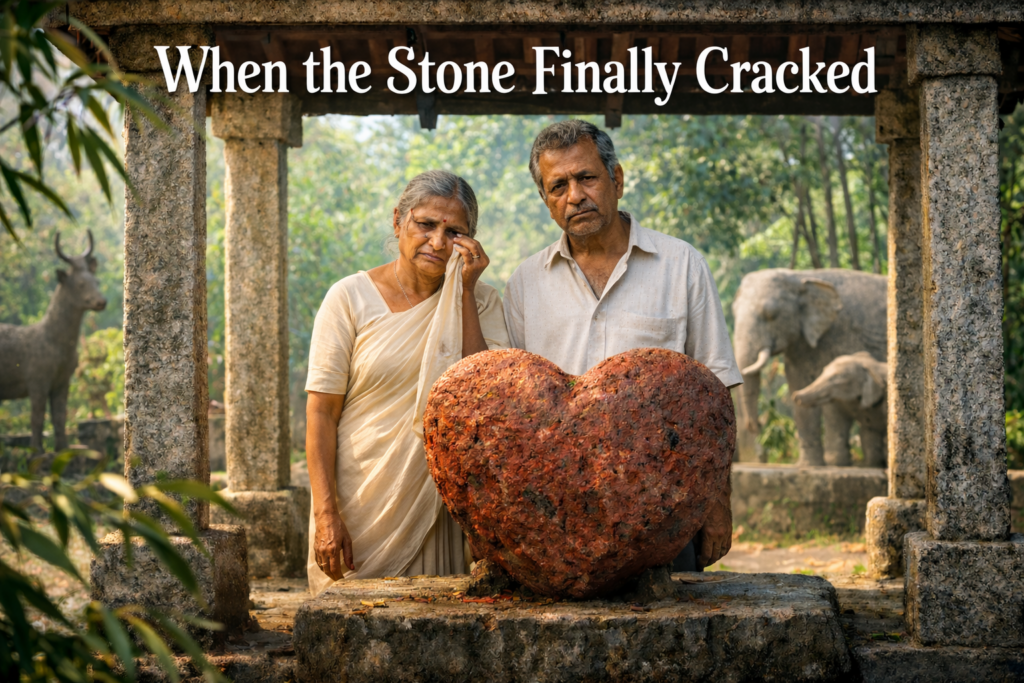
At the centre of the garden stood a small stone pavilion.
It was simple.
Four pillars.
A tiled roof.
And inside it lay the strangest statue of all.
A large stone heart carved from red laterite.
Unlike the animals, this statue was never polished.
The chisel marks were still visible.
Almost like scars.
The first time I saw it, I tugged at my father’s mundu.
“Appa… why is there a heart made of stone?”
My father looked at it quietly for a long time.
Then he said something I would understand only many years later.
“Some wounds never appear on the skin.”
He paused.
“They live quietly inside the heart.”
The Festival of Old Days
A few years later, on a gentle August evening, our family gathered at Uncle Mathai’s house.
It was the feast day of Mother Mary.
Every few years, Uncle Mathai hosted a strange celebration he called “The Old Days Festival.”
Everyone had to dress like people from another time.
Men arrived in white mundu with golden borders, starched jubbas, and sometimes cloth wrapped around their heads like traders from old port towns.
Women wore white kasavu sarees with jasmine flowers resting gently in their hair.
The house looked like a scene from an old black-and-white Malayalam film.
My cousin Anu leaned toward me and whispered with a grin,
“Your uncle is a little mad, you know.”
Perhaps he was.
But everyone loved him.
Because Uncle Mathai had quietly helped half the town.
He paid hospital bills for strangers.
He sponsored school fees for poor children.
He even built small houses for families whose roofs leaked in the monsoon.
Yet the man who helped so many people lived alone.
The Woman Near the Pavilion
That evening, music floated through the house.
A violin sighed beside a harmonium.
Someone tapped softly on a chenda (a drum).
I wandered into the garden.
The evening breeze moved through the bamboo leaves with a soft whisper.
Near the pavilion stood an elderly woman.
Her silver hair was tied neatly behind her head, and she wore a simple cream saree.
Uncle Mathai stood beside her in the fading light.
Something about that quiet moment drew me closer.
Without meaning to, I slipped behind the bamboo fence and watched.
They stood beside the red stone heart.
For a long time, neither of them spoke.
Then the woman turned toward him slowly.
Her voice was soft, almost like someone touching an old wound.
“Mathai,” she said gently,
“Why did you build this place like this? Why did you turn your heart into stone?”
Uncle Mathai did not answer immediately.
He kept looking at the red stone in the pavilion, as though the years of his life were written upon it.
For a moment, the sternness people always saw on his face faded.
In its place appeared something fragile, like a tired boy who had carried a burden too long.
Finally, he spoke.
“Because some hearts,” he said slowly,
“burn too much with memories… and the fire never really dies.”
The woman’s eyes filled with tears.
“So after all these years,” she asked quietly,
“you still blame me?”
He shook his head gently.
“No, Marykutty.”
He breathed out slowly.
“I don’t blame you anymore.”
His voice dropped almost to a whisper.
“I blame the foolish man I was… the man who was too afraid to trust the love standing right in front of him.”
Marykutty wiped her eyes with the edge of her saree.
Then Uncle Mathai said something so quietly that the evening itself seemed to lean closer to hear it.
“A heart that is too proud to trust,” he murmured,
“will eventually learn how to survive alone.”
The words hung between them like a long-forgotten prayer.
The Child He Sent Away
Only later did I learn the rest of the story.
Many years ago, Uncle Mathai had taken in his younger brother’s son.
A small boy named Maxwell. Everyone called him Maxu.
One afternoon, the boy was playing in the garden.
He climbed onto the pavilion floor and began touching the stone animals.
He laughed and hugged the elephant statue.
Then he placed his small hand on the stone heart.
Uncle Mathai saw it. Something inside him snapped.
“You are playing with my heart just like your father did!” he shouted.
The boy began to cry. But in a moment of anger sharper than a knife,
Uncle Mathai sent him away.
And from that day onward, no one ever saw Maxu again.
Or so we believed.
The Door That Opened
That night, the house was alive with music.
Yellow bulbs glowed across the verandah.
The air smelled of jasmine and banana chips.
Then suddenly, the front door burst open.
A young man stood there breathing hard. Before anyone could speak, he rushed forward.
He went straight and hugged Colonel Raghavan, Mathai’s old army friend.
“Sir,” he said,
“You saved my life.”
The room froze.
Someone behind me whispered slowly,
“That is… Maxu.”
The name moved through the room like a ripple across water.
Maxu.
The boy who had once run through this garden.
Now he had returned.
Not as a frightened child, but as a grown man.
When the Stone Finally Cracked
Later that night, worn out by the weight of the evening, Uncle Mathai collapsed near the pavilion in the middle of the garden. When he woke, he whispered,
“I saw my younger self kneeling before the stone heart.”
Colonel Raghavan smiled gently.
“That was no ghost, Mathai.”
He opened the door.
“That was Maxu.”
The young man stepped inside.
For a moment, Uncle Mathai stared at him.
Then he said sharply,
“Leave.”
Maxu’s eyes filled with tears.
“My father died asking me to love you,” he said.
“To become your son.”
His voice broke.
“But you never wanted me.”
Then something unexpected happened.
Julia, Marykutty’s daughter, began to cry.
Maxu hurried to her. “What happened?”
“I love you,” she said.
Uncle Mathai looked at them. “Do you love him?” he asked.
Julia nodded through tears. “Like my life.”
Something changed in the old man’s face.
Slowly, he stepped forward.
Then he embraced Maxu.
“My God,” he whispered.
“What a foolish man I have been.”
He held him tightly.
“My son… forgive me.”
And in that moment,
The hardest stone in the garden finally cracked.
The Words on the Stone
A year later, Maxu and Julia were married.
One evening, we stood beside the pavilion.
The red stone heart still rested there.
Maxu knelt and carved two small words into the stone.
Now Resting
Uncle Mathai had passed away a few months earlier.
Peacefully.
As though the weight he carried all his life had finally slipped from his chest.
Even today, when I pass through Kuriachira, I sometimes slow my steps near the old road where Uncle Mathai’s house once stood.
The gate is older now.
The paint has faded.
The garden has grown quieter.
But the stone animals are still there.
The giraffe still lifts its long neck toward the sky.
The elephant still stands beside its calf.
The cranes still watch the pond as though waiting for a fish that will never arrive.
Children still wander in on Sunday afternoons.
They climb onto the elephant’s back.
They run between the statues laughing.
To them, it is only a strange garden full of animals.
They do not yet know that every statue there was once a piece of a man’s memory.
Sometimes I stand beside the pavilion and look at the stone heart lying in the middle.
The words carved into it are still visible.
Now Resting.
For many years, I believed the statues in that garden were meant to preserve something.
But age has taught me something different.
Nothing in life can truly be preserved.
Not youth.
Not love.
Not even sorrow.
Time moves through the world the way the monsoon wind moves through coconut trees, quietly, patiently, bending everything in its path.
And yet, strangely, the things we try hardest to bury inside ourselves often outlive us.
A harsh word spoken in anger.
A love that was never trusted.
A forgiveness that came too late.
These are the real statues we build.
Not with stone, but with memory.
Looking back now, I think Uncle Mathai filled his garden with animals because animals do not carry such burdens.
A deer does not regret yesterday.
An elephant does not worry about tomorrow.
They live only in the present moment.
Only human beings have the strange gift and the strange curse of remembering.
Perhaps that is why hearts sometimes harden.
Not because they stop loving.
But because they grow tired of carrying the weight of what has already happened.
Yet if there is one quiet lesson that the garden taught me, it is this:
A heart does not turn to stone in a single day.
It hardens slowly,
through pride,
through silence,
through the small refusals to forgive.
And the miracle is not that hearts become stone.
The miracle is that sometimes, even after many years, they can soften again.
Sometimes a word spoken in truth.
Sometimes a tear.
Sometimes the return of someone we once pushed away.
That is enough.
When I leave the garden, I often look once more at the stone heart in the pavilion.
And I think of Uncle Mathai.
A man who spent half a lifetime protecting his heart with stone,
only to discover, at the very end,
that the strongest hearts are not the ones that never break,
But the ones that learn how to open again.
Because in the end, perhaps this is the quiet secret of being human:
We do not heal by building walls around the heart.
We heal by letting the stone crack.