
The Richest Breakfast of My Childhood
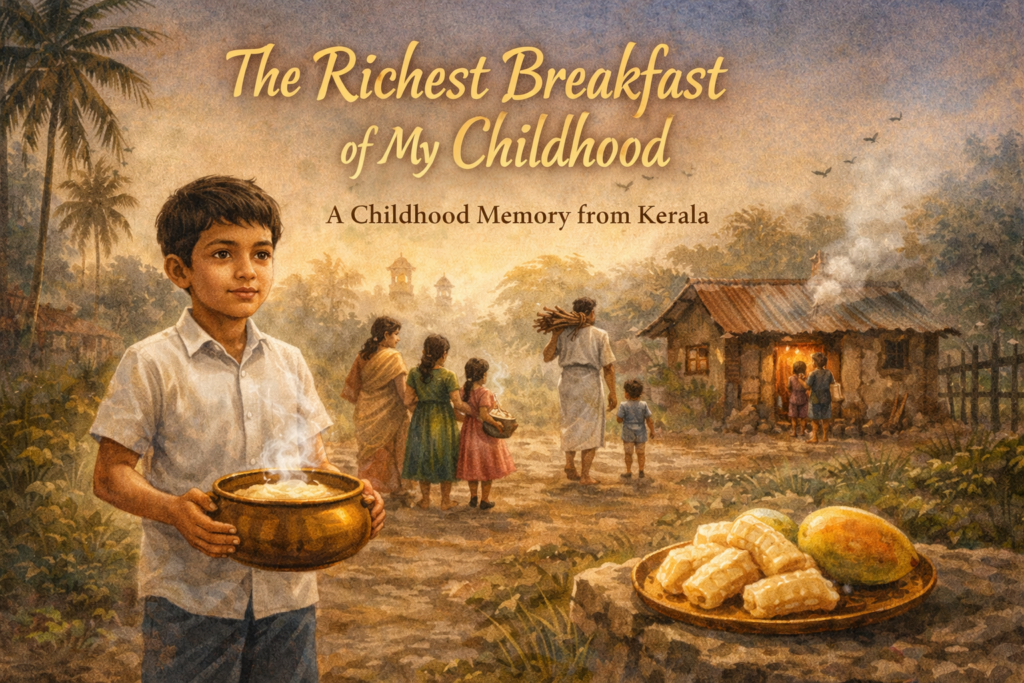
The Richest Breakfast of My Childhood
A Childhood Memory from Kerala
Most New Year mornings are remembered for their abundance, tables heavy with food, laughter around the house, and the cheerful noise of celebration.
But the New Year breakfast that has stayed with me all my life contained almost nothing.
A little Tapioca.
One mango.
And yet, looking back across the many decades of my life, I can say without hesitation that it was the richest breakfast I have ever eaten.
I was about eleven years old then. We lived in a modest tiled house in Thrissur, a quiet town in Kerala. The front verandah opened to a narrow lane shaded by coconut palms. In the backyard, Amma grew curry leaves, jasmine, and two banana plants that leaned lazily toward the well, as if they, too, enjoyed the slow rhythm of village life.
That New Year morning began like any festive morning in our home.
We woke early, bathed, and came down the wooden staircase with shining faces and freshly washed frocks. My elder sister, Alphonsa, wore a green dress, Mini a pink one, and little Maria a bright yellow frock. I wore my favourite pale blue shorts and A white shirt.
“Happy New Year, Appa!” we shouted as we ran into the dining room.
Appa stood near the table in his white mundu, smiling.
But Amma was not there.
“Where is Amma?” Alphonsa asked.
Before Appa could answer, we heard the gate open outside and hurried footsteps in the courtyard.
Amma came in wrapped in a shawl. Her face looked troubled and a little tired, as though she had just returned from something unexpected.
“Children,” she said gently, “don’t begin breakfast yet.”
On the table stood our usual morning meal: a pot of steaming kanji, a bowl of cherupayar curry, coconut chammanthi, and a plate of ripe nendran bananas. The warm smell rose into the cool morning air and made my stomach tighten with hunger.
We looked at Amma in silence.
“A small boy came to our back gate a little while ago,” she said quietly. “His mother gave birth to a baby last night. They live in the old hut near the canal. There are six other children there. No firewood. No rice. Nothing to eat.”
She paused and looked at us.
“My children… will you give them your breakfast as a New Year gift?”
The room fell silent.
I wish I could say that I agreed immediately.
But I did not.
I was hungry.
And the kanji smelled wonderful.
For one brief moment, a small, selfish thought passed through my mind.
If only we had eaten first.
Even today, I feel a little ashamed when I remember that thought.
Alphonsa spoke first.
“Of course we can give it, Amma.”
Mini asked softly, “Can I come and see the baby?”
Little Maria held the banana plate and said bravely, “They can have my banana.”
Quickly, as if trying to hide my earlier hesitation, I said, “I will carry the kanji pot.”
Amma looked at me with a quiet smile. Mothers often understand more than their children say aloud.
“The heart learns its deepest lessons in the quiet battles that happen inside it.”
Soon, the house became busy.
Appa gathered firewood from the backyard. Amma packed the kanji and curry into vessels. Alphonsa filled steel tumblers with milk. Mini carried the bananas carefully. Maria insisted on bringing a small tin of jaggery pieces. Our helper, Thankamma chechi, added some boiled tapioca.
Then our small procession set out.
Appa walked ahead with the firewood. Amma followed with baby cloths and a shawl. Alphonsa and I carried the hot kanji vessel between us. The others came behind with the remaining food.
The early morning lane was still quiet. Dew sparkled on the grass. Somewhere, a temple bell rang softly. From a distant church came the slow sound of morning prayers. A crow cawed from a coconut tree as if announcing our strange little parade to the village.
At the end of a muddy path stood a small hut with a tin roof.
A thin boy waited outside.
Inside the hut, the sight that met our eyes silenced us.
A weak mother lay on a mat with a newborn baby beside her. Around them sat several pale, hungry children wrapped in a single torn blanket. The clay stove was cold. The room was dim.
For a moment, none of us spoke.
Then Amma said quietly, “First, we must light a fire.”
Appa arranged the wood, and soon flames began to crackle in the stove. The children gathered around the warmth as if it were something magical.
We began serving the food.
Alphonsa poured the milk.
I ladled kanji into plates.
Mini peeled bananas.
Maria handed out jaggery pieces.
The children ate quickly, their eyes shining.
One little girl looked up in disbelief.
“Is this really for us?”
“Yes,” Amma said softly. “Eat well.”
The mother began to cry quietly.
“Hunger teaches us the value of food. But compassion teaches us the value of humanity.”
Soon, the hut felt warmer and almost cheerful. The baby slept peacefully. The children smiled and spoke shyly. Appa joked with them while tending the fire.
When we finally left, the oldest boy followed us to the doorway.
“I thought nobody would come,” he said.
Appa placed a gentle hand on his head.
“When you knock on the right door, someone will come.”
We walked home slowly.
By then, the town had awakened. The smell of dosa batter and coconut oil drifted from nearby houses. A bus honked somewhere on the main road.
Suddenly, Mini laughed.
“Now what will we eat?”
At home, Amma searched the kitchen shelves.
There was very little left.
So our New Year breakfast that day was simple.
A little tapioca.
A few mangoes were shared among us.
Yet it tasted better than any feast.
Because something had changed inside us.
“The hand that gives may become empty for a moment, but the heart that gives becomes full forever.”
Many years have passed since that morning.
I have eaten at grand tables and festive gatherings. But no meal shines in memory like that humble New Year breakfast we carried through a quiet Kerala lane.
Perhaps because that morning revealed something simple and lasting.
“Food fills the stomach. Kindness fills the soul.”
And the older I grow, the more I understand another quiet truth that life slowly teaches us:
“The world does not remember the meals we ate in comfort. It remembers the meals we shared in compassion.”
And that is why, whenever the New Year returns, my mind does not travel to fireworks or celebrations.
It returns instead to that small smoky hut, those shining hungry eyes, and the taste of tapioca and mangoes with a full heart.
Because some mornings feed the body.
But once in a lifetime, a morning arrives that feeds the soul.
“And the nourishment of the soul, unlike food, lasts a lifetime.”