
The Art of Living With Enough
The Art of Living With Enough
I once believed life was a long marketplace,
Where every man must gather more and more.
Like a traveller filling his bags with stones,
I thought wealth alone could open every door.
But years passed quietly like drifting clouds,
And I began to watch the world more slowly.
I saw a farmer resting under a mango tree,
Eating rice and salt with the peace of a king.
His laughter flowed like a small, clear brook,
Simple and bright in the afternoon sun.
He owned no palace, no mountain of gold,
Yet his heart seemed lighter than anyone.
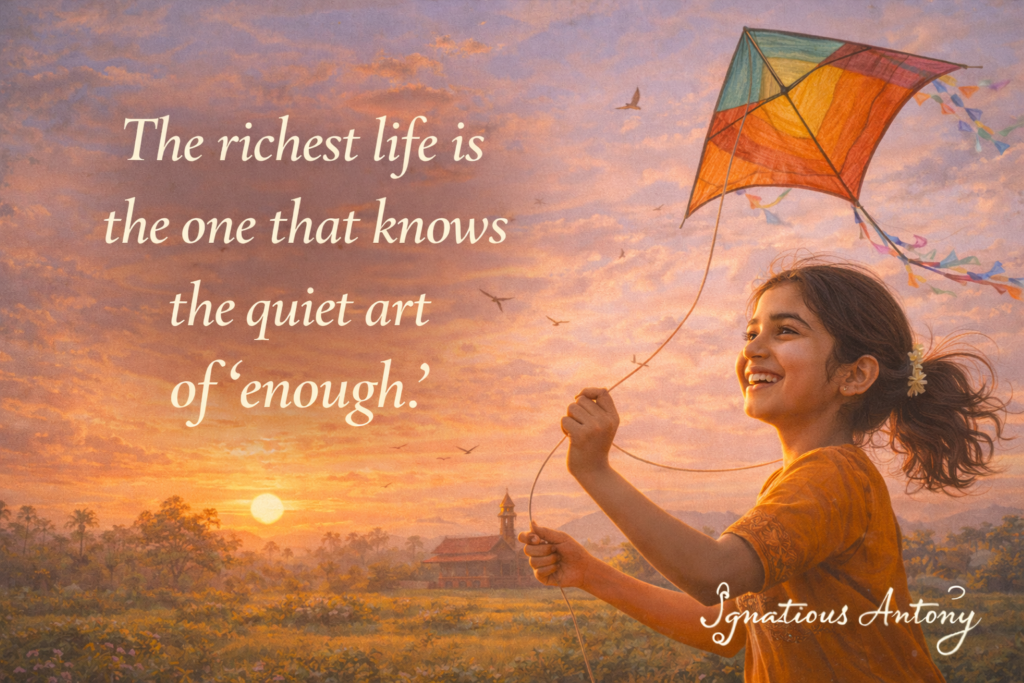
I saw a child flying a paper kite
Against the wide blue sky of evening.
The wind was his orchestra, the clouds his audience,
And joy danced on the string in his hands.
The kite rose like a small dream of freedom,
While the child ran barefoot across the field.
In that moment, he possessed the whole sky,
Though his pockets held nothing at all.
I met an old woman beside the village well,
Drawing water with patient hands.
Her smile was gentle as the moon on a river,
Softly lighting the wrinkles of time.
She said, “My son, happiness is like water.
If you try to hold the whole river,
It slips through your fingers.
But a small cup is enough to quench thirst.”
Then I understood something simple,
Life is not a warehouse to be filled endlessly.
It is a garden where gratitude grows,
And peace blossoms quietly among ordinary days.
A heart that knows the art of “enough”
Is like a lamp in a silent temple,
Not dazzling like lightning in the sky,
But steady, warm, and full of light.
For the richest life is often the simplest:
A meal shared with laughter,
A walk beneath a patient sky,
A mind that rests like a calm lake at dawn.
And when the world runs past in a noisy race,
Those who know “enough” walk gently aside,
Carrying a small treasure in their chest:
A quiet heart
that asks for little,
and therefore
lacks nothing.
Reflection on “The Art of Living With Enough”
This poem reflects on one of the most important yet often forgotten lessons of life: the wisdom of knowing when we have enough. At the beginning, the speaker confesses that he once believed life was like a marketplace where everyone must gather more and more. This image captures the restless spirit of modern society, where success is often measured by how much wealth, recognition, or possessions a person accumulates. Like a traveller filling his bags with stones, people sometimes burden themselves with endless desires, believing that happiness lies just beyond the next achievement.
But as the years pass “like drifting clouds,” the speaker’s understanding begins to change. Instead of chasing after distant goals, he starts observing the quiet scenes of everyday life. Through these simple encounters, he discovers deeper truths about happiness.
The farmer resting beneath a mango tree represents contentment. Though he has little material wealth, he eats a humble meal with the peace of a king. His laughter flows “like a small, clear brook,” suggesting that joy can be simple, natural, and effortless when the heart is free from constant wanting.
The child flying a kite offers another image of pure happiness. The child owns almost nothing, yet in that moment, he seems to possess the entire sky. The wind becomes his orchestra and the clouds his audience. This metaphor shows that joy does not depend on ownership, but on the ability to fully experience the present moment.
The old woman by the village well gives the most direct wisdom. Her metaphor comparing happiness to water is both simple and profound. If someone tries to hold the entire river, it slips away, but a small cup is enough to quench thirst. In other words, when people try to possess everything, satisfaction escapes them. But when they accept what is enough, they find peace.
By the end of the poem, the speaker realises that life is not a warehouse meant to be filled endlessly. Instead, it is like a garden where gratitude quietly grows. Happiness does not need to be dazzling or dramatic like lightning in the sky. It can be steady and gentle, like the soft glow of a temple lamp.
The poem ultimately reminds us that the richest life is often the simplest one. A shared meal, a peaceful walk, a calm mind at dawn, these small moments carry a deeper wealth than endless possessions. When a heart learns the art of “enough,” it discovers a quiet freedom: a life that asks for little, and therefore lacks nothing.